Sherlock Holmes

Sherlock Holmes is a fictional character created by Arthur Conan Doyle in 1887. He is an English consulting detective living in London at 221b Baker Street.
At first Arthur Conan Doyle named the detective as Sherrinford Holmes (not Sherringford as he wrongly mentioned in his auto-biography Memories and Adventures 40 years later) and the biographer Ormond Sacker (see manuscript in A Study in Scarlet). But he changed his mind and renamed them as Sherlock Holmes and John H. Watson.
The following informations only take their source in the original texts written by Sir Arthur Conan Doyle. All references are sourced in parenthesis with abbreviation of the story title.
Identity

- Name : Sherlock Holmes
- Birth date : 1854. He was described as a sixty-years man in 1914 (LAST 197).
- Profession : Consulting Detective (STUD 324).
- Nationality : British.
- Family
- Addresses
- Decoration : The Legion of Honour, granted in 1894 for the arrest of Huret, the Boulevard assassin in Paris (GOLD 4).
Physical appearance

Tall & Gaunt
- He measured 6 feet (3STU 470) or over 6 feet but he was so lean that he seemed even taller (STUD 196).
- He had a tall, gaunt figure made even gaunter and taller by his long grey travelling-cloak and close-fitting cloth cap (BOSC 19).
- He had a tall, austere figure (HOUN 1188), a tall lean figure. (VALL 1577).
- He was a tall, thin man (TWIS 54), gaunt man of sixty. (LAST 197).
Thin
- He had a thin, eager face (BERY 348).
- He had a long, thin back (DANC 1), with thin hands (DYIN 33).
- He had a thin, sinewy arm (EMPT 97), a long, thin, nervous arm (ILLU 6).
- He had a long, thin form (MAZA 61).
- He had long, thin fingers (REDC 2), a long, thin fore-finger (YELL 45).
- He had thin knees (REDH 302).
- He had a long, thin nose (SIGN 970).
- His face was narrow (GOLD 199).
Features
- He had a dolichocephalic skull with well-marked supra-orbital development (HOUN 131).
- His hair were black (DANC 2).
- He had heavy tufted brows (BRUC 304), heavy, dark brows (LADY 517), bushy eyebrows (VALL 184).
- He had a thin hawk-like nose (STUD 197, REDH 302).
- He had thin (EMPT 197) and firm (3GAR 440) lips.
- He had steady grey eyes (MAZA 201) particularly sharp and piercing (STUD 197), with a far-away, introspective look when he was exerting his full powers (GREE 62).
Voice
His clothing

He had that cat-like love of personal cleanliness (HOUN 2772). He affected a certain quiet primness of dress (MUSG 1).
He usually wear a tweed suit or frock-coat, and occasionally an ulster (STUD 965).
In private, he wear a mouse-coloured dressing-gown (EMPT 399), a purple one (BLUE 1) and sometimes a blue one (TWIS 400).
In the country, he had a tweed suit and cloth cap, he looked like any other tourist (HOUN 2772), or a long grey travelling-cloak and close-fitting cloth cap (BOSC 19), or his ear-flapped travelling-cap (SILV 17).
Smoking habits
Holmes smoked cigars, cigarettes, and of course, pipes. Three specific pipes are mentioned:
- Most often, he smoked his old black pipe (CREE 9), the old and oily black clay pipe (IDEN 205) when in meditative mood (SOLI 137).
- He smoked occasionally an old briar-root pipe (SIGN 63).
- He smoked a cherrywood in a disputatious mood (COPP 4).
He had a litter of pipes over the mantelpiece of his bedroom (DYIN 138).
Note that, contrary to the image widespread today, Sherlock Holmes was never smoking a calabash pipe in his adventures.
Physical condition

Sherlock Holmes was a man who seldom took exercise for exercise's sake. Few men were capable of greater muscular effort, and he was undoubtedly one of the finest boxers of his weight; but he looked upon aimless bodily exertion as a waste of energy, and he seldom bestirred himself save where there was some professional object to be served. Then he was absolutely untiring and indefatigable (YELL 5). He was a fair runner (HOUN 2185).
He was exceptionally strong in his fingers (BERY 375) with a grasp of iron (LAST 304). He possessed a strength for which one would hardly credit him (STUD 93).
He was always in training (SOLI 287). He complained that idleness exhausted him completely (SIGN 1607). However, he could spend days in bed (3GAR 8) and was a late riser as a rule (SPEC 7). But he could be up all night (HOUN 2) and could be up very early for a case (BLAC 36), during which he was vigorous and untiring (PRIO YELL), going for days, or even a week without rest (MISS, REIG, TWIS). His diet, spare at the best of times (YELL), was abandonned altogether when he was working (FIVE, MAZA, MISS, VALL), for he had conceived that starving himself increased the supply of blood to his mind. He said: "I am a brain, Watson. The rest of me is a mere appendix. (MAZA 86).
He had an abnormally acute set of senses (BLAN 326).
He had frugal tastes (PRIO 677), and his habits were simple to the verge of austerity (YELL 8).
The state of his health was not a matter in which he himself took the faintest interest (DEVI 9). He had a wiry, iron constitution (DEVI, ILLU). But sometimes, nothing was sufficient to rouse him from his nervous prostration (REIG 8).
While retired, he was somewhat crippled by occasional attacks of rheumatism (PREF), but took up swimming (LION).
He knew little or nothing of amateur sport (MISS 53) or of the turf (SHOS 286), and he claimed to have few athletic tastes himself (GLOR 21).
He practised several sports: Baritsu (EMPT 127), Boxing & Fencing (GLOR 21), Singlestick (STUD 262), Fishing (SHOS 387), Golf (GREE 5) and Swimming.
His personality


Watson described him as an automaton, a calculating machine with something positively inhuman in him (SIGN). Sometimes with a face of that Red Indian composure which had made so many regard him as a machine rather than a man (CROO, NAVA). He loved above all things precision and concentration of thought (SOLI).
Watson often refers to his restlessness (REDH, SIGN, THOR) and his impatience (BRUC, EMPT, STUD, 3STU, VALL, YELL), his nervousness (ILLU, LADY, SIGN) and excitement (DANC, NORW, REIG, STOC, THOR), his natural curiosity and eager, his habit of biting his nails (BRUC, STOC) when he is concerned, and the importance he carried in his pride (FIVE), reputation, self-respect (CHAS, HOUN) and somehow selfishness (NAVA).
He couldn't agree with those who rank modesty among the virtues. To the logician all things should be seen exactly as they are, and to under-estimate oneself is as much a departure from truth as to exaggerate one's own powers (GREE). What you do in this world is a matter of no consequence. The question is, what can you make people believe that you have done. (STUD)
He was egotistical (BOSC, COPP, ILLU, LAST, NOBL, RETI, SIGN, STUD) and with didactic manners (SIGN). He was as sensitive to flattery on the score of his art as any girl could be of her beauty (STUD, REDC). His most obvious weakness was that he was impatient with less alert intelligences than his own (BRUC). He could be openly contemptuous of his mental inferiors (BOSC, CARD, SIGN, STUD) and those of whom he disapproved (MAZA, THOR). His behaviour was most often particularly annoying to Watson (COPP, HOUN, MUSG, SIGN, VALL).
He loved admiration and applause. The same singularly proud and reserved nature which turned away with disdain from popular notoriety was capable of being moved to its depth by spontaneous wonder and praise from a friend (SIXN 464). He found it wise to impress clients with a sense of power (BLAN 15).
"Some touch of the artist wells up within me and calls insistently for a well-staged performance. [..] The blunt accusation, the brutal tap upon the shoulder — what can one make of such a denouement? But the quick inference, the subtle trap, the clever forecast of coming events, the triumphant vindication of bold theories — are these not the pride and the justification of our life's work?" (VALL 1714). He never can resist a touch of the dramatic (NAVA 735, MAZA 589, NORW 357, SILV 11, SIXN 463).
Sometimes he tended to his own righteousness and settle a private vengeance (FIVE, 3GAR). He admitted that once or twice in his career he felt he had done more harm by his discovery of the criminal than he had made himself, for his crime (ABBE). He forgived other personal vendettas (CHAS) and admitted he felt directly responsible for the death of Dr. Roylott (SPEC). He did not hesitate to use illegal methods in a morally justifiable cause (CHAS) and he often thought he could be a very effective criminal if he used his talents against the law (BRUC, CHAS, RETI, SIGN), which inspector Gregson admitted it was a luck that Holmes was he was on the side of the Force, and not against it (GREE 382).
Like all great artists, Holmes was easily impressed by his surroundings (THOR 14). He was a believer in the genius loci (VALL 1481). Holmes alone could rise superior to petty influences (SIGN) and he had in a very remarkable degree, the power of detaching his mind at will (HOUN 863, DEVI, REDH).
He took little care for his own safety when his mind was absorbed by a problem (THOR,604), but he thought as stupidity rather than courage to refuse to recognise danger when it is close upon him (FINA 24). And as he loved above all things precision and concentration of thought, he resented anything which distracted his attention (SOLI 10). He would never permit cases to overlap, and his clear and logical mind would not be drawn from its present work to dwell upon memories of the past (HOUN 3657).
Taste for unusual
As professionnally, he stood alone in Europe, both in his gifts and in his experience (VALL 220). He didn't like commonplace cases, for, working as he did rather for the love of his art than for the acquirement of wealth, he refused to associate himself with any investigation which did not tend towards the unusual, and even the fantastic (SPEC 1). Holmes, however, like all great artists, lived for his art's sake. He has seldom claimed any large reward for his inestimable services. So unworldly was he — or so capricious — that he frequently refused his help to the powerful and wealthy where the problem made no appeal to his sympathies, while he would devote weeks of most intense application to the affairs of some humble client whose case presented those strange and dramatic qualities which appealed to his imagination and challenged his ingenuity (BLAC 3).
Sociability & Friends
Without having a tinge of cruelty in his singular composition, Holmes was undoubtedly callous from long over-stimulation (VALL 244). He described himself as never a very sociable fellow (GLOR 20). He do not encourage visitors (FIVE 18). He had an aversion to women, and a disinclination to form new friendships (GREE 3). He was surrounded by loneliness and isolation (MAZA 3). Seclusion and solitude were very necessary for Sherlock Holmes in those hours of intense mental concentration during which he weighed every particle of evidence (HOUN 476).
But he had some friends:
- Algar : a member of the Liverpool Force (CARD 335).
- Barker : a London private detective (RETI 276).
- Wilson Hargreave : a member of the New York Police Bureau (DANC 475).
- Mr. Sherman : a bird-stuffer who called Holmes by his christian name (SIGN 1176).
- Harold Stackhurst : an educator in Sussex during Holmes' retirement (LION 17).
- Verner : a distant relation (NORW 12).
Attitude
He had an old carelessness of manner (DYIN 36), and a half-humorous, half-cynical vein which was his habitual attitude to those about him (DEVI 375), but harshness was foreign to his nature (SOLI 11). Some clients have even referred to his kindness (REDC 8). He could be particularly bright and joyous, with that somewhat sinister cheerfulness which was characteristic of his lighter moments (THOR 15) and with the peculiarly mischievous gaze which was characteristic of his more imp-like moods (THOR 602). He was remarkable for his easy courtesy (IDEN 46). Sherlock Holmes was a past master in the art of putting a humble witness at his ease (MISS 111). He had an almost hypnotic power of soothing when he wished (REDC 27).
Habits
He was a man of habits, narrow and concentrated habits (CREE 8).
Holmes was certainly not a difficult man to live with. He was quiet in his ways, and his habits were regular. It was rare for him to be up after ten at night, and he had invariably breakfasted and gone out before Watson rose in the morning. Sometimes he spent his day at the chemical laboratory, sometimes in the dissecting-rooms, and occasionally in long walks, which appeared to take him into the lowest portions of the city. Nothing could exceed his energy when the working fit was upon him; but now and again a reaction would seize him, and for days on end he would lie upon the sofa in the sitting-room, hardly uttering a word or moving a muscle from morning to night (STUD 188).
However, his incredible untidiness, his addiction to music at strange hours, his occasional revolver practice within doors, his weird and often malodorous scientific experiments, and the atmosphere of violence and danger which hung around him made him the very worst tenant in London (DYIN 3). He was in his personal habits one of the most untidy men that ever drove a fellow-lodger to distraction (MUSG 1). He had a horror of destroying documents, especially those which were connected with his past cases (MUSG 8). He kept his cigars in the coal-scuttle, his tobacco in the toe end of a Persian slipper, and his unanswered correspondence transfixed by a jack-knife into the very centre of his wooden mantelpiece (MUSG 4). Thus, without his scrap-books, his chemicals, and his homely untidiness, he was an uncomfortable man (3STU 19).
He had bohemian habits (ENGR 6). He loathed every form of society with his whole bohemian soul, remained in Baker Street, buried among his old books, and alternating from week to week between cocaine and ambition, the drowsiness of the drug, and the fierce energy of his own keen nature (SCAN 14).
Once retired in Sussex, he had given himself up entirely to that soothing life of Nature for which he had so often yearned during the long years spent amid the gloom of London (LION 2).
Emotions
All emotions, and that one particularly, were abhorrent to his cold, precise, but admirably balanced mind. He was, I take it, the most perfect reasoning and observing machine that the world has seen: but, as a lover, he would have placed himself in a false position (SCAN 5). He thought that love is an emotional thing, and whatever is emotional is opposed to his true, cold reason which he placed above all things. He should never marry himself, lest it bias his judgment (SIGN 2828). He could examine a client with as little sentiment as a scientist would show to a specimen (SOLI 17). He had sometimes a saturnine figure (MAZA 3). His manner was not effusive. It seldom was (SCAN 26). If his emotions were dulled from long over-stimulation, his intellectual perceptions were exceedingly active (VALL 244).
He said that "the emotional qualities are antagonistic to clear reasoning" (SIGN 320). "I use my head, not my heart" (ILLU 349).
He said also that life is full of whimsical happenings (MAZA]), and despite the assertion that he rarely laughed (HOUN, MAZA, SUSS), he laughed, smiled and joked incessantly, though his ideas of humour were called "strange and occasionnally offensive" (LADY), and even perverted (MAZA), and were often manifested in wry irony or outright sarcasm (CREE, HOUN, LADY...).
His aversion to women, and his disinclination to form new friendships, were both typical of his unemotional character (GREE 3).
Convictions

Philosophy
Sherlock Holmes quotes about Fate:
- Why does Fate play such tricks with poor helpless worms? (BOSC 623).
- The ways of Fate are indeed hard to understand. If there is not some compensation hereafter, then the world is a cruel jest (VEIL 274).
- Is not all life pathetic and futile? We reach. We grasp. And what is left in our hands at the end? A shadow. Or worse than a shadow — misery. (RETI 17).
- What is the meaning of it, Watson? What object is served by this circle of misery and violence and fear? It must tend to some end, or else our universe is ruled by chance, which is unthinkable. But what end? There is the great standing perennial problem to which human reason is as far from an answer as ever (CARD 494).
Religion
- Holmes agreed with anti-christian ideas of Winwood Reade when he recommend to read the Martyrdom of Man (SIGN 338).
- He agreed with Richter quoting the writer: the chief proof of man's real greatness lies in his perception of his own smallness (SIGN 1381).
- He refused to believe in supernatural. (DEVI, HOUN, SUSS).
- He read and quoted Darwin (STUD 850).
- He said: There is nothing in which deduction is so necessary as in religion. It can be built up as an exact science by the reasoner (NAVA 331).
- He confessed his Biblical knowledge to be a trifle rusty (CROO 393).
At last, when he retired, in South England, his time was divided between philosophy and agriculture. (PREF)
His Profession

Holmes thought that detection should be an exact science and should be treated in a cold and unemotional manner. (SIGN)
To his sombre and cynical spirit all popular applause was always abhorrent, and nothing amused him more at the end of a successful case than to hand over the actual exposure to some orthodox official, and to listen with a mocking smile to the general chorus of misplaced congratulation (DEVI 2). So unworldly was he — or so capricious — that he frequently refused his help to the powerful and wealthy where the problem made no appeal to his sympathies, while he would devote weeks of most intense application to the affairs of some humble client whose case presented those strange and dramatic qualities which appealed to his imagination and challenged his ingenuity (BLAC 4).
Despite his disdain for notoriety (SIXN 465), he gained considerable fame through Watson's writings (GREE, HOUN, NAVA, RETI, 3GAR, VALL, VEIL), and which benefited to Watson's fame as well (ILLU, VALL).
He demonstrated himself to be a keen judge of human character (BERY, BOSC, CARD, COPP, ILLU, THOR). He displayed a propensity to categorize persons (BLUE, CHAS, EMPT, IDEN, REDH), but not to underestimate his foes (EMPT, FINA, HOUN, ILLU, REDH), and showed a tendency ti inflate their abilities (MISS), claiming to appreciate the challenge of a good foeman (PRIO). He told that nothing was more stimulating than a case were everything goes against him (HOUN).
As professionnally, he stood alone in Europe, both in his gifts and in his experience (VALL 220). He didn't like commonplace cases, for, working as he did rather for the love of his art than for the acquirement of wealth, he refused to associate himself with any investigation which did not tend towards the unusual, and even the fantastic (SPEC 1). Holmes, however, like all great artists, lived for his art's sake. He has seldom claimed any large reward for his inestimable services. So unworldly was he — or so capricious — that he frequently refused his help to the powerful and wealthy where the problem made no appeal to his sympathies, while he would devote weeks of most intense application to the affairs of some humble client whose case presented those strange and dramatic qualities which appealed to his imagination and challenged his ingenuity (BLAC 3).
Motivation
Holmes had a dual nature (REDH 350). Nothing could exceed his energy when the working fit was upon him; but now and again a reaction would seize him, and for days on end he would lie upon the sofa in the sitting-room, hardly uttering a word or moving a muscle from morning to night (STUD 192). He never fell tired by work, though idleness exhausted him completely (SIGN 1607). Alternating from week to week between cocaine and ambition, the drowsiness of the drug, and the fierce energy of his own keen nature (SCAN 14). He could be bright, eager, and in excellent spirits, a mood which in his case alternated with fits of the blackest depression (SIGN 349).
His powers became irksome to him when they were not in use (VALL 437). He said: « My mind rebels at stagnation. Give me problems, give me work, give me the most abstruse cryptogram, or the most intricate analysis, and I am in my own proper atmosphere. I can dispense then with artificial stimulants. But I abhor the dull routine of existence. I crave for mental exaltation. » (SIGN 31) His mind was like a racing engine, tearing itself to pieces because it was not connected up with the work for which it was built (WIST 26, DEVI 180).
His life was spent in one long effort to escape from the commonplaces of existence (REDH 547).
He mentioned Gustave Flaubert : « L'homme c'est rien, l'oeuvre c'est tout. » (The man is nothing, the work is everything) (BOSC 552). He thought that work was the best antidote to sorrow (EMPT 190). He worked rather for the love of his art than for the acquirement of wealth (SPEC 1).
Methods


Sherlock Holmes said (SIGN 74) the 3 qualities necessary to the ideal detective are:
Observation
Holmes possessed immense faculties and extraordinary powers of observation (SCAN 15). He could spend two hours to one of those minute and laborious investigations which formed the solid basis on which his brilliant edifices of deduction (ABBE 309). His method was founded upon the observance of trifles (BOSC 492).
He thought that "the little things are infinitely the most important (IDEN 128). Even the trivial fact may start a train of reflection in the mind (VALL 324), and one must really pay attention to details (BLAC 392) as the gravest issues may depend upon the smallest things" (CREE 46).
He had an extraordinary genius for minutiae (SIGN 87).
He often insisted that people see but don't observe (SCAN 53).
Without datas, he could presume nothing (HOUN 3008) or imagine nothing (VALL 1112). He yelled: « 'Data! data! data! I can't make bricks without clay » (COPP 195).
Holmes had 3 rules for observation:
- It is of the first importance not to allow your judgment to be biased by personal qualities (SIGN 318).
- It is difficult for a man to have any object in daily use without leaving the impress of his individuality upon it (SIGN 119).
- How ever did you see that? Because I looked for it (DANC 349).
Deduction
Holmes wrote about the science of deduction in the article "The Book of Life" (STUD 291) and he was willing to devote his declining years to the composition of a textbook which shall focus the whole art of detection into one volume (ABBE 25).
Holmes said it is a capital mistake to theorize before you have all the evidence (STUD 477, SCAN 79, SECO 297). Insensibly one begins to twist facts to suit theories, instead of theories to suit facts" (SCAN 80). Holmes never guessed. He thought it was a shocking habit — destructive to the logical faculty" (SIGN 161). He never made exceptions as the exception disproves the rule (SIGN 323). He said an hypothesis must cover all the facts (SIGN 1319). If several explanations presented themselves, he tried test after test until one or other of them had a convincing amount of support (BLAN 476). He said it was necessary to find that line of least resistance which should be the starting-point of every investigation (EMPT 55). He warned that it's a bad habit to form provisional theories and wait for time or fuller knowledge to explode them (SUSS 250). He told the first rule of criminal investigation: "one should always look for a possible alternative and provide against it" (BLAC 346). When a fact appeared to be opposed to a long train of deductions, it invariably proves to be capable of hearing some other interpretation (STUD 1367).
Holmes had an old maxim that « When you have eliminated the impossible, whatever remains, however improbable, must be the truth. » (BERY 562, SIGN 935, BLAN 475, BRUC 621).
However, he recognized the value of imagination (RETI 405, SILV 320) and intuition (SIGN 65). And he could put himself in the place of one whose motives or actions he wished to trace (EMPT, FINA, MUSG, RETI, SIGN).
Holmes said that: « Circumstantial evidence is a very tricky thing, it may seem to point very straight to one thing, but if you shift your own point of view a little, you may find it pointing in an equally uncompromising manner to something entirely different (BOSC 77); but circumstantial evidence is occasionally very convincing, as when you find a trout in the milk, to quote Thoreau's example. » (NOBL 295).
Seclusion and solitude were very necessary for Sherlock Holmes in those hours of intense mental concentration during which he weighed every particle of evidence, constructed alternative theories, balanced one against the other, and made up his mind as to which points were essential and which immaterial (HOUN 476).
For examples of deductions see each stories.
Knowledge

Watson described Holmes' knowledge (STUD 237) :
- Knowledge of Literature. Nil.
- Knowledge of Philosophy. Nil.
- Knowledge of Astronomy. Nil.
- Knowledge of Politics. Feeble.
- Knowledge of Botany. Variable. Well up in belladonna, opium, and poisons generally. Knows nothing of practical gardening.
- Knowledge of Geology: Practical, but limited. Tells at a glance different soils from each other. After walks has shown me splashes upon his trousers, and told me by their colour and consistence in what part of London he had received them.
- Knowledge of Chemistry. Profound.
- Knowledge of Anatomy. Accurate, but unsystematic.
- Knowledge of Sensational Literature. Immense. He appears to know every detail of every horror perpetrated in the century.
- Plays the violin well.
- Is an expert singlestick player, boxer, and swordsman.
- Has a good practical knowledge of British law.
Holmes said that breadth of view is one of the essentials of the detective profession, and the interplay of ideas and the oblique uses of knowledge are often of extraordinary interest (VALL 1636). For him, all knowledge comes useful to the detective (VALL 323). His studies were very desultory and eccentric, but he had amassed a lot of out-of-the-way knowledge which would have astonish his professors (STUD 47). He was an omnivorous reader with a strangely retentive memory for trifles (LION 485). He had a passion for definite and exact knowledge (STUD 70).
He thought that the ideal reasoner would, when he has once been shown a single fact in all its bearings, deduce from it not only all the chain of events which led up to it, but also all the results which would follow from it (FIVE 284). And that it was not so impossible that a man to possess all knowledge which is likely to be useful to him in his work, and this he endeavoured to do (FIVE 289). He hold a vast store of out-of-the-way knowledge, without scientific system, but very available for the needs of his work. His mind was like a crowded boxroom with packets of all sorts stowed away therein — so many that he might well have but a vague perception of what was there (LION 300). It was one of the peculiarities of his proud, self-contained nature that, though he docketed any fresh information very quickly and accurately in his brain, he seldom made any acknowledgement to the giver (SUSS 70). He said that a man should keep his little brain attic stocked with all the furniture that he is likely to use, and the rest he can put away in the lumber-room of his library, where he can get it if he wants it (FIVE 297).
Holmes told Inspector MacDonald that the most practical thing he could do in his life would be to shut himself up for three months and read twelve hours a day at the annals of crime (VALL 378). Holmes was the one who knows the higher criminal world of London so well as he do (FINA 61), and he thought it was his business to follow the details of Continental crime (ILLU 47).
Disguises

Holmes would have made an actor, and a rare one (SIGN 1883). His expression, his manner, his very soul seemed to vary with every fresh part that he assumed. The stage lost a fine actor, even as science lost an acute reasoner, when he became a specialist in crime (SCAN 427, MAZA 238). He had the thoroughness of the true artist (DYIN 535).
He had at least five small refuges in different parts of London in which he was able to change his personality (BLAC 10).
Holmes thought it is the first quality of a criminal investigator that he should see through a disguise (HOUN 3212) but he failed to recognise Jefferson Hope disguised as Mrs. Sawyer (STUD) or Hugh Boone whom he said he had observed often in the streets of The City (TWIS).
Here is the list of disguises used by Sherlock Holmes:
- A sailor (SIGN)
- An asthmatic old master mariner (SIGN)
- A drunken-looking groom (SCAN)
- An amiable and simple-minded Nonconformist clergyman (SCAN)
- A doddering opium smoker (TWIS)
- A common loafer (BERY)
- A venerable Italian priest (FINA)
- An elderly book-collector (EMPT)
- An East End familiar known as Captain Basil (BLAC)
- A plumber with a rising business named Escott (CHAS 164)
- An unshaven French ouvrier (LADY)
- A workman looking for a job (MAZA)
- An old sporting man (MAZA)
- An elderly woman (MAZA)
- An Irish-American spy named Altamont (LAST)
- Illustrations of his disguises
-
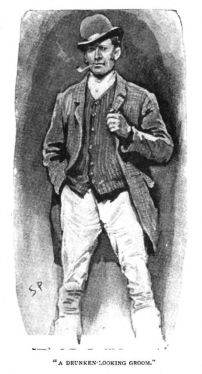 Sherlock Holmes as a drunken-looking groom (SCAN)
 -
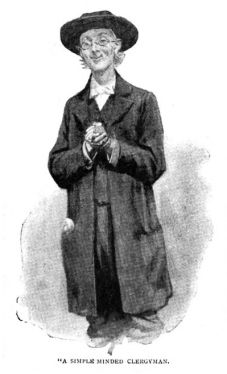 Sherlock Holmes as an amiable and simple-minded Nonconformist clergyman (SCAN)
 -
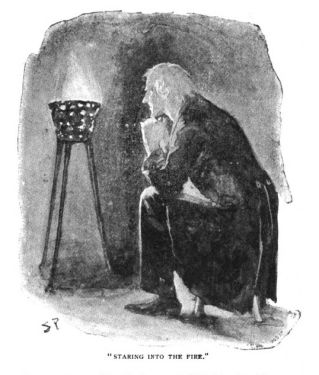 A doddering opium smoker (TWIS)
 -
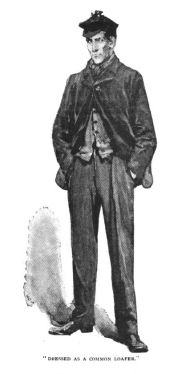 A common loafer (BERY)
 -
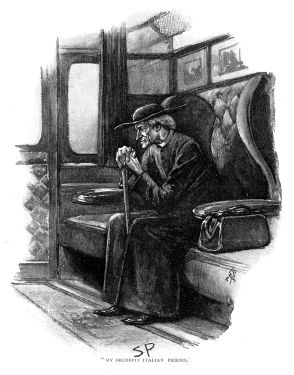 A venerable Italian priest (FINA)
 -
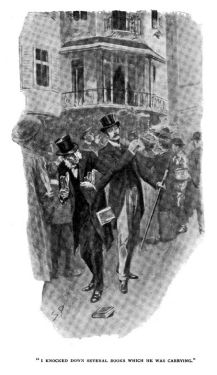 An elderly book-collector (EMPT)
 -
 An unshaven French ouvrier (on the right) (LADY)


Income
Holmes worked rather for the love of his art than for the acquirement of wealth (SPEC 1). Like all great artists, he lived for his art's sake, and, save in the case of the Duke of Holdernesse, he seldom claimed any large reward for his inestimable services (BLAC 2).
His professional charges were upon a fixed scale, and he did not vary them, save when he remitted them altogether (THOR 162). He told to his client, Helen Stoner, his profession was his reward; but she was at liberty to defray whatever expenses she may be put to, at the time which suits her best (SPEC 58).
He was sometimes rewarded well. In some cases, he received:
- £1,000 for the return of the Beryl Coronet (BERY 588).
- £1,000 for the return of the Blue Carbuncle (BLUE 135).
- £300 in gold, and £700 in notes from the KIng of Bohemia (SCAN 268), and the King gave him a snuff-box of old gold, with a great amethyst in the centre of the lid (IDEN 21).
- £12,000 from the Duke of Holdernesse (PRIO 712).
- The house of Scandinavia and the French Republic have left him in such a position that he could continue to live in the quiet fashion which is most congenial to him. (FINA 50).
- The Lady Frances Carfax family told Holmes that no sum will be spared if he can clear the matter up (LADY 66).
- The reigning family of Holland rewarded him with a remarkable brilliant ring (IDEN 25).
- Holmes spent a day at Windsor, whence he returned with a remarkably fine emerald tie-pin (BRUC 905).
Failures

Blunders was a more common occurrence than anyone would think who only knew him through the Watson's memoirs (SILV 34).
In 1887, Holmes confessed he has been beaten four times: three times by men and once by a woman (FIVE 48).
During the long period of continuous work, some cases have baffled Holmes' analytical skill (FIVE 3), a few unavoidable failures (SOLI 3) and some were complete failures, and as such will hardly bear narrating, since no final explanation is forthcoming (THOR 3). However, Watson published two cases where Holmes failed :
He was likely to fall into error through the over-refinement of his logic — his preference for a subtle and bizarre explanation when a plainer and more commonplace one lay ready to his hand (SIGN 1789).
It seemed a certainty when first it flashed across my mind in the cell at Winchester, but one drawback of an active mind is that one can always conceive alternative explanations which would make our scent a false one (THOR 638). When a man has special knowledge and special powers like Holmes it rather encourages him to seek a complex explanation when a simpler one is at hand (ABBE 256).
Relationship with Police
He often left credit to the police in his cases:
- Jones gets the credit [..] there still remains the cocaine-bottle. (SIGN 2842).
- Lestrade [..] To you, and to you only, belongs the credit of the remarkable arrest which you have effected. (EMPT 369).
- 'Out of my last fifty-three cases my name has only appeared in four, and the police have had all the credit in forty-nine (NAVA 435).
- Twice already in his career had Holmes helped him [inspector MacDonald] to attain success, his own sole reward being the intellectual joy of the problem (VALL 218).
- I assure you that I efface myself from now onwards (RETI 317).
- Also in CARD, THOR, NORW.
But he also chafed the police avoid recognition (STUD). He often acted independentely (BOSC, DANC, SILV, SIXN, VALL, WIST) as, in his opinion, local aid was always either worthless or else biased (BOSC). When he went into a case, it was to help the ends of justice and the work of the police. If ever he had separated himself from the official force, it is because they have first separated themselves from me. He had no wish ever to score at their expense (VALL). He liked to tease the official detectives by giving them clues while neglecting to explain their meaning (BOSC, CARD, SIGN, SILV). Though he was hard with others, he didn't spare himself. He blamed himself when he was too slow to solve the problem (ABBE, CREE, LION, THOR, TWIS).
Monographs
Sherlock Holmes was the author of several monographs about criminal topics :
- The Polyphonic Motets of Lassus : which was printed for private circulation and was said by some experts to be the last word upon the subject (BRUC 780).
- The Secret Writings : in which he analyzed 160 separate ciphers. He callled it a "trifling" monograph (DANC 432).
- The Dating of Documents (HOUN 163).
- The Tracing of Footsteps : with some remarks upon the uses of plaster of Paris as a preserver of impresses (SIGN 89).
- The Influence of the trade upon the form of the hand : with lithotypes of the hands of slaters, sailors, corkcutters, compositors, weavers, and diamond-polishers (SIGN 90).
- Upon the Distinction Between the Ashes of the Various Tobaccos : enumerating a hundred and forty forms of cigar, cigarette, and pipe tobacco, with coloured plates illustrating the difference in the ash (SIGN 82).
- Two short monographs on ears in the Anthropological Journal (CARD 313).
- A contribution to the literature of tattoo marks (REDH 48).
- A magazine article entitled "The Book of Life" : in which he demonstarted how much an observant man might learn by an accurate and systematic examination of all that came in his way (STUD 291).
- In retirement he wrote the "Practical Handbook of Bee Culture" (LAST 302).
And Sherlock Holmes had serious thoughts of writing :
- Upon the uses of dogs in the work of the detective (CREE 25).
- Upon malingering (DYIN 522).
- Upon the type-writer and its relation to crime (IDEN 309).
- He was pursuing some laborious researches in early English charters — and Early English charters (3STU 6).
Francois le Villard translated Sherlock Holmes' works into French (SIGN 77).
He promised Watson that some day he would write his own accounts of his cases (ABBE 24).
And indeed, he did it for two stories : The Blanched Soldier and The Lion's Mane.
He proposed to devote his declining years to the composition of a textbook which would focus the whole art of detection into one volume (ABBE 25).
His Life
Before his detective activity
On his childhood and adolescence, we don't know anything. Except that in his two years at college he realized that a profession might be made out of what had up to that time been the merest hobby (observation and deduction) (GOLD 73). The father of a classmate told the young Holmes that all the detectives of fact and of fancy would be children in his hands and that's it was his line of life (GOLD 71). Then now and again cases came in his way, principally through the introduction of old fellow students, for during his last years at the university there was a good deal of talk there about him and his methods (MUSG 45). The third of these cases was that of the Musgrave Ritual (MUSG 46). His career started at that time.
His detective activity
He began his detective activity around 1878 and his partnership with Watson around 1882 (FIVE). His practice began slowly (MUSG, STUD), but by 1889 he claimed having investigated five hundred cases of capital importance (HOUN 923). And over a thousand cases by 1891 (FINA 320). From late 1880s (VALL) to april 1891 (FINA), he devoted his time to fight the Moriarty's criminal organization. Early in 1891, Holmes and Moriarty fought at the Reichenbach Falls in Switzerland. Moriarty died there and Holmes chose to disappear and make people think he is dead. See Hiatus (FINA, EMPT). He returned to active practice in 1894 (EMPT). Between 1894 and 1901 he handled hundreds of private cases, some of them of the most intricate and extraordinary character, in which he played a prominent part (SOLI 2).
After his detective activity
He retired late 1903 or early 1904 (CREE 3) after being in active practice for twenty-three years (VEIL 1). He chose to retire alone in a farm upon the South Downs, Sussex (LAST 361, LION 2, PREF) where he betaken himself to study and bee-farming (SECO 4). Just before the First World War was his last known case with the arrestation of the the Prussian spy Von Bork (LAST).
His Eating Habits
When he worked, he could stop eating. He told to Watson that: « The faculties become refined when you starve them. What your digestion gains in the way of blood supply is so much lost to the brain. I am a brain. The rest of me is a mere appendix. Therefore, it is the brain I must consider. » (MAZA 85, REIG 6).
His Health Problems
In the spring of the year 1897, Holmes's iron constitution showed some symptoms of giving way in the face of constant hard work of a most exacting kind, aggravated, perhaps, by occasional indiscretions of his own (DEVI 7).
During his retirement, he was crippled by occasional attacks of rheumatism. (PREF)
His Relation with Women
Holmes thought that love is an emotional thing, and whatever is emotional is opposed to his true, cold reason which he placed above all things. He should never marry himself, lest it bias his judgment (SIGN 2828).
He had an aversion to women (GREE 3). He said: « Women are never to be entirely trusted — not the best of them » (SIGN 1684). However, Holmes had, when he liked, a peculiarly ingratiating way with women, and that he very readily established terms of confidence with them (GOLD 414).
He thought that the woman's heart and mind were insoluble puzzles to the male (ILLU 162). He said their most trivial action could mean volumes, or their most extraordinary conduct could depend upon a hair-pin or a curling-tongs (SECO 292). He has seen too much not to know that the impression of a woman may be more valuable than the conclusion of an analytical reasoner (TWIS 360). He valued a woman's instinct (LION 213).
But Holmes manifested no further interest to Miss Violet Hunter when once she had ceased to be the centre of one of his problems (COPP 589). He could use his seduction talents to woo, for example, the Milverton's housemaid Agatha which he engaged to her to collect datas on Milverton (CHAS 239).
Despite the fact that Holmes admired Irene Adler, the only women who have beaten the detective in 1888 (SCAN). Holmes admitted in 1897 that he never loved (DEVI 570).
Interests
He was interested in :
- Arts
- Music (see below).
- Chemistry
- Middle-Age:
- Blackletter editions (REDH 351).
- Stradivarius violins (SIGN 1935).
- Buddhism of Ceylon (SIGN 1935).
- Warships of the future (SIGN 1935).
- Chaldean roots (DEVI 577).
- Bees (SECO 4).
Music

He was an enthusiastic musician, being a very capable performer, but also a composer of no ordinary merit. All the afternoon he sat in the stalls wrapped in the most perfect happiness, gently waving his long thin fingers in time to the music, while his gently smiling face and his languid, dreamy eyes were as unlike those of Holmes the sleuth-hound, Holmes the relentless, keen-witted, ready-handed criminal agent, as it was possible to conceive (REDH 348). He could talk about nothing but violins, narrating with great exultation how he had purchased his own Stradivarius, which was worth at least five hundred guineas, at a Jew broker's in Tottenham Court Road for fifty-five shillings (CARD 262) and played well (FIVE, STUD 261). The violin was his favourite occupation (STUD 910). His violin style was eccentric as all his other accomplishments (STUD 267).The violin was an institution for Holmes (CREE 9).
Watson about Holmes playing violin: « I see that I have alluded above to his powers upon the violin. These were very remarkable, but as eccentric as all his other accomplishments. That he could play pieces, and difficult pieces, I knew well, because at my request he has played me some of Mendelssohn's Lieder, and other favourites. When left to himself, however, he would seldom produce any music or attempt any recognized air. Leaning back in his arm-chair of an evening, he would close his eyes and scrape carelessly at the fiddle which was thrown across his knee. Sometimes the chords were sonorous and melancholy. Occasionally they were fantastic and cheerful. Clearly they reflected the thoughts which possessed him, but whether the music aided those thoughts, or whether the playing was simply the result of a whim or fancy, was more than I could determine. I might have rebelled against these exasperating solos had it not been that he usually terminated them by playing in quick succession a whole series of my favourite airs as a slight compensation for the trial upon my patience. » (STUD 266)
He was a concert lover (REDH 537, RETI 187, STUD 729).
He was interested in the following artists:
- Norman-Neruda (STUD 729).
- Charles Hallé (STUD 729).
- Chopin (STUD 828).
- Paganini (CARD 263).
- Sarasate (REDH 304).
- Charlie Peace (ILLU 136).
- Lassus (BRUC 904).
- De Reszkes (HOUN 3822).
- Meyerbeer: "Les Huguenots" (HOUN 3821).
- Wagner (REDC 588).
About Norman Neruda, he told that her attack and her bowing were splendid. "What's that little thing of Chopin's she plays so magnificently: Tra-la-la-lira-lira-lay" (STUD 829).
German music was more to his taste than Italian of French, as it was introspective for him (REDH 311). Holmes wrote a monograph upon the polyphonic motets of Lassus which was printed for private circulation and was said by some experts to be the last word upon the subject (BRUC).
He had an addiction to music at strange hours (DYIN 3). In period of lethargy, he would lie about with his violin hardly moving from the sofa (MUSG 8).
Chronologies
Sherlock Holmes' Performers

