Fortune Telling (interview)
Fortune Telling is an interview of Arthur Conan Doyle published in The Daily Chronicle on 13 october 1919.
The article reports Conan Doyle's approval of a magistrate's ruling in a fortune-telling case, while making clear that he strongly opposed fortune-telling itself as unreliable and potentially harmful. It also broadens the issue into a defence of honest mediumship and psychical research, arguing that outdated laws such as the Witchcraft Act and parts of the Vagrancy Act unfairly hinder Spiritualist investigation.
Editions
- in The Daily Chronicle (13 october 1919 [UK]) as Fortune Telling
- in Light (18 october 1919 [UK]) as The Trial and Acquittal of Mrs. Bloodworth
Fortune Telling

NEWS OF SIR A. CONAN DOYLE ON THE CLAPHAM JUNCTION CASE.
"A VERY UNCERTAIN GIFT."
Over the week-end, in spiritualistic circles, everybody was discussing the decision of Mr. Bankes, K.C., the South-Western Police-court magistrate, in the fortune-telling case reported on Saturday.
Mr. Bankes dismissed the case because he was satisfied that the accused believed she had the power of foretelling the future. "This decision,"
said Sir Arthur Conan Doyle yesterday, to a "Daily Chronicle" representative, "reflects the greatest credit on the magistrate. It is a very fair and honest rung, and I am entirely in accord with his reading of the law. As to whether it will be allowed to stand unchallenged, or be upset if it goes to appeal, is another matter. But the thanks of all good spiritualists are due to Mr. Bankes for such a detached and unprejudiced pronouncement.
"SHOULD BE DISCOURAGED."
"That is one aspect of the case. As to fortune-telling itself, I am dead against it. Those who profess to practise it deal in a very uncertain gift. Their prognostications may come true, or they may be altogether wrong. Sometimes, where ill-fortune is foretold, it leads to all sorts of dire results, causing unhappiness to many innocent people.
"Fortune-telling should be discouraged in every possible way; and I do not think that certain West-End practitioners will be able to discover much extra legal shelter in this decision, which shields honest, though possibly misguided, folk."
"Fortune-telling proper," said Mr. David Gow, editor of "Light," who was one of Sir Arthur's week-end guests at Crowborough, "is really outside the line of psychical investigation. We are all against fortune-telling, and my views coincide with those of Sir Arthur Conan Doyle.
"I do hope that the decision may prevent the legal persecution of honest mediums.
WITCHCRAFT ACT.
"The Witchcraft Act assumes that there caa be no possible communication with spirits. The world of thought has pro- gressed since this ridiculous Act was drawn up, but it is extraordinary what a lot of mischief an old Act of Parliament can be egged on to do by interested sticklers over the letter of the law.
"In the Vagrancy Act there is a small clause of about two lines, which is made more than enough to impose serious penal- ties on spiritualists. A petition, strongly supported by some of the finest thinkers of the day, has been sent to the authorities, asking for the deletion of the clause, or such alteration as can be justified by the known facts. "Our investigations are carried out to And further proofs of the existence of life after death, and it is our view that these researches should not be hampered by archaic legal enactments.
"Where Bond-street is wrong the law can be applied quite readily enough; and Mr. Bankes's decision is not likely to hamper the administration of justice."
More sources
-
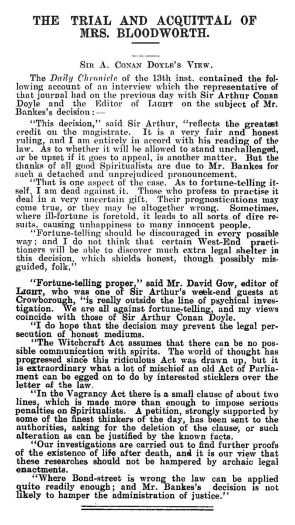 The Trial and Acquittal of Mrs. Bloodworth (Light, 18 october 1919, p. 330-331)


