Percy Fawcett

Percy Harrison Fawcett DSO (18 august 1867 - disappeared 29 may 1925) was a British geographer, artillery officer, cartographer, archaeologist and explorer of South America. He disappeared in 1925 (along with his eldest son, Jack, and one of Jack's friends, Raleigh Rimmel) during an expedition to find an ancient lost city which he and others believed existed in the Amazon rainforest.
Arthur Conan Doyle and Percy Fawcett
In 1953, Percy Fawcett's second son, Brian Fawcett (1906-1984), published a book "Exploration Fawcett" gathering the manuscript notes of his father.
According to these notes, Sir Arthur Conan Doyle met Percy Fawcett during a lecture (see below). Fawcett did not claim he gave Conan Doyle the full idea of The Lost World. Conan Doyle already had "an idea for a novel on Central South America" before receiving Fawcett's information. Fawcett said he provided information and photographs about the Ricardo Franco Hills :
« Above us towered the Ricardo Franco Hills, flat-topped and mysterious, their flanks scarred by deep quebradas. Time and the foot of man had not touched those summits. They stood like a lost world, forested to their tops, and the imagination could picture the last vestiges there of an age long vanished. Isolated from the battle with changing conditions, monsters from the dawn of man's existence might still roam those heights unchallenged, imprisoned and protected by unscalable cliffs. So thought Conan Doyle when later in London I spoke of these hills and showed photographs of them. He mentioned an idea for a novel on Central South America and asked for information, which I told him I should be glad to supply. The fruit of it was his Lost World in 1912, appearing as a serial in the Strand Magazine, and subsequently in the form of a book that achieved widespread popularity. »
-
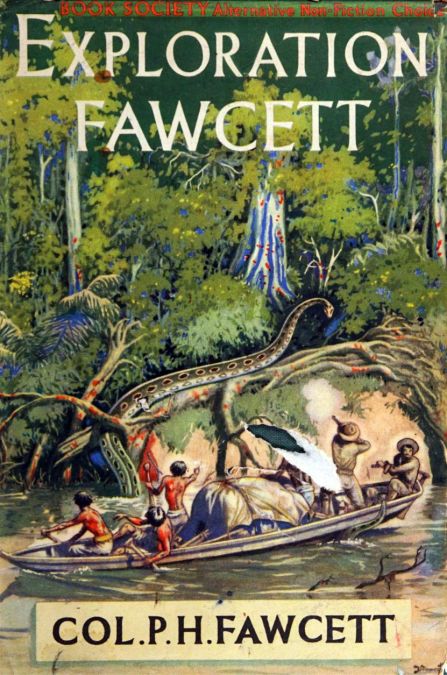 Exploration Fawcett (1953, Hutchinson & Co.).
 -
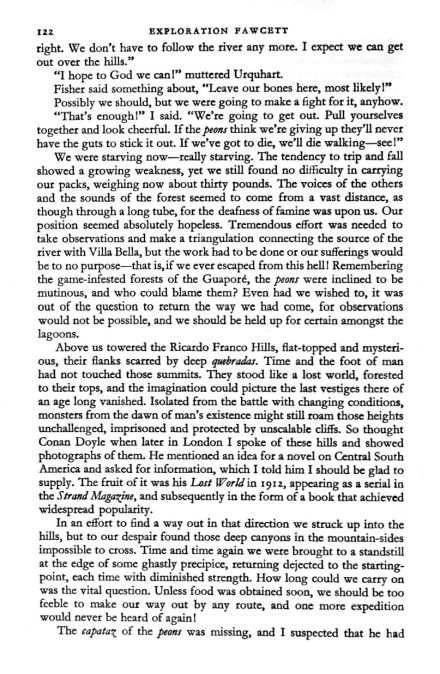 Exploration Fawcett (1953, Hutchinson & Co., p. 122).


The Lost World bordering the great Matto Grosso plateau, the account of which inspired Conan Doyle's famous book.
-
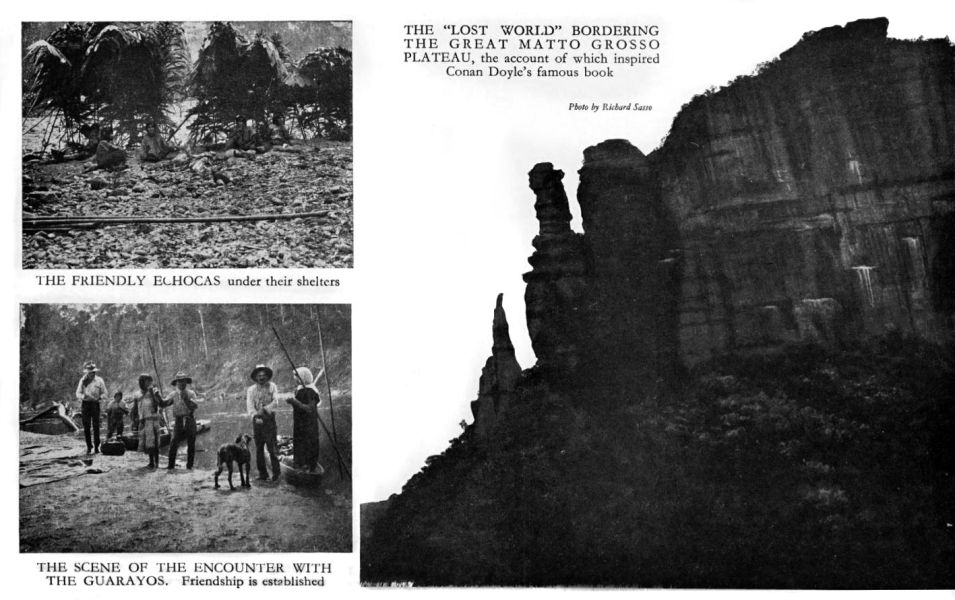 Exploration Fawcett (1953, Hutchinson & Co., p. 145).


