Review:Arthur Conan Doyle/Dr. Bernard Sasso
This review of the biography "Arthur Conan Doyle", by James McCearney, was written by Dr. Bernard Sasso and published in the A.C.D. - The Journal of The Arthur Conan Doyle Society (Vol. 1, No. 3) in september 1990.
Review


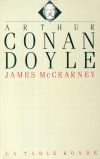
- Arthur Conan Doyle
- by James McCearney
- La Table Ronde, 1988; 368pp.; 120.00FF (Paper)
- Available in Britain through The European Bookshop. 4 Regent Place. Warwick Street, London WIR OBH, Telephone 071-734-5259: (Major Credit Cards accepted)

Reviewed by Dr. Bernard Sasso
Since the publication, in 1964, of Pierre Nordon's well-known study Sir Arthur Conan Doyle - L'homme et l'oeuvre, no other biography of Conan Doyle has been published in France, a country where all his works have been translated and widely read and appreciated.
The renewed interest in the life of Conan Doyle, sparked off in the eighties by such important works as Owen Dudley Edwards' The Quest for Sherlock Holmes, meant that a new biography in French which would take account of and integrate these recent developments, was overdue. This task has now been fully achieved by James McCearney's book published in the late eighties by La Table Ronde.
McCearney, a Scotsman born and educated in Glasgow, has lived in France for twenty years. His early research was concentrated on the French Monarchist leader, Charles Maurras, on whom he wrote his thesis and published a book in 1978, Maurras et son temps. Since arriving in France, McCearney has taught at the famous École des Sciences Politiques in Paris (the French equivalent of the London School of Economics), where he is presently giving seminars on the history of the Conservative Party since the Reform Bill of 1832.
His interest in Conan Doyle started with an article on Sherlock Holmes which he was asked to write for a history magazine in the early eighties and, from this, the idea of writing a full-length biography of the creator of Sherlock Holmes was formed. Since the publication of the biography, which was extremely well received in France, as well as in Belgium and Switzerland (where McCearney recorded a programme on Conan Doyle for Swiss television), he has been working on two other projects: a study, soon to be published, on the Indian Mutiny of 1857, and a biography of Robert Louis Stevenson which should appear in 1994 in time to coincide with the centenary of the death of this author.
The reader of this biography should not expect any startling revelations or discoveries concerning the life of Conan Doyle. McCearney's aim was not in this direction but rather, through an entire re-reading of Conan Doyle's works, and with elements drawn from previous biographies, to give a portrait of Conan Doyle in the wider landscape of his time and period, and to show how the different stages of his literary production paralleled his public and private development. With McCearney's historical background, this aim has been very ably fulfilled.
At the centre of McCearney's biography is his concern to see the whole life of Conan Doyle as fundamentally influenced and directed by the darwinian theory of evolution (as McCearney points out, Conan Doyle was born in the year Darwin published his celebrated Origin of Species), and Conan Doyle's constant attempt to evolve a position which would reconcile a gradual but relentless evolution of the human race towards Progress and Goodness and a benevolent Providence.
This theme runs throughout the biography and, possibly, provides one of the keys to McCearney's understanding of Conan Doyle's personality. His strong and firmly rooted optimism, argues McCearney, suffered devastating blows at the turn of the century through the political and social upheavals which Britain experienced: her pre-eminence, and the values she represented, were decisively challenged: the Boer War, Germany's Imperial ambitions and power, and the destruction of the social consensus on which Victorian society had been built, announced a new era. Liberal England was on her death-bed and with her, underlines McCearney, a chunk of Conan Doyle's beliefs and optimism died, eventually feeding his pessimistic thoughts on the end of civilisation, the collapse of Empires, and the decadence of Britain.
On this point, the biography is of particular interest as McCearney, throughout his study, emphasises the "political" dimension of Conan Doyle's literary production, especially the Sherlock Holmes stories. He carefully charts how the aesthetic and decadent Holmes, a hero of Pascalian dimension facing a world metaphysically void in the early stories, is transformed into a "tamed wonder-worker putting his potentially subversive talents at the service of the bourgeois order."
On this aspect of Conan Doyle's life, McCearney strongly presents a writer who, although wishing a fairer social system, is essentially a man trying to consolidate the established order. McCearney's portrait is undoubtedly linked here with his understanding of Conan Doyle's life. Although constantly sympathetic, his biography points to the Nouveau Riche elements in his subject. Through his own efforts and huge talents, Conan Doyle succeeded beyond expectations, a living example of what Samuel Smiles had advocated in his famous book Self-Help (also published the year Conan Doyle was born).
Essentially a Self-Made Man, Conan Doyle's political and social outlook was conditioned by this framework where all frontiers could be reached for the daring and the hard-working. With this background, how would it be possible for Conan Doyle not to believe in a benevolent Providence and in a gradual evolution of mankind towards Good — at least until his optimism was finally shattered by external events?
This well-written biography certainly deserves close attention. It has the main qualities required of such a work in France: giving an account of a person's life and development in the wider social and political context within which this life has been shaped and directed.
- Article courtesy Christopher Roden, founder of The Arthur Conan Doyle Society (1989-2003).

