Review:Christopher Morley on Sherlock Holmes/Christopher Roden
This review of the book "The Standard Doyle Company - Christopher Morley on Sherlock Holmes", by Steven Rothman was written by Christopher Roden and published in the A.C.D. - The Journal of The Arthur Conan Doyle Society (Vol. 2, No. 2) in autumn 1991.
This review celebrates The Standard Doyle Company, a collection of Christopher Morley's Sherlockian writings, highlighting his foundational role in early Holmes scholarship and the creation of the Baker Street Irregulars. While rooted in "the game," the volume also reveals Morley's deep and genuine admiration for the wider works of Arthur Conan Doyle.
Review


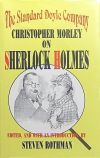
- The Standard Doyle Company -
- Christopher Morley on Sherlock Holmes
- Edited, and with an Introduction by Steven Rothman; Fordham University Press, 1990; 429pp; U.S. $19.95
- (Available from Fordham University Press, University Box L, Bronx, NY 10458. U.S.A.)

Reviewed by Christopher Roden
Each of us comes to study the life and works of Sir Arthur Conan Doyle in his different way but I suspect that the great majority first encounter Conan Doyle through Sherlock Holmes. It is rare for me to encourage 'the game' within the pages of this Journal, but The Standard Doyle Company brings together the writings of one of the most eminent of Sherlockians and, in its pages, shows just how much Christopher Morley, despite his reluctance to allow ACD credit for writing the Holmes stories, appreciated the works of Conan Doyle.
The early years of Sherlockian study must have been exciting times indeed. The names of Starrett, Roberts, Bell, Sayers and Knox remind us of the great contribution which those trail-blazing enthusiasts made to their subject (our subject), and of the seeds of enquiry which were sown for those who followed them. Christopher Morley's name deserves to be added to the list, and his unique contribution is celebrated in this thick volume which includes many of Morley's contributions to The Saturday Review of Literature in columns titled The Bowling Green and Trade Winds.
Christopher Morley was born in 1890 and was, therefore, among the first generation to be weaned on Holmes' adventures. By the time the stories were completed in 1927, Morley was well established as a Man of Letters. Well read in Western Literature, he made his living by writing, reading, commenting, publicising and lecturing but, although he was well known in the literary world, many regarded him as being out of step with the literary scene: he worked in Manhattan, but lived on Long Island; he contributed to The Saturday Review of Literature rather than the more fashionable New Yorker; and he was unlikely to be found enjoying the company of friends in the stylish Algonquin.
In the course of his long career, Morley wrote extensively on Holmes, and his writings were to influence both his contemporaries and following generations of Sherlockians. The many contributions in this book, however, include much which confirms Morley's love of all of Conan Doyle's work. In an extract from 'In Memoriam Sherlock Holmes', Morley recalls youthful visits to his local library:
- 'I then put in two or three years in reading everything else of Dr. Doyle's. One walked downtown to the old Enoch Pratt Free Library on Mulberry Street in Baltimore and got out a book The Firm of Girdlestone, or The Captain of the Pole Star, or Beyond the City, or A Duet, or Round the Red Lamp, or The Stark Munro Letters, or The Doings of Raffles Haw. For I specialized chiefly in the lesser known tales, and deplore Sir Arthur's tendency (in his autobiography) to make light of some of these yarns. As for The White Company and The Refugees and Micah Clarke and Uncle Bernac, these were household words. When one found at the library a Conan Doyle he had not read, he began it at once on the walk home. It was quite a long trudge from Mulberry Street to the 2000 block on Park Avenue, and the tragedy often was that, loitering like a snail, almost like the locomotion of a slowed moving picture, the book was actually finished by the time one got home. There was all the journey to do over again the next day.'
Morley was also a collector (is he to blame for vast sums which modern day enthusiasts expend in an effort to be completists?) and his own attitudes are worth repeating:
- 'In the matter of editions there is also room for much gossip. As with all esteemed authors, there is too much talk of first editions and fine copies and not nearly enough about the chance examples and shabby second-hand culls that we more frequently encounter. Does no one else take pleasure in phony copies, piracies, wretched reprints jobbed off for mail-order sets and department store trading? What an oddly miscellaneous spectacle is the collection of any average Doyle enthusiast. My own fortuitous gathering of Doyles ranges (by gift or purchase) from the bound volumes of The Strand Magazine for 1891-93 in which Holmes's adventures and memoirs first appeared, down to S. C. Roberts's admirable pamphlet. I have some genuine firsts among them, but not less prized are the queer and abominable copies picked up from time to time at hazard. My American edition of The Stark Munro Letters (Appleton '95) has the rubber stamp of the Y.M.C.A. Library, Montreal. Beyond the City, vilely impressed on brittle yellowing paper, was sponsored by F. Tennyson Neely, 1894. A Study in Scarlet is one of a set imprinted W. R. Caldwell and Co. The Firm of Girdlestone carries the name Siegel Cooper & Co., New York and Chicago. Most mysterious of the lot is A Case of Identity and Other Stories, from The Optimus Printing Company, 45-51 Rose Street, New York, down by Brooklyn Bridge. Next after Oscar Wilde, poor old Conan Doyle must have been utilized by more will-o'-the-wisp publishers than any other modern writer.'
American Sherlockians have just cause to be proud of Morley as it was he who founded The Baker Street Irregulars and, of course, the rest, as they say, is history. But although Morley had, in his own words "a morbid hanker for inventing clubs", he was soon to recognise the administrative headache which accompanies formal organisations. In a 1949 essay On belonging to Clubs he wrote:
- 'Truly, men in Clubs have an urge toward Deficit, Damnation and Death. Now the scholarly group of Baker Street find themselves swaddled, or saddled, with a publishing business, an annual meeting, and a province of pulp. They have about 30 scionist branches whose letters have to be answered. But not by me.'
The Irregulars continued to become more institutionalised and Morley began to take a back seat. By 1948, Edgar W. Smith was proposing the incorporation of the BSI to protect the publishing of the Journal and, despite his protests at being involved in a corporation, Morley was made president of BSI Inc. Unfortunately, his suggested name for the new corporation (and the source of the title for this book), The Standard Doyle Company, was disregarded. One wonders how today's Irregulars would have styled themselves if the suggestion had been adopted!
Baker Street Journal readers will perhaps remember Morley's contributions under the guise of Clinical Notes by a Resident Patient, which continued until his death in 1957. These jottings arrived on the desk of Edgar W. Smith, the Journal's Editor, in the form of letter or postcard and, very occasionally, in the form of a short essay. Clinical Notes covered a wide range of topics, chiefly Sherlockian, but are also interesting for the frequent insights which Morley gave his readers into the 'other world of Conan Doyle'. One particular jotting tells an anecdote of ACD from a privately printed book by Dr. Henry Pleasants, Jr.:
- Dr Pleasants was a member of the Haverford College cricket team that played in England in the summer of 1904. (In the great days of Philadelphia cricket Haverford College used to send a team every four years to play English schools, colleges and clubs.) The climax of the tour was always the game with the famous Marylebone Cricket Club. Dr. Pleasants tells how thrilled the Haverford boys were when they learned that A.C.D. had been chosen to play for M.C.C. He writes:
- 'The M.C.C. started batting; and for a while it looked as if we would have an easy time. Our bowling was deadly. Then out on the field ambled the great novelist. He was tall and must have weighed well over 200 pounds. As he approached the wicket, he nodded to each of us and made some dry comment on the progress of the game. He then took his position at bat, and started in. He was an accomplished cricketer. For fully an hour he smashed the ball over the field. Only twice did he give chances. Both of these went to me; and each time I disgraced myself by dropping the ball like a hot potato. We finally put him out in time to win the game; but it was no credit to me. I could have immortalized myself in the cricketing world by catching him out. He was a great sportsman.'
The Standard Doyle Company covers just about every aspect of Holmes, and it is unlikely that any Sherlockian will read it without feeling some enrichment (even if it is not possible to agree with everything that Morley wrote), and it is sure to give birth to some fresh ideas. Let's end this discussion of a thoroughly enchanting book with Morley's poem for Christmas 1949, and thoughts which surely all of us will echo on the long winter's nights which lie ahead:
- TE DEUM LAUDANUM
- What opiate can best abate
- Anxiety and toil?
- Not aspirins, nor treble gins,
- Nor love, nor mineral oil-
- My only drug is a good long slug
- Of Tincture of Conan Doyle.
- Article courtesy Christopher Roden, founder of The Arthur Conan Doyle Society (1989-2003).

