Review:Complete Sherlock Holmes & Other Detective Stories/Barbara Roden
This review of the book "Complete Sherlock Holmes & Other Detective Stories", by Sir Arthur Conan Doyle was written by Barbara Roden and published in the A.C.D. - The Journal of The Arthur Conan Doyle Society (Vol. 5, 1994).
Review


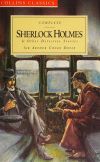
- Complete Sherlock Holmes & Other Detective Stories
- by Sir Arthur Conan Doyle
- edited by Owen Dudley Edwards
- HarperCollins (Collins Classics), 1994; xvii + 1,468pp; £9.99 ISBN 0-00-470691-9

Reviewed by Barbara Roden
The arrival of this edition of the complete Sherlock Holmes stories, hard on the heels of the Oxford Sherlock Holmes and its World's Classics incarnation, brings to mind the old truism about buses: you wait years for a decent edition of the Holmes stories to be published, and then three of them come along at once. Edwards, having striven to ensure that the Oxford texts were as authentic as possible, has sensibly used the same texts in this edition: which means, of course, that everyone who was angered because the Oxford text substituted 'Cove' for 'Cave' in 'The Red Circle' can get upset all over again.
The fact that this book contains the Oxford texts of the stories, but not the scholarly edifice that supported them, may lead some readers to feel that this volume is redundant: after all, the luxury of having the complete Canon in every room of the house is one that most of us feel we can live without. However, this book is much, much more than simply Sherlock: contained within its covers is every story that Conan Doyle ever wrote that could be considered to be even remotely a detective story. And, in a stroke so simple it is brilliant, the tales have been arranged chronologically, meaning that the path and development of Conan Doyle the writer can be traced from 1881, when he was twenty-two years old and writing 'That Little Square Box', to 1927, when the sixty-seven year old author wrote 'Shoscombe Old Place'. The early story, with its cardboard characters, clumsy cross-purposes and somewhat forced humour, contrasts forcibly with the mature Conan Doyle, writing about Holmes and Watson with practised ease, giving us that believably pitiable rascal Sir Robert Norberton, and switching effortlessly from comedy ('Just two weary Londoners who badly need some good Berkshire air' 'Well, you are in the right place for that. There is a deal of it lying about') to tragedy ('[The lantern's] rays were reflected back from the coffin plates, many of them adorned with the griffin and coronet of this old family, which carried its honours even to the gate of Death').
Many of the non-Sherlockian stories will be familiar to Doyleans, with 'The Lost Special', 'The Man With the Watches', 'The Case of Lady Sannox', 'The Brazilian Cat', 'Lot No. 249' and 'The Terror of Blue John Gap' duly making their appearances. Other, less-familiar, stories are worthy of note, however. 'The Cabman's Story' and 'Uncle Jeremy's Household' can both be seen as forerunners of the Holmes stories, with the former particularly influencing A Study in Scarlet (and possibly Fergus Hume's The Mystery of a Hansom Cab: it would be interesting to know if, in 1884, copies of Cassell's Saturday Journal made it as far afield as Australia and New Zealand). As Edwards points out in his Introduction, tales such as 'The Surgeon of Gaster Fell', 'A Pastoral Horror' and 'Our Midnight Visitor' sprang in part from the plight of Conan Doyle's father, while 'J. Habakuk Jephson's Statement' was taken by some as being a factual account of the ill-fated mystery ship Mary Celeste.
Edwards's Introduction leans heavily towards the Holmes stories, which is perhaps not surprising. It is, as with everything Edwards writes, crammed full of information, biography, opinion, speculation, erudition, and wit, and rare will be the reader who does not find him or herself nodding in agreement with much of what is said. For example, when discussing 'Uncle Jeremy's Household', Edwards writes, ... in later works Conan Doyle would not discard potential sources of entertainment as casually as he here throws aside Uncle Jeremy, the Yorkshire Bard. He became a master-artist of the absurd...', and this is so obviously true that one cannot help but agree completely. The author who failed to make the most of the comic potential of Uncle Jeremy in 1885 was able, in 1904, to create a thumbnail sketch of Lord Mount-James, describing him as one of the richest men in England and then having him declare to Holmes that he came as quickly as the Bayswater bus would bring him.
The volume also contains an informative Bibliography, again by Edwards, which gives the places and dates of original publication of each of the stories and novels included. There is a brief discussion of much of Conan Doyle's other writing, as many of his works contain detective-story sub-plots. There is also a discussion of which books a reader who wishes to know more about ACD and Holmes would be best seeking-out, and an evaluation of which biographies of Conan Doyle are best. Nordon and Pearson emerge relatively unscathed, while John Dickson Carr comes in for a bit of a bashing: '[Carr] invents incidents and conversations, thus reducing ACD to a Carr fictional character — and Carr succeeded as a detective-fictionist in spite of his characters'. Ouch.
I do, however, have one criticism of this book, one which there is no getting away from: it is far too big as a paperback. The book does not open flat without damage to the spine, nor does it stay open easily, and it is simply too heavy to read in bed (or any place where you don't have a sturdy table to support the volume). That isn't the fault of the author or editor, but perhaps the publisher could have remedied the problem by issuing the book in two paperback volumes, or perhaps as a hardcover. Still, it is a welcome addition to the Conan Doyle bookshelf; just make sure that said shelf is heavily reinforced.
Barbara Roden
- Article courtesy Christopher Roden, founder of The Arthur Conan Doyle Society (1989-2003).

