Review:Conan Doyle (Coren's Biography)/Christopher Roden
This review of the biography "Conan Doyle", by Michael Coren was written by Christopher Roden and collected in the article "The Quest Continues: Five Reviewers in search of a Biography" in the A.C.D. - The Journal of The Arthur Conan Doyle Society (Vol. 6, 1995).
Review


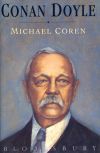
- Conan Doyle
- by Michael Coren
- Bloomsbury; 1995; 213pp; £18.99; ISBN: 0-7475-2192-1

Reviewed by Christopher Roden
Great Expectations
As co-editor of ACD I have the advantage of knowing what my fellow reviewers have said. That is a double-edged sword: on the one hand I have the opportunity of avoiding repetition, on the other I have to recognise that, without repeating something of what some or all of them have said, I am left with little to say.
In looking at Michael Coren's book, therefore, I have decided that my best approach would be to recall what he had to say at the Society's Toronto Convention in May 1994 and compare that with what has actually been achieved.
Coren was our guest on the panel discussion which closed proceedings at the Convention, and I think it is a fair assessment to say we all listened with bated breath in the hope that we might gain some insight into the approach he would be taking as a biographer.
We were told that he had already spent two years working on the book, which would be ready for writing by the October of 1994. Conan Doyle was the best product of his time of his era-and even if this book was to present only a partial view, he would be trying to contextualise his subject. Even with the lack of access to the family papers. Coren said that he had managed to turn up some new material via the Wells and Chesterton archives. There was also interesting information from the Zionist archives illustrating Conan Doyle's tolerance and wisdom, which was quite remarkable for the period-it showed him to be very perceptive and a very sound person.
As to why he was writing a biography at this time, Coren was quite open: he was writing for money. He was, he said, a working biographer who felt qualified to write about Victorian and Edwardian authors and literature. Apart from the work he was doing, he also felt that there was room in the market for a young adult biography of ACD.
The first printing of the book would be 120,000 copies in eight languages. Christopher Redmond was on hand to compare this to a printing of 3,000 copies for his A Sherlock Holmes Handbook.
Coren said that he would attempt to compile the best and clearest assessment of Conan Doyle to date. He would compile it from a non-Sherlockian point of view, even though there was nothing to compare with Holmes. There was, he felt, little probability of redressing the balance between Holmes and Conan Doyle's other works, but to be faithful one had to look at the other works.
Particularly, Coren said, he would be looking at Conan Doyle's Spiritualism, which other biographers often treated with contempt, regarding ACD as a buffoon. He would, he said, treat Conan Doyle's Spiritualism with respect-how many other great men with great intellectual qualities also believed?
Besides Spiritualism, Coren pointed out that he was particularly interested in Conan Doyle's feelings regarding Roman Catholicism. This produced a very interested reaction from the audience and questions as to whether Coren would berate ACD for his decision to leave the Roman Catholic church in the same way as he had dealt with the anti-Semitism of Wells and Chesterton in previous biographies. Coren was quick to respond positively. The position of Conan Doyle over Roman Catholicism was, he said, very different from anti-Semitism, which is a reaction rather than a religion.
He hoped, he said, to liberate Conan Doyle from his own creation (Sherlock Holmes), because Conan Doyle deserves to stand on his own. The biography would be around 250,000 words and could not be definitive, but had to be written even without access to the family papers.
There was, he said, a British' decency about Conan Doyle — others might say there must have been something much deeper than that.
Was Conan Doyle a great writer? Coren felt that he was a successful writer; some of his characters were cardboard; some of his plots were thin; and he thought that perhaps he wrote too quickly. But it was unfortunate that Conan Doyle was not taken seriously by too many academics-academics are frightened people — Conan Doyle probably never would be taken too seriously because he was a popular author. Coren ended by saying that he came to ACD as a biographer (he added that he was butterfly-minded and readily jumped from one subject to another), but he would do his best, even though this was likely to be a 'warts 'n all biography'.
Well, we now have the result of his labours, and really, far from being 'warts 'n all', Coren's biography paints a kindly picture of Conan Doyle. We should be thankful for that, and thankful that Coren's liking for Conan Doyle lasted for the duration of his commission-in contrast to his work on Wells, whom he began by liking and ended disliking quite considerably. However, it does not follow that a liking for one's subject will necessarily result in a good biography and such is the case with Coren's book. In fact he seems to like Conan Doyle so much that he can find little to criticise — apart from expressing contempt for The Maracot Deep — and presents us with a picture of a man who had no major discernible character or personality faults. Indeed, we might express surprise that Coren does not press for the canonisation of his subject-though. in view of his expressed distaste for Sherlockians (on more than one occasion in the book), I feel sure he would use the term conanisation instead.
He begins well enough, and not without originality, painting a word picture of his subject by reference to the 1928 Fox Movietone interview. At last, one might hope, a study of Conan Doyle's life is to be treated to an innovative approach. Hopes are soon dashed, however, as Coren ploughs, tediously more often than not, through events in ACD's life which he has culled chiefly from Memories and Adventures and from the various travel/Spiritualist volumes. His quotes are so voluminous, in fact, that had they been omitted precious little material would have remained with which to make a book, and it really would have been much better if that had been realised by both author and publisher. And the publisher really deserves a fair share of the criticism for this book: it was Bloomsbury who made such a hash of the captions for the splendid set of photographs (the highlight of the book as far as I was concerned), and it was Bloomsbury who perpetrated deception on a grand scale by calling the biography 'definitive' in their dust jacket blurb. That it certainly is not.
Coren told us in Toronto that the book had to be written without use of the family papers'. and it is still not possible to accept that without asking 'why?' Coren provided the answer to that, too: he was writing the book for money-and, if rumours are to be believed, a great deal of money. Fair enough; he has a living to make just like the rest of us. But we know Coren to be capable of good work, and good work simply is not on show here. From the lack of quoted sources to the invention of ridiculous conversation, Coren presents himself as a tabloid hack-a pretty poor tabloid hack — and the knowledge that he is truly not a hack and is capable of much better work makes the disappointment of Conan Doyle all the more difficult to take.
The biographical material about Conan Doyle, in terms of books already written, is extensive. The prospect of exciting new interpretations of his life and work will be increased when the family archives finally become available — and if the listings in the Appendix of John Dickson Carr's The Life of Sir Arthur Conan Doyle is anything by which to judge matters, the archives most certainly will provide much-needed new information. Coren could have waited, but even then, on this showing, he would not have been the man to make use of the material in question: his research is slim-there is every indication that he has not read a fraction of what he needed to read-referencing of his sources is virtually non-existent, and his structuring is weak. To add to all of that, he seems to be at odds with himself over the question of Sherlock Holmes. Those Sherlockian monomaniacs... he writes, 'would do well to read the introduction to [[[Memories and Adventures]]] before bed, every night.' He then proceeds to give plot descriptions of virtually every Sherlock Holmes story written by Conan Doyle, and it becomes obvious that his own reading has not extended far beyond the canon. My personal view is that there is more to be gained by reading beyond the Introduction to Memories and Adventures and that, had Mr Coren extended his own reading-or given us evidence to believe that he had read more widely-his book might have had more to offer.
But Coren misses opportunities, and misplaces emphases. For example, he makes much of ACD's friendship with the Jewish novelist Israel Zangwill. Admittedly, one piece of correspondence in which ACD discusses the subject of the resettlement of Jews is extremely revealing-but Conan Doyle had friendships with many of his contemporaries, and there is nothing to suggest that his association with Zangwill was greater or lesser than with any of the others. Coren's discussion of ACD's portrayal of Steve Dixie in 'The Three Gables' highlights a letter sent to ACD by a black reader in the United States, expressing disappointment that through Sherlock Holmes ACD had referred to Dixie as a 'savage. 'It is to Conan Doyle's credit,' writes Coren, 'that he replied in contrite tones, explaining that if he ever wrote again of a man of "this race and colour" he would try to be empathetic. This completely misses the important and fascinating point as to whether Conan Doyle, through his portrayal of Steve Dixie particularly, but in other instances too, was displaying racist tendencies, or if his thinking was simply consistent with the general thinking of his times.
My colleagues have highlighted the factual errors-sometimes trivial, sometimes absurd the lack of noted sources, the pathetic bibliography, so all that remains is to consider how Coren has measured up to the aims he stated in Toronto.
By no means is this the clearest, or the best, assessment of Conan Doyle to date, nor does it approach anywhere near to the promised 250,000 words. By no means has Coren succeeded in liberating Conan Doyle from his creation-indeed, by playing so heavily on the plots of the Sherlockian stories, and limiting his reading to so great an extent, he has done more harm than good. I will allow that his treatment of Conan Doyle's Spiritualism is more than any whole-life biographer has so far attempted, and that there seems to be more than pure open-mindedness underlying what Coren writes on the subject: 'A contemporary student of Arthur Conan Doyle,' he says, 'should in a broad sense be a spiritualist'. That may be going a little too far, but at least it shows that Coren was prepared to examine a contentious subject in a progressive way and temper the ridicule which seemed to emerge in an earlier article he wrote on the subject (One Man's Fall From Faith'; Crisis, October 1992) — however right or wrong his conclusions may be.
Sadly, we have learnt nothing really new. Sadly, Coren has chosen to ignore the whole of the Society's output for the past seven years (apart from borrowing, uncredited, parts of the Introductions to both Western Wanderings and The Future of Canadian Literature). Sadly, there seems to have been an arrogance at work which suggested to Coren that he could throw together a passable biography of Conan Doyle with the minimum of effort. Sadly, those who read the book without already knowing more of Conan Doyle, or not having these reviews as a guide to the book's shortcomings, will regard this as definitive. That, however much Coren's book may stimulate interest in ACD, has to be the greatest sadly' of all.
- Article courtesy Christopher Roden, founder of The Arthur Conan Doyle Society (1989-2003).

