Review:Conan Doyle (Coren's Biography)/Jon L. Lellenberg
This review of the biography "Conan Doyle", by Michael Coren was written by Jon L. Lellenberg and collected in the article "The Quest Continues: Five Reviewers in search of a Biography" in the A.C.D. - The Journal of The Arthur Conan Doyle Society (Vol. 6, 1995).
Review


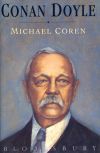
- Conan Doyle
- by Michael Coren
- Bloomsbury; 1995; 213pp; £18.99; ISBN: 0-7475-2192-1

Reviewed by Jon L. Lellenberg
Uninspired
In recent years, with Arthur Conan Doyle's papers unavailable for scholarly use, it has seemed that progress toward definitive biography could only be made around the edges of his life. And while this has been unsatisfying for many, nonetheless progress has continued to be made, with useful efforts ranging from Geoffrey Stavert's look back at Portsmouth and Southsea, during Conan Doyle's days there as a young doctor and struggling writer, to Owen Dudley Edwards's brilliant use of Edinburgh sources to explore Conan Doyle's upbringing. But doing Conan Doyle's entire life justice, let alone delving deeply into the principal biographical issues of that life, would require, everyone seemed to realize reluctantly, renewed access to the family papers which Pierre Nordon was the last to use thirty-odd years ago.
Nonetheless, Michael Coren, fresh from biographies of H. G. Wells and G. K. Chesterton, presents us with a new life of Conan Doyle now. As the biographies go, it is in the line established fifty years ago by Hesketh Pearson, taking its place alongside the popular lifes of the creator of Sherlock Holmes by the Hardwicks, Hoehling, Wood, Brown, and Julian Symons. And among that company, Coren's book is not the least of them. While his depiction of Conan Doyle is marred by frequent small mistakes of detail, and some larger ones of inference or supposition, it is on the whole a serviceable biography for people who, having read Sherlock Holmes, display casual interest in the author. From Coren's treatment, those readers will learn that Conan Doyle's upbringing at his mother's hands was imbued with a romantic view of history; that he was raised Roman Catholic, but broke with the Church, and was left with an aching void of faith; that he was struck by the uncanny powers of observation displayed by Dr Joseph Bell, and derived Sherlock Holmes's method from them; that Sherlock Holmes made him a popular and immensely successful writer, but that he thought Holmes less worthy than much of his other work; that he went on to take strong public stands on many public issues; that he, while living a life of loyalty to his ailing wife, conducted a platonic love affair with another woman, whom he finally married in 1907, after his wife's death; and so on.
At the Conan Doyle Society's convention in Toronto in 1994, Coren remarked that, given the unavailability of the family papers, his biography would necessarily be more along the lines of Pearson's than Nordon's. And so it is. But in his introduction to the published volume, he goes further than his book actually justifies in suggesting that it is something more than just a new popular biography. He calls it 'a biographical study of Conan Doyle rather than an orthodox literary biography,' arguing that the unavailability of the family papers must not, cannot, stop us from bringing new perspectives to bear on so fascinating a character' — by which he seems to mean downplaying the importance of Sherlock Holmes to allow the things Conan Doyle thought more important about his life to emerge: Conan Doyle the doctor, Conan Doyle the adventurer, Conan Doyle the journalist, and, above all, Conan Doyle the spiritualist. It is, he says, 'the intention of the present book to describe Conan Doyle the man, composite of all of these aspects and of many more.'
If this was Coren's intention, he failed to do the research necessary, relying far too heavily upon his subject's Memories and Adventures. Seventeen of the book's thirty-six scanty footnotes cite it. For someone purportedly interested in Conan Doyle the doctor, Coren does not have much at all to say about that, and his bibliography includes no work shedding light on Conan Doyle's medical education, practice, and outlook, or the ways they influenced his writing, such as Rodin and Key's Medical Casebook of Dr Arthur Conan Doyle. His examination of Conan Doyle's adventures, among which he includes his tours of North America in 1894, 1914, 1922, and 1923, is without reference to Howard Lachtman's and Christopher Redmond's books on the subject. And where Conan Doyle the journalist, pamphleteer, and public figure is concerned-Coren provides accounts of the divorce law reform work, the Titanic, Boer War and Belgian Congo controversies, and the campaigns to clear George Edalji and Oscar Slater — many specialized works about the issues involved do not appear in his bibliography either.
Conan Doyle the Spiritualist does receive a good deal of attention from Coren, giving his biography one dimension that many of the others lack. Instead of sliding past the embarrassing subject as rapidly as possible, like John Dickson Carr, Coren focuses on it from the beginning, giving it more attention than any other friendly biography save the Revd John Lamond's, which after all was Spiritualist biography. And Coren's treatment is less sceptically condescending than some of his own writings preceding this biography. He makes it clear that Spiritualism did not suddenly seize an aging Conan Doyle at the end of the Great War, but that he took an interest in psychic investigation from at least his youthful Southsea years, under the influence of men like Major General Alfred Drayson. The importance of Conan Doyle's declaratory letter to Light in 1887 is emphasized, and Conan Doyle's Spiritualist development from then on is followed, and here Coren's bibliography cites Lamond's biography, Kelvin Jones's Conan Doyle and the Spirits, and half a dozen other works about Spiritualism. An extensive account of Conan Doyle's debate with Joseph McCabe in 1920 gives readers a good idea of the arguments for and against Spiritualism in those years, and of the way Conan Doyle handled himself on the public platform. Coren concludes with a sympathetic judgment about Conan Doyle's faith:
- ... we cannot dismiss his religious and philosophical ideas as absurd if we wish to retain any intellectual consistency in the study and appreciation of Conan Doyle. A man who was sufficiently gifted and brilliant to invent and develop Sherlock Holmes and Professor Challenger, qualify as a doctor and suggest military reforms far ahead of their time surely did not have one gargantuan weak spot when it came to his personal belief in life after death and the supernatural. We may disagree with him but we would do well also to respect him. He was no extremist and blind zealot. He understood compromise and moderation.
This is a perspective for which some may be grateful-but others will regard Coren's treatment as evasive, taking an easy narrative path and preaching homilies about openmindedness instead of doing a biographer's hard work.
There are other aspects of Coren's biography which deserve to be noticed in a review here. While he did little original research, his earlier exploration of G. K. Chesterton's papers at the British Library turned up a number of letters from Conan Doyle which add to our knowledge of his views on various subjects. Coren is also interested in Conan Doyle's attitude toward Jews and Jewish subjects, and a 1905 letter to Israel Zangwill, now in Jerusalem's Central Zionist Archives, provides an interesting look at Conan Doyle's attitude toward Zionism. Coren returns to the Jewish thread repeatedly, in ways as diverse as the use of the name Adler for the woman in Sherlock Holmes's life, to the protracted campaign to set Oscar Slater free, to the friendship with Harry Houdini. In the end, Coren finds Conan Doyle more enlightened than most of his gentile contemporaries.
But on the whole, aside from the sympathetic treatment of the Spiritualism, Coren presents what is today's conventional wisdom about Arthur Conan Doyle's life, and less of that than he could have from the published sources. His discussion of Conan Doyle's relationship with his mother is inadequate, and his account of Conan Doyle's father is so slight and unrevealing as to startle anyone who is aware of Michael Baker's The Doyle Diary, one more important source not in Coren's bibliography. Dr Bryan Charles Waller and his reported great influence on the young Conan Doyle is never mentioned, and for someone who has exhibited interest in Roman Catholic writers in the past, Coren looks less into the youth's religious upbringing and education than one might have expected.
In 1987, in The Quest for Sir Arthur Conan Doyle, my collaborators and I looked at Conan Doyle biography up to then primarily in terms of six critical issues. We have already seen here how Coren proposed to address Conan Doyle's life despite the family papers' unavailability, and how he covered the Spiritualist crusade. As far as Conan Doyle's place as a writer is concerned, Coren seems to give him high marks without ever taking a stand, or tackling the issue of whether his work was literature or popular fiction. Despite the professed intention to downplay Sherlock Holmes, it is Holmes who receives most of the literary attention in this book. The Challenger tales, the historical novels, and to a lesser extent the Brigadier Gerard stories are also there, but whole areas of Conan Doyle's fiction are ignored, and nowhere does Coren make any attempt to assess the literary value of what Conan Doyle wrought. The Sign of the Four is described as the work that established Conan Doyle as a writer (leading Coren to make some peculiar suppositions about Conan Doyle and drugs), and all of the Holmes novels and stories receive rather pointless plot summaries, but the actual creation of Sherlock Holmes is almost dismissed in a couple of paragraphs which give readers no real sense of the power of what Conan Doyle's imagination had created. Coren eventually quotes at length from T. S. Eliot's 1929 Criterion review of The Complete Sherlock Holmes (without giving the source), about the literary and mythic meaning of Sherlock Holmes; but beyond this borrowed authority, he makes no assessment at all.
As for Conan Doyle as a man — was he simple or complex, what he contributed to Holmes himself or did he merely borrow Joe Bell, what was his psychology and how did it reflect itself in his work-readers will not find Coren very useful in examining these issues, even where he provides some treatment of them. What we know today to have been some of the important influences upon Conan Doyle's personality and character have been neglected, providing little justification for the many times Coren writes as if knowing exactly what was in Conan Doyle's mind: for example, linking a growing desire to take part in one of Britain's wars to a 'mild hypochondria' that Coren claims emerged as Conan Doyle entered his thirties. Despite a tone of authority, readers familiar with Conan Doyle's life will discern that Coren does not really know his subject very well; to cite only one example, Coren speaks of Conan Doyle needing a secretary to help him write letters as the end of his life approached in 1930, apparently without realizing that Conan Doyle had had a secretary for decades, Major Alfred Wood, 'Uncle Woody' to the children.
This is not a good book, neither is it a particularly bad book. It gives students of Conan Doyle's life little that they do not already know, and none of that is central to an understanding of the man and writer. But it is not the worst of the biographies to have in print for casual readers interested in Sherlock Holmes's creator. In the end, it will arouse little but indifference in readers of ACD, which is about as harsh a verdict as this uninspired book is able to arouse in this reviewer.
- Article courtesy Christopher Roden, founder of The Arthur Conan Doyle Society (1989-2003).

