Review:Conan Doyle (Coren's Biography)/Richard Lancelyn Green
This review of the biography "Conan Doyle", by Michael Coren was written by Richard Lancelyn Green and collected in the article "The Quest Continues: Five Reviewers in search of a Biography" in the A.C.D. - The Journal of The Arthur Conan Doyle Society (Vol. 6, 1995).
Review


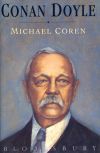
- Conan Doyle
- by Michael Coren
- Bloomsbury; 1995; 213pp; £18.99; ISBN: 0-7475-2192-1

Reviewed by Richard Lancelyn Green
Ineffable Twaddle
'It would,' says Michael Coren, have been better for all concerned had the wretched work never appeared'. He was talking about The Maracot Deep, but it would be better applied to his appalling biography.
The book was proposed in 1991 and is the work of the younger brother of Alan Coren. On the strength of his earlier books on G. K. Chesterton and H. G. Wells, Coren was apparently paid 'the highest advance for any literary biography written by a Canadian' (even though he is an Englishman). It was money ill-spent: of all the studies of Conan Doyle, this must rank as the worst ever published. It would have been inexcusable if it had appeared in the 1960s, but it almost beggars belief that such a mediocre and lacklustre work could have appeared in the 1990s.
As the reviewer is named in the acknowledgements, it would be as well at the outset to offer a disclaimer of any involvement with the book. Advice was not sought at any stage. Arrangements for use of the various photographs in the book were made with the English publisher, and it is they and the author who share responsibility for the captions — for 'Sydney Paget', 'James Payne', the fancy dress party at 'Windlesham' in 1898, 'Lilly Lodersons' — and the other absurdities which are typical of the book.
A biographer of Conan Doyle who is unable to spell Edgar Allan Poe (he appears as 'Edgar Allen Poe'); who says that 'J. Habakuk Jephson's Statement' was based on the Marie Celeste, rather than the Mary Celeste; who refers to Dr. Watson's friend as 'Stanford' (instead of Stamford) and gives the name of his future wife as 'Miss Mortan' (Morstan); who says that James Payn wrote Lost Sir Massinberd (rather than Lost Sir Massingberd); who is unable to transcribe the title page of Micah Clarke — so that Gervas appears as 'Hervas'; who calls the suspect in the Edalji case 'Rodney Sharp' instead of Royden Sharp, and calls D.D. Home 'D.D. Howe' — is clearly unsuited to the task and has no idea what he is talking about.
It does not inspire confidence when Conan Doyle's first published story, 'The Mystery of Sasassa Valley', is given as 'Sarassa Valley' and is said to have been published in October 1879 when it actually appeared on 6 September 1879. And The White Company was not published in 1890, but 1891: Conan Doyle and Drayson did not contribute stories to Every Boy's Magazine (which reprinted material from the Boy's Own Paper); Conan Doyle did not write to the Medical Times, but to the Daily Telegraph, from which the letter was taken. The suggested title for The Sign of Four was 'The Sign of the Six', not 'The Sign of Six', and it appeared in Lippincott's Magazine as The Sign of the Four (not The Sign of Four). And what is to be made of the reference (p. 88) to The Exploits of Brigadier Gerard, which appears to suggest that it is a novel: 'Conan Doyle had written about Gerard before, in short-story form, but now produced a full book about the French hero'!
Coren is equally lax when dealing with biographical matters. Richard Doyle's cover for Punch remained in use until the mid nineteen-fifties, not the 'forties'; James Doyle did not write a book called Chronicle of England and the Official Baronage of England-they are two separate works; Conan Doyle's elder sister, Annette, was not a neglected girl' and was not obliged to send almost all her income back to Scotland' (she did so of her own free will); the younger sister, Lottie, was not 'known as Caroline'; Conan Doyle did not 'spend many evenings at the Portsmouth Literary and Scientific Society lecturing on his favourite authors' he gave lectures on Gibbon and Carlyle and one based on his experiences in the Arctic Seas. And there are countless other examples: Conan Doyle was never 'an active politician'; he was not a hero of the Boer War'; his brother, Innes, was not a 'mere youth' when he died in 1919.
The book is full of mistaken assumptions and inaccurate speculations, and again and again Coren reveals his ignorance by making statements which are untrue. Referring to the death of Kingsley Conan Doyle, for example, he says, 'In October 1917 Conan Doyle was lecturing in Nottingham. He received a telegram from his daughter Mary explaining that his son was dying of influenza and pneumonia after having been wounded on the Somme. Conan Doyle cried, just little, and then went out to deliver his lecture, upon the subject of spiritualism. He learnt of Kingsley's death shortly afterwards. on Armistice Day.' The truth (and truth should matter to a biographer) is that Kingsley died on 28 October 1918, a day after Conan Doyle had given a lecture in Leeds. He received the telegram when he was still in that city. He was due to give a lecture in Nottingham on the following day and, despite his bereavement, went ahead with it. Kingsley had returned to civilian life earlier in the year and was no longer a serving soldier. He had been wounded on the Somme on 1 July 1916, but the cause of death was pneumonia, supervening on influenza. Armistice Day was 11 November 1918.
In many instances he descends into absurdity and the realms of fantasy-as when he refers to Baron von Reichenbach: the name was learnt early by Conan Doyle and, on the evidence of his Sherlock Holmes stories, was never forgotten'! Or makes ridiculous and unfounded assertions, such as: 'The opening of a new railway line, the launching of a ship, the introduction of a new piece of technology into a major factory — all were assumed to be the sorts of things Conan Doyle might be interested in and like to be invited to'! 'He was also asked to put his name to various new products, including soap, tobacco, newspapers, cars, and even primitive fitness machines'. Can Coren name the railways, ships, and pieces of new technology to which he refers-or give the name of the soap, newspaper or car to which Conan Doyle was asked to put his name? And what evidence has he of 'a series of death threats that occurred between 1910 and 1914', or that Conan Doyle was given a police bodyguard' in 1912? What evidence has he that Conan Doyle 'would often write out his letters a second time so as to keep a personal record that was in perfect condition'?
Coren is not fit to be called a biographer, and he is also no literary critic. Conan Doyle gave birth to Sherlock Holmes,' he says, 'fed him and saw that he grew to maturity. He brought to bear the usual skills involved in fiction and characterization. As for those people who believe that somehow Holmes was a real person and Conan Doyle a mere conduit, they are to be pitied.' This is puerile stuff. 'His Last Bow' was a vehicle to attack the Germans, Irish extremists and suffragettes. There is little doubt,' he says of the central character in The Maracot Deep, that this was the last appearance of Sherlock Holmes'. If he is prepared to put his name to such rubbish, he is the one to be pitied.
Conan Doyle should never have been published. It is badly written, shallow, slipshod, arrogant, and tedious. The only material which would be unfamiliar to most readers are a few letters to Israel Zangwill; otherwise the book is a hash, based largely on Memories and Adventures, Conan Doyle and the Spirits, and the Conan Doyle Society's edition of Western Wanderings. It omits many of the most significant events of Conan Doyle's life (there is no mention, for example, of his brother-in-law, E. W. Hornung, or of his friendship with W. K. Burton), and it is padded out with unnecessary synopses of the Sherlock Holmes stories. There are no 'new perspectives' or insights, and no understanding of Conan Doyle's character. Coren does Conan Doyle a great disservice (as does the publisher by claiming that this dreadful potboiler is 'definitive').
Coren is wrong about almost everything and he is particularly bad when dealing with the subject of Spiritualism. He did no research and never approached any of the living members of Conan Doyle's family. It is also highly depressing to find that he has ignored many works which he might have been expected to use (such as the Bibliography of A. Conan Doyle — which would have given him a rather clearer picture of what Conan Doyle did and did not do during his lifetime). His list of sources is almost non-existent (he is wrong to say that the papers in Switzerland are not accessible), and his 'Bibliography' at the end of the book is laughable. There is apparently a book by Joseph Bell published in 1893 called Mr Sherlock Holmes, and another called Letters to the Press by John Michael Gibson and Richard Lancelyn Green — but most of the important recent works of scholarship, such as the studies of Conan Doyle in Southsea or the account of his American lecture tour in 1894, are unknown to him.
'Of the numerous books published about Conan Doyle and Sherlock Holmes,' says Coren, many are best left alone.' This is certainly true in his own case. Conan Doyle should be left alone as it is a travesty of the truth, a childish and incompetent ramble by a singularly inept individual.
- Article courtesy Christopher Roden, founder of The Arthur Conan Doyle Society (1989-2003).

