Review:Conan Doyle by Michael Coren/Doug Elliott
This review of the biography "Conan Doyle", by Michael Coren was written by Doug Elliott and published in the Canadian Holmes (Vol. 19 No. 3, Spring 1996).
This review of Michael Coren's Conan Doyle considers the book a sympathetic and accessible popular biography, but criticizes it for being too superficial, poorly sourced, and lacking genuinely new scholarly insight despite its respectful treatment of Conan Doyle and his spiritualism.
Review


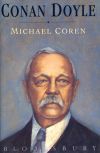
- Conan Doyle
- by Michael Coren
- Bloomsbury Pub., 1995

We have been waiting a long time. The thirteen existing biographies, well assessed by prominent Sherlockians in The Quest for Sir Arthur Conan Doyle (ed. Jon L. Lellenberg), are all wanting in different respects. For many years it was popularly believed that, until the Doyle family papers could be wrested from the bonds of familial legal wrangling, there was no hope of a definitive biography. In 1983, Owen Dudley Edwards laid that myth firmly to rest with his The Quest for Sherlock Holmes, proving that with ingenuity, a desire to see the subject from a fresh vantage point and a lot of old-fashioned basic research, wonders could be wrought. The great Conan Doyle biography, we thereby concluded, was yet possible.
More than two years ago Michael Coren spoke at a Bootmaker meeting about his forthcoming biography. He would not, he assured us, trash his subject: this was cause for some relief among the assembled Bootmakers, since in his biography of H.G. Wells he had summarized Wells' legacy as "pernicious and destructive."
In recent years, Coren has become an unavoidable fixture in the Toronto media. His regular newspaper columns, radio broadcasts and appearances on television panels have, I understand, caused him to be widely heralded in some circles and soundly disliked in others. He has even written, not respectfully, I am led to gather, about (gasp!) Bootmakers. Somehow, I have missed all this. I neither read the right papers, listen to the right radio nor watch the right TV to have developed much of an opinion about Michael Coren. I have met him twice and on both occasions I found him an affable and good-humoured conversationalist. Depending on your viewpoint, I am either the perfect reviewer or I have completely failed to do my homework. Never mind.
In his introduction to the present work, Coren describes it as a "biographical study of Conan Doyle rather than an orthodox literary biography." He wishes to bring "new perspectives to bear on so fascinating a character." I would place the results of his efforts in the category of "popular biography": written in a plain, straightforward style, it seems to be intended as an introduction for the general reader. As such, it has more in common with the works of Carr, Higham and Symons than the analytical literary biographies of Pierre Nordon and Owen Dudley Edwards or the essays of Lamond or Pearsall with their single underlying themes. Furthermore, weighing in at barely 200 pages of largish type, is decidedly light-weight.
As to "new perspectives", there is very little that is not well covered by other biographical works. Several themes are perhaps developed to a greater extent than has been seen elsewhere: Conan Doyle's impulsiveness, his sympathy for Jewish issues, his liking for Canada. However, Coren fails to review or materially acknowledge many of the genuine new perspectives that have appeared recently in the Journal of the Arthur Conan Doyle Society or that grow thickly on the pages of The Quest for Sherlock Holmes. For example, there is not a word of Edwards' revelation of the large role played by Bryan Charles Waller in Conan Doyle's early years in Edinburgh, simply the enigmatic note that when Arthur's father, Charles, was institutionalized, "The family broke up and Mary [Conan Doyle's mother] went to live in Yorkshire, in Masongill Cottage on the Waller estate." The significance of Masongill or Waller is not stated.
In general, Coren seems content to simply describe the facts of Conan Doyle's life, providing a brief historical background as needed. The emphasis seems somewhat erratic: three pages summarize the Shaw-Doyle letters in the press about the Titanic disaster, yet the brief description of Conan Doyle's abortive career as a Wimpole Street eye specialist fails to mention the crucial fact that the doctor attracted not a single patient.
Where serious biographic issues arise, Coren is often content with a sweeping statement: "Holmes was heavily influenced by Dr. Joseph Bell, and was in part Conan Doyle, but he was mostly the sum of the author's imagination and literary skill." And again: "Lord Macaulay influenced his sense of history and Sir Walter Scott his sense of fiction. But mostly he was influenced by his own sense of what was right and what had happened many years ago, something that had been with him since he was a small boy." I would like to have seen a bit more justification for such contentious pronouncements as: "He was determined never to be a prisoner of his own age, an age he did not particularly care for at that."
Coren takes a number of strong positions, not all of which I can agree with. He defends Conan Doyle's belief in the Cottingley fairies fraud by suggesting that many others were taken in as well, that only recently has the technology been available to detect the fakery and that only recently has one of the perpetrators confessed. To many of us, the evidence of our eyes alone was sufficient to raise considerable doubt. Coren forgets that the burden of proof in such cases lies with the claimant.
He suggests that the death of Conan Doyle's mother contributed to his conversion to spiritualism. Yet Mary Doyle died in 1920, four years after he had announced his beliefs and long after he had become famous as a speaker on the subject.
Coren touches only briefly on the Sherlockian phenomenon that Conan Doyle created. His perspective on "Sherlockian monomaniacs" is unambiguous: "As for those people who believe that somehow Holmes was a real person and Conan Doyle a mere conduit, they are to be pitied." This view is surprisingly grumpy considering the dashes of humour that pepper this book. I can only respond: Lighten up, Michael!
On the plus side, Coren treats his subject with much sympathy and respect. He does not shrink from reviewing Conan Doyle's Spiritualist phase and refuses to ridicule the philosophy.
- We cannot dismiss his religious and philosophical ideas as absurd if we wish to retain any intellectual consistency in the study and appreciation of Conan Doyle. A man who was sufficiently gifted and brilliant to invent and develop Sherlock Holmes and Professor Challenger, qualify as a doctor and suggest military reforms far ahead of their time surely did not have one gargantuan weak spot when it cam to his personal belief in life after death and the supernatural. We may disagree with him but we would do well also to respect him.
Conan Doyle's life-long quest for a religion, culminating in his dedication to Spiritualism, is well integrated into the story. Much of the Spiritualism material he seems to have drawn from Kelvin I. Jones' Conan Doyle and the Spirits.
In dealing with Conan Doyle's literary output, Coren provides short comments on many of the Holmes tales and the non-Sherlockian novels that exhibit a liking for these works. Nothing, however, is said of Conan Doyle's other short stories or his poetry. Literary influences are dealt with very summarily and several of Conan Doyle's key revelatory writings such as The Stark Munro Letters and "The Inner Room" are touched on only superficially or omitted completely.
There are a number of typographical errors: Mary Morstan is referred to as "Mortan"; a photo of Jean Conan Doyle's friend Lily Loder-Symonds is captioned "Lilly Lodersons"; the Spiritualist medium D.D. Home is called "D.D. Howe"; Conan Doyle's story set in Sasassa Valley becomes "Sarassa Valley". A photo captioned "Conan Doyle in fancy dress as a Viking at Windlesham, 1898" was actually taken in Hindhead that year, nine years before he moved into Windlesham. None of these mistakes are serious in the grand scheme of things but they suggest that the work was assembled in haste with little attention to proof-reading.
From a research point of view, Conan Doyle presents more serious problems. Many reader would like to dig deeper into Coren's sources, explore the nuances of fact, quote, conjecture and conclusion that makes up his word-portrait of his subject. The book makes this a very frustrating task.
The chapter notes are limited and the few attributions in the "Sources" section seem arbitrary. Many long quotes in the text remain uncredited. (There are no notes at all for the final chapter.) Almost half of the credited sources are from Conan Doyle's autobiography, Memories and Adventures, written in J 924. From this one might fear that Coren had fallen into the trap of taking his point of view from the subject's own words about himself. The text itself shows evidence of other influences, but he still draws heavily from the autobiography.
The second most common source quoted is the G.K. Chesterton Papers in the British Library. This leads to the natural conclusion that Chesterton and Conan Doyle were deep and life-Jong friends. Odd that the other biographers didn't mention this, including John Dickson Carr, who was almost as taken by Chesterton as by Conan Doyle. On the other hand, Coren's previous biographies include one on Chesterton, so one might suspect him of making one round of research do double duty. Of the few remaining sources listed, few are helpful: one, referring to the warm response in England to Conan Doyle's pamphlet The Boer War: Its Cause and Conduct, says simply "Author".
There are photographs, of course, but some are gratuitous and with no relationship to the story. One photo is captioned "With the Branger brothers, 1894". There is no indication of where the photo was taken nor is there any mention of the Branger brothers in the text. The fact that the three men are wearing skis might suggest that the photo relates to Conan Doyle's achievement in introducing the sport to Switzerland but for the first-time reader the connection is highly tenuous. Most significantly for the frustrated would-be researcher, there are no photo credits.
Coren offers a bibliography of material "about Conan Doyle and Sherlock Holmes" that includes many of the standard biographies and several of the writings on the writings. Significantly, DeWaal's massive bibliographies, the Gibson and Green Bibliography, the publications of the Arthur Conan Doyle Society and of the major Sherlockian organizations, and the dated yet still authoritative Annotated Sherlock Holmes are all omitted. Though there are passing references to the Arthur Conan Doyle Society, Christopher Roden, Owen Dudley Edwards, and to "documents ... in Toronto", neither the Acknowledgments nor the Sources sections indicate that Coren used these invaluable resources and there is no internal evidence that he did so.
He does not include a summary bibliography of Conan Doyle's writings, as do most biographers, forcing one to skim the text for titles.
So what do we have: a brief summary of Sir Arthur Conan Doyle's life and an even briefer summary of his works. A good introduction to the subject but with little new to offer to the serious student. It is pointless to criticize the book for what it omits -I for one would love to see a serious treatment of Conan Doyle's posthumous life, much like what Michael Holroyd did for Bernard Shaw-for these were clearly not part of Coren's plan. However, ...
We have been waiting a long time. I have a persistent dream that Owen Dudley Edwards, Richard Lancelyn Green, Christopher Redmond and Christopher Roden will someday put their heads together to pen the final, the ultimate, the authoritative, ... the biography. Well, perhaps not those four. But some day, someone will do it. No more fanciful a thought, perhaps, than fairies in the garden. Sorry, folks, this one wasn't it. The wait continues.
Doug Elliott
- "There was cheering when he toured the trenches signing autographs. The usual pattern was for a huge can of tea to be heated and poured and Conan Doyle, in his self-styled uniform of questionable military status, would sit with them and talk, sometimes for hours. There were times when he came back to the same trench and was told that some of the men he had drunk tea and talked with were now dead. He would pause, look out at no man's land and then return to the conversation. His attitude to those who refused to fight was direct and unchanging. Pacifists and objectors were 'half-mad cranks whose absurd consciences prevented them from barring the way to the devil.' Conan Doyle was becoming more conservative with age." — Michael Coren, Conan Doyle.
Coren on the Canon:
Excerpts from Conan Doyle
The Sign of Four
"The Sign of Four established the great detective and many of his eccentricities and foibles. It also established Conan Doyle. It deserved to."
A Case of Identity
"This is the weakest of the twelve tales, [in The Adventures] perhaps the weakest of the Holmes stories, as though Conan Doyle was taking a breath between two bouts of consummate storytelling."
The Red-Headed League
"It is not hyperbole to say that this is one of the sharpest and most satisfying pieces of detective fiction ever written."
The Valley of Fear
" ... turned out to be one of Conan Doyle's greatest creations. Actually, [it] is two stories, each <if which can be read almost without reference to the other."
The Three Garridebs
"[T]he tale owes just a little too much to that gem [RED-H] in The Adventures of Sherlock Holmes. Yet it still contains the occasional moment of sheer Sherlockian magic, mingling anticipation of the chase with eccentricity and depth of character."
The Sussex Vampire
"... contains the curious incident of the bloodsucker on England's south coast. But, one replies, there was no bloodsucker on the south coast. That was the curious incident."
- Article courtesy The Bootmakers of Toronto.

