Review:FairyTale: A True Story/Doug Elliott
This review of the movie "FairyTale: A True Story", by Ernie Contreras was written by Doug Elliott and published in the Canadian Holmes (Vol. 21 No. 2, Winter 1997).
Doug Elliott reviews Fairytale: A True Story as a visually charming but uneven fictionalization of the Cottingley Fairies affair, arguing that while the film captures wonder and childhood magic, it simplifies history and offers only a superficial portrayal of Arthur Conan Doyle and Harry Houdini.
Review


Sir Arthur Conan Doyle (Peter O'Toole) meets Elsie Wright (Florence Hoath, centre) and Francis Griffiths (Elizabeth Earl), the two young girls who claimed to have seen and photographed fairies.
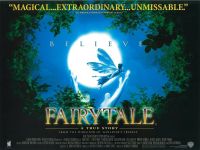
- FairyTale: A True Story

Sir Arthur Conan Doyle, and two of his friends, the theosophist Edward Gardner and the escape artist Harry Houdini are portrayed currently on movie screens across the land. Afonner Meyers went to see the film.
A review by Doug Elliott M. Bt.
Fairytale - A True Story is a fictionalized account of the Cottingley Fairies, a true story that came to the public's attention in 1920 through the agency of the world's most famous Spiritualist, Sir Arthur Conan Doyle. In the spring of that year, Sir Arthur was shown some photographs that showed two young girls in the company of tiny humans sporting translucent wings. The pictures had been taken in 1917 by the girls themselves, Elsie Wright, 16, and her cousin Frances Griffiths, 10, near the Wright home in Yorkshire.
Conan Doyle was immediately intrigued. His Spiritualist beliefs admitted to the possibility of any number of spirit phenomena and he further convinced himself that two charming young English girls could not possibly be guilty of such deception. Experts pronounced the photos genuine and Sir Arthur went inunediately into print, first with "Fairies Photographed" in the December issue of Strand, and then with a book, The Coming of the Fairies, in 1922. Conan Doyle's support of the photos earned him a good deal of ridicule. Nonetheless, he went to his grave with his belief in their genuineness unshaken.
In 1983 the girls finally came clean. They had photographed pictures of fairies cut out of magazines and propped up with hat-pins. (Like one of Holmes' clever deductions, it all seems so obvious in retrospect: in one photo a pin head can be clearly seen on a diminutive elven navel.)
The idea for Fairytale was pitched to producer Wendy Finerman (Forrest Gump) in 1990 by writers Albert Ash and Tom McLoughlin. Inunediately captivated, she brought in screenwriter Ernie Contreras and director Charles Sturridge (television's Gulliver's Travels and Brideshead Revisited) to realize this story of magic, deception and childhood innocence.
The film takes a number of liberties with the actual events. Harry Houdini becomes a major character who investigates the affair along with Sir Arthur. In reality, though Conan Doyle spoke to Houdini in England in early 1920 about the photos, Houdini's response is not recorded and there is no evidence that he was particularly interested. The screenplay also compresses the time-scale, making a continuous narrative of several events that stretched from 1917 to 1922. It also introduces a "bad guy", marauding reporter John Ferret (Tim McInnerny), who is determined to catch the girls in their deception. There are also real fairies.
Watching the film, I shared the theatre with a horde of young girls and their mommies. There was a continuous chatter of young voices in the auditorium throughout the film, diminishing when the two girls or the fairies were on screen and increasing when grownups were involved. It was clear that the film was only partly successful in captivating children. The anguish of war-time England and the personal battles of Elsie's parents are completely lost on young audiences.
To a Doylean, the film also offers very little. Peter O'Toole who, despite artful makeup, looks nothing like the 58-year-old Conan Doyle, is given little material to work with and does not even attempt Doyle's soft Scottish accent. His one big scene occurs after the photos have been declared genuine. Asked what they should do next, Conan Doyle pronounces, 'We must publish!" Beyond that, O'Toole's job seems to be to look genial and grandfatherly.
Harvey Keitel as a somewhat pudgy Houdini has a much meatier part, brings magic and deception into the mix. Keitel plays down the flamboyant escape artist, expressing little of the real-life ego and abrasiveness that Houdini could exhibit when confronted with Spiritualist phenomena.
The film itself never seems to find its focus. The plot flits like an errant fairy from the grim reality of wartime England to the delightful woodland stream to the girls' shared secret to Houdini's London stage show. Says co-producer Bruce Davey, 'One of the wonderful things about the story of Fairytale - A True Story is that there is something for all ages." Ultimately the film's failing is that it tries to be something for everyone and ends up being not quite enough for anyone.
Along with its failings, the film has some nice touches. The two young actresses, Florence Hoath as Elsie and Elizabeth Earl as Frances, work well together, and their moments with the fairies are delightful. The rest of the characters, particularly the gentle, permanently-confused Arthur Wright (Paul McGann) and his haunted, grieving wife Polly (Phoebe Nichols) are well-portrayed and convincing. The atmosphere and the times are recreated in loving detail, and the fairies, darting and swooping, seemingly weightless, are wonderfully believable. Watch for a surprise cameo at the end of the film.
To enjoy Fairytale - A True Story you need to bring the right parts of yourself to your seat. Leave the picky analytical Sherlock Holmes at home and bring only your inner child. If you can suspend your disbelief for two hours, you will find wonder and magic aplenty, This, of course, has nothing to do with Sherlock Holmes.
- Article courtesy The Bootmakers of Toronto.

