Review:Medical Casebook of Doctor Arthur Conan Doyle/David Stuart Davies
This review of the book "Medical Casebook of Doctor Arthur Conan Doyle", by Alvin E. Rodin & Jack D. Key was written by David Stuart Davies and published in the A.C.D. - The Journal of The Arthur Conan Doyle Society (Vol. 1, No. 1) in september 1989.
Review


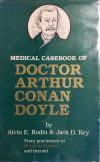
- Medical Casebook of Doctor Arthur Conan Doyle
- by Alvin E. Rodin & Jack D. Key
- Krieger, 1984; 473pp., U.S. Dollars 33.50

Reviewed by David Stuart Davies
Many of us come to Conan Doyle through the character of Sherlock Holmes — through the shadow to the substance. Consider then, the genius that could create such a vivid shadow, one that has in time helped to mask the creator. The 'Medical Casebook' considers Conan Doyle not just as the progenitor of the Baker Street detective, but also as a unique figure whose medical interests and expertise pervaded his whole career. The authors maintain that Conan Doyle was always Doctor Conan Doyle. Indeed they quote the man himself who lay very little store in honours and titles as affirming: "The title I value most is doctor"
.
In a biographical survey, this book lays the myth perpetuated by several biographical accounts, that Conan Doyle was only an adequate physician; that he saw few patients; and had minimal medical dills. That Conan Doyle was not just a 'run of the mill' medical student at Edinburgh University is shown not only by his highly respectable final grades and the fact that in those days half the student body failed to complete the course but also, because of his desire to ease straitened circumstances at home, he compressed the classes for a year into six months in order to "earn a little money as a medical assistant."
What is not shown in the examination results is the humanism of the man: a prerequisite for any successful medical practitioner.
'In his autobiography, D. Marinus stated that: "Conan Doyle impressed me chiefly by his very kind and considerate manner towards the poor people who came to the out patient department, whom I'm afraid some of us were in the habit of treating somewhat cavalierly." This is indeed high praise for a medical student of any era.'
Consideration for others, particularly those worse off than himself is seen in all Conan Doyle's actions throughout his crowded life: from Edalji, where his knowledge of opthalmics was invaluable, to Slater, from his patients at Southsea, to the British soldiers in the Boer War for whom Conan Doyle provided much needed medical assistance. Indeed, in the African conflict the blend of medical knowledge, crusading zeal and literary talent came together in 'The War in South Africa — Its Cause and Conduct' which, the authors maintain, was responsible for 'turning the world opinion in favour of Britain.' They state convincingly that during the Boer War Conan Doyle was a war historian, a patriot, a medical writer of great prescience who 'placed the patient above politics and protocol'.
The book even traces the relationship of Conan Doyle's interest in Spiritualism to medicine, including the recording of the pulse variations of mediums during trance to seek out frauds.
After the biographical section the authors chart with comprehensive aplomb the use Conan Doyle made of his medical knowledge and interest in his writings, both fiction and non-fiction. Rodin and Key are able to show that even the non-medical fiction reveals the writer as an experienced physician who draws, not merely on his early learning but also one who kept in touch with the leaps and bounds medical science took as it made its revolutionary progress from the Victorian Age into the Twentieth Century. For example, in The Ring of Thoth (1890), the original mummy story, Sosra the son of the Priest of Osiris injects himself with a serum he has developed as a protection against the epidemic of the white plague which was sweeping the Egypt of 1600 B.C. This substance 'would endow the body with strength to resist the effects of time, of violence or of disease.' Unfortunately for Sosra, this renders him immortal, while his love, Atma, refusing the serum, dies. It is in the Nineteenth Century that Sosra at last finds the ring of Thoth which contains the antidote to his longevity. He dies embracing the mummified body of his love, Atma. The authors of the 'Medical Casebook' make the following observation:
'This rather fanciful tale of faithful love over the centuries is characteristic of Conan Doyle's ideals of romance and enduring love. It is also related to his non-fiction article 'Life and Death in the Blood' published seven years earlier. The universal preventative of Osiris is the fictional equivalent of vaccination material which Conan Doyle predicted would eradicate infectious diseases (and in some instances has).'
In 'The Casebook' there is obviously a close look at the stories in Round the Red Lamp as well as physicians in his non-medical fiction. And of course there is a large section on 'Conan Doyle, Holmes & Watson.' If there is a medical slant in anything Conan Doyle wrote, however oblique, it is referred to. The copious notes and appendices that complete the book further add to the wealth of information presented by the authors.
No matter what previous knowledge and conception the reader has of Conan Doyle before picking up this fascinating book, on completing it he will not only be a great deal wiser but also filled with further admiration and astonishment regarding the man who was Arthur Conan Doyle: a man who said "There's hardly anything that doesn't interest me."
This book clearly demonstrates that to be true.
The authors have done a splendid job: the attention to detail and scope of reference is most impressive. It is a pleasure to read such a scholarly book — as without doubt this is — and find it enjoyable and well written. So after scholarship goes hand in hand with dense, convoluted prose that has an inbuilt resistance to interpretation. Not so here.
It's a must for the Conan Doyle bookshelf.
- Article courtesy Christopher Roden, founder of The Arthur Conan Doyle Society (1989-2003).

