Review:Nova 57 Minor/Christopher Roden
This review of the book "Nova 57 Minor", by Jon L. Lellenberg, was written by Christopher Roden and published in the A.C.D. - The Journal of The Arthur Conan Doyle Society (Vol. 1, No. 3) in september 1990.
Review

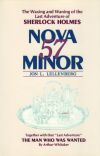
- Nova 57 Minor
- The Waxing and Waning of the Last Adventure of Sherlock Holmes
- by Jon L. Lellenberg
- Gaslight Publications. 1990; 107pp.; U.S.$15.95
- Available direct from Gaslight Publications, 626 North College Avenue, Bloomington, Indiana 47404. Add $1.25 for shipping in U.S. or $3.00 surface mail to U.K. and elsewhere. (Visa and Mastercard accepted.)

Reviewed by Christopher Roden
While researching for his biography of Conan Doyle in 1942. Hesketh Pearson discovered a complete unpublished Holmes story entitled The Man Who Was Wanted. He described it as "certainly not up to scratch", but nevertheless included the opening paragraphs of the story in his biography. The time bomb which he unwittingly ignited, did not finally explode until August 1948, when the American Cosmopolitan magazine published the adventure, now retitled The Case of the Man Who Was Wanted, describing it on the magazine's cover as "A hitherto unpublished story by Sir Arthur Conan Doyle."
As the story behind the story unfolds, we learn that Pearson had subsequently heard from a Mr. Arthur Whitaker in September 1945, and had learnt that Whitaker was, in fact, the true author of the story. Proof of Whitaker's authorship later emerged and was to be supported by the incontrovertible evidence of Conan Doyle's own letter to Whitaker, dated 7 March 1911, in which he offered 10 guineas adding:
- Sometimes I am open to purchase ideas which I lay aside and use at my own lime in my own way.
Jon Lellenberg has crafted a superb piece of journalism to produce an attractive, well-illustrated and well-written book which relates the history of the story from discovery to publication, and discusses the arguments which raged over its authenticity.
Of particular interest to followers of Conan Doyle biography, will be the reticence of Hesketh Pearson to become involved in the affair. Pearson's actual involvement, and the animosity which came to exist between him and the Conan Doyle brothers following the publication of Conan Doyle — His Life and Art, receive full coverage which adds a further interesting perspective to the story.
Nova 57 Minor is certainly an important contribution both to Doylean and Sherlockian writing, a contribution for which Mr. Lellenberg is to be congratulated. This slim, but important volume, should be considered a must by anyone with more than just a passing interest in his subject.
- Article courtesy Christopher Roden, founder of The Arthur Conan Doyle Society (1989-2003).

