Review:Oscar Slater: The Mystery Solved/Christopher Roden
This review of the book "Oscar Slater: The Mystery Solved", by Thomas Toughill was written by Christopher Roden and published in the A.C.D. - The Journal of The Arthur Conan Doyle Society (Vol. 4, 1993).
This review examines Thomas Toughill's Oscar Slater: The Mystery Solved, which reassesses the 1909 murder conviction challenged by Arthur Conan Doyle in light of newly released government records. It highlights the book's detailed reconstruction of the miscarriage of justice and its broader implications for modern criminal investigation and legal reform.
Review


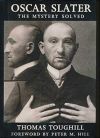
- Oscar Slater: The Mystery Solved
- By Thomas Toughill; Foreword by Peter M. Hill;
- Canongate, Edinburgh, 1993; xiv + 242pp; £13.99, ISBN 0-86241-4512

Reviewed by Christopher Roden
In 1909, Oscar Slater, a German Jew, was convicted and sentenced to death for the brutal murder of Marion Gilchrist, an elderly Glaswegian spinster. It is a case of interest to us because of the involvement of Sir Arthur Conan Doyle, who agitated discussion of Slater's case in the Press and importuned successive Scottish secretaries over the injustice of the case. The facts of the case, and the subsequent miscarriage of justice, are well known and need not be repeated here. Indeed, why, it may be asked, is there a need for a further study of a murder which took place some eighty-five years ago, when Slater himself has been dead for over three decades? The answer is a simple one: the official government records of the case were released in 1989, thus allowing a study of all the available documentation for the case and the naming of a previously unconsidered suspect as the true murderer of Marion Gilchrist.
Toughill may be forgiven for covering old ground — he presents the case in minute detail, adding relevant questions and comments as his story progresses. He pays full attention to matters which were conveniently overlooked during Slater's trial, and places strong emphasis on the importance of the contribution of John Thomson Trench, the police officer who became just as much a victim of events as Slater himself.
But, whilst all of this makes highly interesting reading, it is the book's deeper implications which are most impressive. It would be a simple matter to believe that miscarriages of justice, such as that seen in the Slater case, could not happen today. But that would be too naive in a society where we see our police forces' reputations ripped apart by the actions of corrupt officers; where terrorist suspects are released from long prison terms because their Appeals have shown the evidence against them to be, at best, suspect; and where, despite the availability of strong evidence in his favour, Michael Hickey has been refused a review of his case by successive Home Secretaries, with the result that he remains incarcerated for his alleged murder of newspaper-boy Carl Bridgwater.
Elsewhere in this edition of ACD, a U.S. criminologist makes use of Sherlock Holmes's quotes in identifying areas where investigating police officers should 'always look for a possible alternative and provide against it. It is the first rule of criminal investigation.' If Toughill's highly plausible solution to the Gilchrist murder is correct, the possible alternative in the Slater case was very much Slater himself and every conceivable effort was made to ensure that other, more likely, alternative possibilities were completely suppressed.
Toughill's book is lavishly illustrated and includes a gruesome, previously unpublished, photograph of the body of Marion Gilchrist as it was when discovered. Although we learn nothing new about Conan Doyle's involvement in the case, there is a wealth of thought-provoking information here. The volume will, I have no doubt, come to be regarded as being as important as previous studies by William Roughead, Conan Doyle, William Park and Peter Hunt.
- Article courtesy Christopher Roden, founder of The Arthur Conan Doyle Society (1989-2003).

