Review:Scream for Jeeves: A Parody/Owen Dudley Edwards
This review of the book "Scream For Jeeves: A Parody", by P. H. Cannon was written by P. H. Cannon and published in the A.C.D. - The Journal of The Arthur Conan Doyle Society (Vol. 5, 1994).
This extended critical review examines Scream for Jeeves, a parody blending P. G. Wodehouse and H. P. Lovecraft, and reflects on the literary connections between those writers and Arthur Conan Doyle. It praises the artistic success of the parody while engaging in a broader discussion of intertextuality, influence, racism in popular fiction, and the complexities of political correctness in literary criticism.
Review


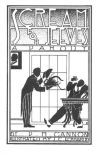
- Scream For Jeeves: A Parody
- by P. H. Cannon; Illustrated by J. C. Eckhardt.
- Wodecraft Press, 1994; 87pp; U.S.$7.50 (Paperback), U.S.$20 (Hardcover). ISBN: 0-940-88460-7
- Distributed by Necronomicon Press, P.O. Box 1304, 101 Lockwood Street, West Warwick, Rhode Island, U.S.A., 02893. (Credit cards accepted).

Reviewed by Owen Dudley Edwards
Our relevance to these felicitous apocrypha of P. G. Wodehouse and H. P. Lovecraft lies chiefly in the essay which concludes the work: The Adventure of the Three Anglo-American Authors: Some Reflections on Conan Doyle, P. G. Wodehouse, and H. P. Lovecraft'. As has been heavily stressed in several volumes of The Oxford Sherlock Holmes, Wodehouse was ACD's disciple, and arguably his most successful one. Lovecraft's specific debts to ACD are less obvious, but are certainly discernible. In his admirable essay 'Supernatural Horror in Literature', Lovecraft observed that
- Doyle now and then struck a powerfully spectral note, as in 'The Captain of the Pole-Star', a tale of arctic ghostliness, and 'Lot No. 249', wherein the reanimated mummy theme is used with more than ordinary skill.
(' ... more than ordinary' is in itself a pleasingly chilling accolade from a writer of horror fiction.) The student of ACD's influence on Lovecraft may hence conveniently begin with these two items, respective areas of their generic impact being most obviously the long Lovecraft stories 'At the Mountains of Madness' (Antarctic ghostliness) and 'The Case of Charles Dexter Ward' (the reanimated daddy or at least great-great-great-great-great-grand-daddy — theme).
Intertextuality is one of the most important and (in the hands of many of its practitioners) one of the least comprehensible critical fields under current pioneer research. For several reasons, then, it is a pleasure to salute Mr Cannon's work, his methods being infinitely more accessible and infinitely more persuasive than any treatise, at least for the Wodehouse-Lovecraft stage of the operation. He begins with three Lovecraft stories retold with what Lovecraft himself would have termed 'a mutation and a madness' as by Bertie Wooster. These show some distressing slips (such as 'Glossup' for 'Glossop', all the more deplorable given the unquestionable relevance of the famous 'nerve specialist' (aka 'loony-doctor' in Woosterian lingo) to the facts in the cases of Mr Lovecraft). But the performances are quite astonishingly successful, more so than any Wodehouse parodies known to me save possibly the apocryphal sequel to 'The Great Sermon Handicap' in Hugh Kingsmill's The Table of Truth (which also holds excellent Hornung-ACD parodies assuming a Raffles-Holmes confrontation). The sureness of touch is evident in the very titles, as Lovecraft's 'The Rats in the Walls' becomes 'Cats, Rats and Bertie Wooster', 'Cool Air' is warmed into 'Something Foetid', and 'The Case of Charles Dexter Ward' supplies 'The Rummy Affair of Young Charlie' although the story under scrutiny proves to be 'The Music of Erich Zann'. (Wodehousians will appreciate the graceful homage to the non-Wooster titles Pearls, Girls and Monty Bodkin and (from the Mulliner cycle) 'Something Squishy' as well as to the Woosterian 'The Rummy Affair of Old Biffy'.) The mastery is clear from the result: only great parody induces even deeper appreciation of the original, and these unquestionably enhance our regard for Wodehousian style and Lovecraftian plot. Mr Cannon flirts happily with other Lovecraft texts, such as the ape-ancestor tale of 'Arthur Jermyn' (reflecting a Rider Haggard influence, though surely also the cameo of Challenger's likeness to the ape-king in The Lost World): that Lovecraftian errand into Debrett is deliciously slid into the Drones Club showing the value of simian descent for swinging across the swimming-bath where B. Wooster so notoriously fell in.
The glory of these three masterpieces should make Cannon volleyed and thundered wherever the names of great Wodehousians are bandied. And it is this positive achievement we must keep before our eyes, despite reservations on the prose essay which follows the trinity of pseudo-Wooster. Nature intends Mr Cannon to be an artist, and if he must also be a critic, it can only be critic-as-artist. Criticism unvarnished is not his forte, nor his piano. As an artist his homage to ACD is as graceful as the rest-Wooster and Jeeves in the Zann episode find an ally in a mysterious Irish-American with the very unIrish name of Altamont: and very properly he speaks more in the style of the Wodehouse Punch version of an Americanized post-Reichenbach Holmes (Oxford Sherlock Holmes-His Last Bow, Appendix) rather than in that of 'His Last Bow' itself. But in essay form Mr Cannon maunders, paying ludicrous attention to absurd hypotheses such as Frances Donaldson's that 'out of every ten Wodehouse addicts only one will be a woman'. Taking only the obvious course of sampling writers, we promptly diagnose Dorothy L. Sayers, Agatha Christie, Margery Allingham and Georgette Heyer as infected and infectious cases of pietas Wodehousianilla vulgaris where post-ACD male detective fictionists require much more protracted tests. Having been infected with the Wodehouse habit by my own Irish mother, I am as unenthusiastic about this Cannon thesis as about its author's 'Doyle, Wodehouse, and Lovecraft, to begin by stating the obvious, share a common Anglo-Saxon heritage, notwithstanding Doyle's Irish ancestry' (which is like saying that Mary, Joan and Anne resemble each other in having fair hair, notwithstanding Anne's red hair). Mr Cannon is on sounder ground (his own) when citing common American interests and experience for the trio, though to complain that the American 'subplots' for A Study in Scarlet and The Valley of Fear are 'long (and tedious)' wins him few friends here.
But the most alarming aspect of Mr Cannon's essay lies in its foray into Political Correctness, and since his book in the main is so admirable a work, whence our duty to encourage its widest circulation, this is a good time to raise general points on the question. Twenty years ago questions of racial prejudice in analyses of popular fiction were widely dismissed by the prevailing gurus. 'Everybody wrote like that then', or 'Bloggs was not really racist in contrast to Snoggs', or 'it was the characters, not their author, who were racist' commonly did duty for critical thought on the question. It was not hard to diagnose that critics of this kind were unlikely to resign from their clubs on discovering that those clubs were for whites/gentiles/Anglo-Saxons only. It is still thrilling to recall the courage with which exceptions such as Colin Watson or D. Martin Dakin ploughed their lonely furrows through the luxuriant crop of rank weeds, and it was a privilege for me to serve, however inadequately, as an apprentice ploughboy in their steps.
The heresy of yesterday is the orthodoxy of today, and aspirants now vie with one another in denouncing racist solecisms of the past. Demands are made for censorship, emasculation, proscription; and evidence of a racialist passage in one work becomes apparent proof of its author's life-long enthusiasm for genocide. In other words, exactly the same kind of people who tried to stifle anti-racist literary criticism twenty years ago are today screaming for unquenchable perennial auto-da-fé. (Yes, that analogy has anti-Catholic associations, and I look forward to seeing any aggrieved parties at Mass, which I attend several times a week.) Political Correctness in 1974 meant that race is not an acceptable area of literary critical analysis; Political Correctness in 1964 meant that I and people like me ought to mind their own business instead of sitting in with blacks at segregated lunch-counters, Political Correctness in 1954 meant that persons objecting to racism were Communists. I rejoice in a world which recognises that ethnic prejudice is social leprosy; I take no pleasure in finding bullies and hypocrites as omnipresent against racism as they were once in favour of it.
To say this is not to detract from the achievement of Mr Cannon, but simply to deplore his innocent deference to today's Political Commissars. To raise the question of similarities and mutual influences among ACD, PGW and HPL on the racial as on other contexts is certainly useful and, given the absolutely fundamental character of extreme racism in Lovecraft's creative thought, necessary. It is the execution which is deplorable. Mr Cannon singles out the portrait of Steve Dixie in 'The Three Gables', an object of bitter regret for many admirers of ACD (so much so that some have difficulty in believing he could have written it). But it is flagrantly unjust to bring up that case without noting the far more important point that ACD was alone in his time in extolling the marriage of black and white in 'The Yellow Face', that he shone like a beacon of truth amid a forest of lies in stripping the romance from the murderous reality of the Ku Klux Klan in 'The Five Orange Pips', and that through the mouth of a mass-murderer he forced the meaning of oppression of blacks before a white audience in 'J. Habakuk Jephson's Statement'. He had some racist spasms, not particularly surprising for a Victorian British boy in a new world on his first African voyage; and he had the honesty to face and largely eradicate his weakness, with splendid literary results. He reverted occasionally, once when in temporary thrall to Carlyle, once with Steve Dixie. Mr Cannon is handsome enough in intention: 'Doyle, a fair-minded man who often championed the underdog regardless of color'. But however well-meaning, this reduces a great affirmation in the cause of racial justice to some sort of Occasional Conformity with Political Correctness.
Lovecraft's racial ideas are central to his thought and works. Mr Cannon is no doubt correct in taking him to grow less racist with age. His early work, 'The Street', could be used as a perfect paradigm of early twentieth-century American anti-immigrant hysteria, and the theme reaches repulsive sophistication in 'The Horror of Red Hook' (1925). Yet in this case the horror-pushing immigrants are allied to a Dutch patrician of New York's first 400, and the degeneration of American or English aristocracy is a much more frequent theme with Lovecraft. Nothing from the most demented racist quite equals the horrors behind the great old family wainscots; indeed, modern degeneration is but one of the perils of nobility, time-leaping diabolist ancestors proving much more insidious. The self-destructive sickness of racialism itself in a sense gives its own answer when the spawn of antiquity is shown for what it is. But if Lovecraftian logic undermines its author's ethnic prejudice, they are loathsome to encounter nonetheless.
Mr Cannon is still at the labelling stage, and penetrates little enough of this. As a decent man, he is repelled by Lovecraft's use of the word 'nigger' and uses a corrective with charming effect in one parody. But its appearance in Wodehouse plunges him into disaster. The error is an easy one, but the term 'nigger minstrel' is not, as he imagines, a racist description of a black musician; it is a professional title of a white performer wearing black make-up. Wodehouse was simply using the professional term. Wodehouse's stage affinities do lead him to present ethnic types in a stagey context. A black lift-attendant is an appropriate destination for discarded loud socks. Psmith in Psmith, Journalist addresses a black gangster (who is climbing from an attic to a roof to murder him) as though the man were one of a black-face minstrel chorus, and indeed sings to him before hitting him on the head: the action of the British publisher in using descending stick on black head for the dust-jacket says volumes about popular standards in British racism, but not very relevantly to Wodehouse. The brilliant sendup of Pat-and-Mike cross-talk music-hall acts in The Mating Season, followed by Gussie Fink-Nottle's equally corrosive panegyric on Synge-song, is one of the most instructive comments on popular ethnic culture and its critics in modern literature; but Mr Cannon, mired in Political Correctness, apparently sees it only as a slur (thus presumably demanding the eradication from English Drama of everything stage-Irish from Sean O'Casey and Dion Boucicault all the way back to Henry V.
But what Mr Cannon misses is that his own brilliant use of the Wooster dialogue is implicit self-involvement in Wodehousian racism: for Wooster and Jeeves, while children of Watson and Homes, are also products of the stage-English stereotypes in American theatre. It's even a theme in Thank You, Jeeves that Lord Chuffnell, Bertie's friend, cannot disentangle himself from the fictional fortune-hunting stage aristocrat Lord Wotwotleigh in the mind of J. Washburn Stoker. The thing was in fact self-parody: the Wodehouse family derives from a hero of Agincourt, as do the Twistleton-Twistleton Earls of Ickenham (the Woosters did their bit in the previous century, at Crécy). Deploring as we should the occasional insensitive ethnic slur in Wodehouse, let us remember (we Irish, Catholics, blacks, Jews, etc.) that he was putting us on the same stage where he placed himself. Personally, I appreciate the compliment.
Owen Dudley Edwards
- Article courtesy Christopher Roden, founder of The Arthur Conan Doyle Society (1989-2003).

