Review:Sherlockian Bookplates/Barbara Roden
This review of the book "Sherlockian Bookplates", by W. E. Butler was written by Barbara Roden and published in the A.C.D. - The Journal of The Arthur Conan Doyle Society (Vol. 3, 1992).
Review


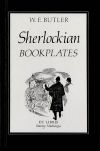
- Sherlockian Bookplates
- by W. E. Butler
- Silent Books, 1992; 57pp: £8.95, ISBN 1-85183-031-6

Reviewed by Barbara Roden
At first glance this slim volume would seem to be for completists only: surely there cannot be that much to say about Sherlockian bookplates. It is therefore pleasantly surprising to find that there is a good deal to be said on the subject, and Mr. Butler has written an amusing, informative, and highly attractive book, lavishly illustrated with Sherlockian and Doylean bookplates from around the world.
A brief account of the origins and history of bookplates, or ex libris, is included before Mr. Butler asks the question: when did Sherlock Holmes or any related Sherlockian theme first appear on a bookplate? His conclusion is that it is unlikely to be later than the first decade or so of this century, for collectors of Conan Doyle will surely have recorded their passion in some fashion on a bookplate. Sherlockian ex libris are then looked at in three sections: type of owner, technique of bookplate, and themes depicted.
The bookplates reproduced here are all arresting in their various ways, with those designed for Remo Palmirani likely to raise an eyebrow or two. The section entitled Did Sherlock Holmes have a bookplate? is a fascinating one, although Mr Butler is careful to note right from the start that the issue is a difficult one:
- This seemingly straightforward question raises most delicate issues for the Sherlockian and the bookplate collector. for we delve simultaneously into references to be drawn from the Sacred Writings, on the one hand, and into the vexed issue of fictitious or imaginary bookplates, on the other. The fact that Holmes and Watson were fictitious characters invented by Sir Arthur Conan Doyle is sufficient for the bookplate collector to dismiss the question out of hand; but let us for the moment appreciate how a dedicated Sherlockian who is not a bookplate enthusiast might approach the matter.
What follows is an approach to the solution of which Holmes himself would approve, supplemented by excerpts from a pastiche by Remo Palmirani which suggests that Holmes did have a bookplate, the copper plate of which was stolen by Moriarty!
The last section of the book is of special interest to Doyleans, concerning as it does the curious incident of Sir Arthur Conan Doyle's bookplate. Or did Conan Doyle have a bookplate? That is the curious incident. Certainly a handsome bookplate bearing the name and title of Conan Doyle does exist, and is reproduced in this book. The conclusion of Mr. Butler, and of Professor Stanley Wertheim, upon whose research Mr. Butler draws, is that the bookplate never belonged to Conan Doyle, and was in fact commissioned by Adrian Conan Doyle in 1955. Professor Wertheim calls the bookplate one of Adrian's less heralded (but more bedevilling) entrepreneurial schemes. The question that remains is, can the bookplate be considered fraudulent? After careful consideration the conclusion is 'no'. It is authentic as a bookplate, in that it contains the words 'ex libris' and is found affixed to books, and it may be authentic in establishing that a particular book once belonged to Conan Doyle. 'No intent on the part of Adrian Conan Doyle to forge his father's bookplate has been established in the sense of designing and producing an ex libris that in texture and age of paper, physical condition, or other attributes would mislead one into believing that the bookplate was contemporary to Sir Arthur and actually used by him.' If there is an element of fraud it would be in the use of the bookplates by unscrupulous people to insinuate that a particular book once belonged to Conan Doyle.
What would Conan Doyle have thought? We cannot know. Mr. Butler's closing words are, however, singularly appropriate. 'But whatever Sir Arthur Conan Doyle's view may have been of the bookplate bearing his name, he has been immortalised in a fashion which probably would have astonished him.' Doyleans, Sherlockians, and bookplate enthusiasts will all agree that this handsome book is an admirable addition to the bookshelf.
B.R.
- Article courtesy Christopher Roden, founder of The Arthur Conan Doyle Society (1989-2003).

