Review:The Adventure of the Lion's Mane/Christopher Roden
This review of the book "The Adventure of the Lion's Mane", by Sir Arthur Conan Doyle was written by Christopher Roden and published in the A.C.D. - The Journal of The Arthur Conan Doyle Society (Vol. 3, 1992).
Review


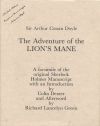
- The Adventure of the Lion's Mane
- by Sir Arthur Conan Doyle
- A facsimile of the original Sherlock Holmes manuscript with an Introduction by Colin Dexter and Afterword by Richard Lancelyn Green
- Westminster Libraries & The Sherlock Holmes Society of London. 1992; Manuscript Format, 102pp; Standard Editon £25.00, Deluxe Edtion (100 copies, numbered and signed) £100. ISBN 0-900802-15-4 (Standard), 0-900802-14-6 (Deluxe).

Reviewed by Christopher Roden
- At this period of my life the good Watson had passed almost beyond my ken.
- An occasional weekend visit was the most that I ever saw of him.
Readers will be familiar with Sherlock Holmes' words from 'The Lion's Mane' explaining why he had chosen to narrate that particular adventure himself. He originally continued:
- It is possible that he would in any case have rejected this case from his records for in his loyalty he would always dwell upon my successes. I do not think that I can look back on the adventure of the Lion's Mane with any particular personal pride and yet in its sort I place it very high among my collection.
This continuation is not the one which the reader of Holmes will instantly recognise. Yet it is the version which ACD originally wrote, before deleting just over six lines from his manuscript and replacing them with the words which have appeared since the story's first publication in 1926.
We can speak with such certainty on the matter following the recent publication of the facsimile edition of ACD's manuscript of 'The Lion's Mane', a joint project between Westminster Libraries and The Sherlock Holmes Society of London, and a companion volume to 'The Dying Detective' with which The Arthur Conan Doyle Society was involved last year.
'The Lion's Mane' manuscript reveals far more alterations than did 'The Dying Detective' but it nevertheless remains obvious that, in 1926. Conan Doyle was still writing his stories without the need for any major revisions. One may suspect that 'The Lion's Mane' was turned into a Sherlock Holmes story to satisfy a commitment to the Strand, and it seems feasible that it may have been conceived originally as a non-Holmes story. In that format a more convincing tale may have been the final outcome. ACD felt that the plot of 'The Lion's Mane' was among the best of the Casebook series: others feel that the story reveals a Johnson lost without his Boswell — or at least a Holmes floundering for the narrative style enabled by the presence of Watson. In his Introduction, Colin Dexter judges that 'The Lion's Mane' is a strong contender for being adjudged the worst in the whole of the Sherlock Holmes corpus.
The stories of the Casebook have been criticised by some commentators for their lack of sharpness it has even been suggested that ACD may not have written some of the stories himself. However, the manuscript of 'The Lion's Mane' proves most definitely that no 'second hand' was involved here, although we may note that the style of ACD's hand changes from time to time in the course of writing. A calculation on the reverse of the penultimate page shows that ACD reckoned the story's length to be 6,840 words: this would have been important to him in reckoning his fee, and serves as a reminder that the Holmes stories were not written simply for pleasure!
'The Lion's Mane' appears in two editions, as did 'The Dying Detective'. The Deluxe version has pages cut to match the original, giving an even greater impression of being close to the real thing. In either Standard or Deluxe form, it is a volume which no Sherlockian or Doylean collection should be without.
Some of those who are fortunate enough to own manuscripts may feel that further facsimile productions debase the currency. For those of us who cannot afford the vast sums which original manuscripts now command, these facsimiles are a godsend: they bring the possibilities of analysis within everyone's reach and enable a much wider audience to offer views, criticism and comment something which can only be good for the deeper study of ACD and his writings. Owners who are prepared to share their treasured possessions in this way do us all a great service and deserve our heartfelt thanks. It is only to be hoped that we shall perhaps soon have the opportunity of seeing a facsimile of a non-Sherlockian manuscript.
C.R.
- Article courtesy Christopher Roden, founder of The Arthur Conan Doyle Society (1989-2003).

