Review:The Annotated Lost World/Barbara Roden
This review of the book "The Annotated Lost World", by Sir Arthur Conan Doyle was written by Christopher Roden and published in the A.C.D. - The Journal of The Arthur Conan Doyle Society (Vol. 6, 1995).
This detailed review assesses The Annotated Lost World, examining its introduction, annotations, appendices, illustrations, and newly uncovered archival material relating to Arthur Conan Doyle's novel. It praises the scholarly apparatus and documentary discoveries while offering critical observations on production choices and illustrative reproduction quality.
Review


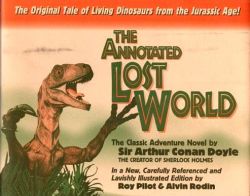
- The Annotated Lost World
- by Sir Arthur Conan Doyle
- Edited by Roy Pilot and Alvin Rodin
- Indianapolis, Wessex Press, 1996; xxiii + 264pp; U.S.$34.95; ISBN: 0-938501-23-2
- Available from Wessex Press, P.O. Box 68308, Indianapolis, IN 46268

Reviewed by Christopher Roden
Lost Worlds; lands that time forgot; the stuff from which childhood dreams are made: the material which has inspired a revival of interest in dinosaurs and pre-history — themes most recently brought to our notice by the Jurassic Park and The Lost World novels of Michael Crichton. That Crichton should be so presumptuous as to choose The Lost World for the title of his pot-boiler — without so much as a nod in Conan Doyle's direction — need not concern us here. In this instance we are concerned with what goes into the makeup of childhood dreams what it is that makes a good childhood adventure appealing to us as we pass through more mature years. That special indefinable ingredient, capable of holding us spellbound for an hour or two, was what Conan Doyle tried to express in his prefatory stanza to the book: 'I have wrought my simple plan / If I give one hour of joy / To the boy who's half a man, / Or the man who's half a boy.'
ACD should rest easy in the knowledge that The Lost World continues to bring far more than one single hour of joy to almost everyone who reads it. It is a lasting experience, despite its occasional flaws; a novel which places Conan Doyle in the forefront of authors of the science-fictional tale.
We may dream of lost plateaus whereon exist remnants of a prehistoric civilisation; we may attempt to identify possible locations for Conan Doyle's inspiration. But, of course, we are not the first to go in search of prehistory; nor was Conan Doyle the first to moot the lost world theory.
Mount Roraima, more than simply a likely contender for the title of the true 'Lost World', first captured the imagination in the first half of the last century, when Sir Robert Schomburgk reached the foot of its elevated plateau at the end of an arduous trek which lasted for several months. He discovered a huge sandstone mesa, surrounded by cliffs which were over one thousand feet high.
In 1834 the British Government engaged Schomburgk to survey and establish the border between British Guiana and Venezuela, which had been in dispute for more than sixty years. Roraima proved to be a keystone in the demarcation of the frontiers for three countries: Venezuela, Brazil and Guyana. Schomburgk travelled great distances in his work, encountering many sights which must have fuelled his imagination. He describes his first view of Roraima thus:
- Before sunrise and half an hour after, Roraima was beautifully clear, which enabled us to see it in all its grandeur. Those stupendous walls rise to a height of 1,500 feet. They are as perpendicular as if erected with a plumb-line; nevertheless in some parts they are overhung with low shrubs which, seen from a distance give a dark hue to the reddish rock. Baron von Humboldt observed that a rock of 1,600 feet of perpendicular height has been sought for in vain in the Swiss Alps, nor do I think that Guiana offers another example of that description. A much more remarkable feature of this locality, however, lies in the cascades, which fall from their enormous height, and, strange as it may appear, afterwards flow in different directions into three of the mightiest rivers of the northern half of South America, namely the Amazon, the Orinoco, and the Essequibo. ... for these wonderful cascades Roraima is famed among the Indians who in their dances sing of the wonders of 'Roraima, the red rock, wrapped in clouds, the ever fertile source of streams'. I can imperfectly describe the magnificent appearance of these mountains. They convey the idea of vast buildings and might be called Nature's forum.
Roraima certainly caught the imagination. In 1874, we find that the Spectator had urged:
- Will no one explore Roraima and bring back to us the tidings which it has been waiting these thousands of years to give us? One of the great marvels of the mysteries of the Earth lies on the outskirts of one of our colonies-British Guiana-and we leave the mystery unsolved, the marvel uncared for.
During the period between 1879-84, Henry Whitley, a keen ornithologist, did visit the Roraima area, and he reported as follows:
- The savannah land at the foot of Roraima is covered with immense boulders and smaller pieces of sandstone. These have evidently at some remote time broken away from the face of the rocks and although I made inquiries amongst all the old Indians, some of whom had been in the service of Sir Robert Schomburgk forty years ago, not one of them had ever seen a part of the rock break away, and they told me that they must have fallen away ages ago, for they have no record of any such circumstance from the tales of their ancestors
- The scenery around Roraima is very grand; rain was constantly falling on Roraima and Kukenaam during the greater part of my stay in the neighbourhood, and for days together the mountains were enveloped by clouds; at times, when it cleared, waterfalls were observed coming over the edge of the cliff, and when the sun was shining, the deep red colour on parts of the vertical sides, standing out as they did from the sombre coloured forest on the lower slopes, was seen to great advantage. It seems impossible to ascend either Kukenaam or Roraima except by balloon and this could only be done from the south side, on account of the strong wind constantly blowing from that direction. It might be possible to ascend by forming scaffolding, making use of the timber of the large forests on the slopes, but in this case it would be the work of great time and expense.
Here, possibly, is a description which helped Conan Doyle in the writing of his novel. ACD's love of history may also, however, have led him in the direction of Sir Walter Raleigh, who was probably the first white man ever to write about the area (though it is doubtful that he ever saw Roraima):
- I was enformed of the mountain of Christall, to which in truth for the length of the way, and the evil season of the yeare, I was not able to march, nor abide any longer upon the journey: we saw if farre off and it appeared like a white church towre of an exceeding height. There falleth over it a mightie river which toucheth no part of the side of the mountaine, but rusheth over the top of it, and falleth to the ground with a terrible noyse and clamor, as if 1,000 great belles were knockt one against another. I think there is not in the world so strange an overfall, not so wonderful to behold. Berreo told me it hath diamonds and other precious stones on it, and that they shined very farre off: but what it hath I knowe not, neither durst he or any of his men ascende to the toppe of the saide mountaine, those people adjoyning beeing his enemies and the way to it is so impassible.
Roraima was climbed, in 1973, by a fairly lightweight (in mountaineering terms for those days) expedition of British climbers which included Hamish MacInnes, Joe Brown, Don Whillans, and Mo Anthoine. Their climb was recorded for a BBC television film, which I recall as being somewhat disappointing-much of the climb had taken place in appalling conditions and, consequently, there were few really exciting photographic sequences in the film. Hamish MacInnes preserved his memories of the expedition in Climb to the Lost World (Hodder and Stoughton, 1974; Penguin, 1976), a book which, somewhat surprisingly, the present editors seem to have overlooked in their tireless search for background information. MacInnes details the impressions of Roraima's summit:
- 'It's incredible,' he [Mo Anthoine] gabbled excitedly. 'Like a bloody great aircraft carrier.'
- He hauled the bags up, and shortly afterward Joe and Don joined us on the plateau. ...
- ... We dumped our gear and started to walk across the level plateau. It was a dark, bare table top, variegated by tiny shallow pools and sunken gardens. ... The Prow had been well-named. From the top, also, it resembled the bows of a ship jutting out over a verdant sea. We stood on the brink, sensing a dangerous magnetic attraction in the drop below us. ...
- ... We walked about feeling strangely unrestricted: there were no roots, no jungle, no vertical drops ... just flat rock. We saw a magnificent panorama of mesas: a weird contorted skyline of grotesque sandstone figures towards the Venezuelan part of the summit. We looked along the edge of those fantastic cliffs and saw the waterfalls tumbling down into the Paikwa watershed. About a mile distant was the Diamond Waterfall. There were hidden gardens containing naturally executed statues, fashioned by the omnipotent forces of wind, water and time. There were rocks which resembled igloos. The conglomerate capping the summit was striking: white pebbles stood out in the washed and wind-blown sandstone. ... We gazed into shallow pools — like dark mirrors — which, for the first time, reflected man, and watched, fascinated, small black frogs. ... There was always something new of interest. It was a wonderland like nothing on earth. For me, Roraima is still one of the wonders of the world. What lay in the bottom of some of those deep crevices? In successive ages of erosion the water has cut fantastic channels within channels in the depths of these chasms. There were various levels of chambers; it was like staring down into opera boxes, all delicately carved in arches and scrolls. The point of the Prow is probably the flattest on the whole summit. The crevices became progressively deeper and more frequent as Don [Whillans] and I moved onwards. To continue, one would have needed ropes and climbing equipment.
- ... Normally when one climbs a mountain, or makes a first ascent, there is little memorable about the summit in itself. An isolated point on the earth's surface, where someone may or may not have been before. You go up and you come down. It is rather like opening and closing a door; a fine view is often glimpsed for a short period. The Roraima trip was quite different in this respect. We were in alien country all the time. It was a new and fascinating environment, with the novelty of discovering plants and insects, many hitherto unknown to science. The climbing was as hard as anything we had experienced before; the conditions only comparable to those at high altitude in sheer misery. To arrive on that fairyland summit after such a gruelling passage was enough to make anyone feel light-headed. We had climbed to the security of a huge ship, out of a slimy sea...
But enough of the past from me — Pilot and Rodin adequately cover possible sources of inspiration in their very detailed Introduction to this book. They discuss the possible models for the explorers themselves: Lankester, Casement, Rutherford, Budd, etc.: possible sites for the lost world of which Conan Doyle writes; the inhabitants of the Lost World; the influence of the story itself; and The Lost World as literature. With regard to the latter, I reserve my judgement: I have always felt that The Lost World was a classic adventure yarn, rather than pure literature, a term I would apply to the Sherlock Holmes stories, Micah Clarke, The White Company and others of Conan Doyle's works. I personally do not think that ACD ever intended it to be more than a ripping adventure, and I am not at all surprised that the novel is not more highly rated as a work of literature. Our editors feel otherwise — but when one is around a particular work for so long, one becomes all absorbed and perhaps less ready to stand back and view the overall quality of the work against genuine claimants of the term 'literature'. That view does not lessen my regard for The Lost World — I just happen to be slightly less enthusiastic about its merits as 'literature' than are the editors.
Merits aside, what is really memorable about The Lost World is our introduction to Professor Challenger. After Sherlock Holmes and Dr. Watson, Challenger is the finest of Conan Doyle's creations (even if Brigadier Gerard does run him a close third), and it is interesting to note that Dame Jean Conan Doyle, in a prefatory message for this book, compares Challenger to a description we are given of Mycroft Holmes: 'It is as if you met a tramcar coming down a country lane.' It is not, it seems, possible to escape the omnipotence of Sherlock Holmes — he truly is everywhere.
In Challenger, Conan Doyle found a means of escapism: it was the Challenger character, it will be remembered, that he adopted to fool his brother-in-law, Willie Hornung. And it is on the subject of Conan Doyle as Challenger that this volume really shines: the editors devote a whole appendix to the physical contribution that Conan Doyle made to The Lost World. They have unearthed from The Berg Collection, in New York Public Library, photographs and illustrations provided by Conan Doyle for the photographer to work from, and also the photographs which formed the constituent parts of the final frontispiece for the first edition. All of this makes fascinating reading-the volume is worth its price for this material alone. As always, however, a definitive volume invariably becomes out of date! Unknown to the editors when the book was in preparation, there exists an earlier photograph of Challenger. This was posed for by one Wilfrid Dalziel, and a copy of the photograph is pasted into Dalziel's copy of the book which was recently acquired by the Lancelyn Green collection. Slowly, the jigsaw of The Lost World fits into place. There is, I am sure, much work still to be done — Conan Doyle is a continual learning process.
A further appendix is devoted to the 1925 film version of The Lost World, and this provides some fascinating insights into the making of the film and its early screenings: Conan Doyle's showing of dinosaur sequences to the Society of American Magicians in June 1922; the premiere of the film in London in June 1925; the fact that The Lost World was the world's first in-flight movie, being shown to a special party which flew from Croydon aerodrome on 7 April 1925; and the fact that the film is the first to successfully use rear-projection, which it did in one single scene.
The appendices also provide a chronology of the adventure and a discussion of how Edwin Ray Lankester's Extinct Animals may have been an influence on The Lost World.
Annotating a volume — whoever the author — can be a tricky business. What one person regards as essential, another will regard as commonplace. I recall long hours spent debating exactly what should be annotated when The Oxford Sherlock Holmes was in preparation — and even then we might have felt that we had over-annotated in some instances. Pilot and Rodin seem to have the balance about right in this volume: their annotations provide a great deal of useful background information, though in one instance the information is wildly inaccurate in discussing the modern day value of £200,000 (the valuation of the diamonds brought back from the lost world), an arithmetical error has led to their being assessed at $600,000 rather than the more accurate figure of around $15,000,000. It may be a trivial error to which to draw attention, but people do tend to rely on such information. But if there is a major benefit to annotation in a volume of this nature, it is the opportunity to include illustrations. Illustrations there are in abundance: from Rountree's original drawings from the Strand to the complete set of Joseph Clement Coll's illustrations for the American serialisation in The Sunday Magazine. I am delighted to see them all there, even though from them stems my major criticism.
Let me say that the book's production is excellent it is a quality production; there can be no question of that. The collecting together of all the illustrations is a long overdue task, and I, for one, am delighted to praise the effort which has gone into including them in this book. The detail and excitement which Rountree managed to convey in his Strand work adds something very important to the serialised work. Despite all the efforts that have been made, however, there is a downside to my praise: somehow, the illustrations, as reproduced here, fail to generate quite the same excitement, and I believe there are two good reasons for this. From the point of view of reproducing any illustrations to a high quality, it is essential to choose the correct paper, especially where the originals are of questionable quality — and, whilst the Strand's illustrations are adequately produced for that magazine, they are notoriously difficult things from which to achieve good reproduction. With that in mind, therefore, the choice of paper becomes all the more vital. Unfortunately, the paper chosen for this volume, and the size to which the illustrations have been reduced, does both Rountree and Coll less than justice. Let's be under no misapprehension: Rountree's illustrations for the Strand were superb in every detail. It is a little disappointing, therefore, that on the first occasion that they have been gathered together in a quality publication they should be given less than the treatment they deserve. There surely was a way to ensure that illustrations which occupied a full page in the Strand should appear in larger format than they do here.
The book is published in a landscape format, which some collectors may regard as less desirable than the standard portrait format: those who collect do so hate to see uneven lines of books on their shelves! However, The Annotated Lost World is a book that Doyleans will want to have. Indeed, its new material makes it an essential addition to the Doylean library. Here is one of the most significant pieces of Doyleana to emerge in recent years — one which I commend highly. Both Roy Pilot and Alvin Rodin have devoted many years of hard work to bringing this project to fruition. They are to be praised: it truly is a splendid effort. Praise too is due to Wessex Press: this is their first publication — and a very worthy and attractive production it is, too.
Christopher Roden
- Article courtesy Christopher Roden, founder of The Arthur Conan Doyle Society (1989-2003).

