Review:The Annotated Lost World/Doug Elliott
This review of the book "The Annotated Lost World", by Roy Pilot & Alvin Rodin was written by Doug Elliott and published in the Canadian Holmes (Vol. 20 No. 1, Autumn 1996).
Doug Elliott warmly praises The Annotated Lost World by Roy Pilot and Alvin Rodin as a richly illustrated, insightful, and deeply enthusiastic edition that enhances Conan Doyle's adventure novel with valuable annotations, historical context, and scholarly commentary while preserving all the excitement and wonder of the original story.
Review


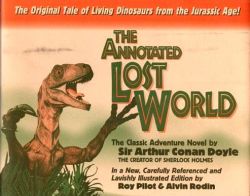
- The Annotated Lost World
- by Sir Arthur Conan Doyle
- Annotated, with an Introduction by Roy Pilot and Alvin Rodin
- Wessex Press, Indianapolis, $50 (U.S.$34.95) ISBN 0-938501-23-2

Confession time: I love The Lost World. I love its unrelenting pace, its innocent playfulness, its sense of wonder and amazement at every turning. I love the hearty tum-of-the-century male-bonding friendships, no longer possible to write about outside of parody. I love the crisp clean spare style. I am endlessly fascinated by the annoying, irascible and hilarious Professor Challenger. I love the skill of the author that permits me, though I know the premise and many of the details to be plainly impossible, to suspend my nineteen-nineties skeptical judgement and be carried along by the pure storytelling of it. I love Conan Doyle's sense of humour, his not-so subtle satire of academe, his gentle ribbing of every character in turn, his mischievous masquerade as Challenger for the publicity photos. I love the attention to detail, that seldom-explored territory where genius lies. I love to follow the countless tendrils that reach out from the novel into the real world: Ray Lankester, Percy Fawcett, Wallace Beery, Willis O'Brien...
"The Lost World. If any chronicler can even write that name without a glow of pleasure, he must have the soul of a dried grape," wrote John Dickson Carr. And I, indeed, have no aspirations to raisinhood.
You might suspect me of being a biased reviewer. Truth is, I love this novel only slightly less than I love Sherlock Holmes, which is to say, plenty. Truth is, I would praise any volume that put The Lost World once again before the public even if its only virtue was adequate typography.
It is apparent at a glance, however, that Roy Pilot and Alvin Rodin have greater ambitions than simple publishing. In this handy volume there are many more delights to be added to the riches that the author provides. Let me enumerate a few.
First, a reviewer's warning: If you grinned and nodded uncontrollably at my opening paragraphs, read on. You probably can't resist anyway. If you raised your eyes to heaven, clicked your tongue and wondered how an educated middle-aged adult in 1996 can enjoy such a piece of obsolete, mindless, politically-unenlightened drivel as this eighty-year-ago minor pot-boiler which doesn't even have Holmes to redeem it, well, perhaps its time to turn the page: the rest of this review isn't any better.
The first thing one notices about The Annotated Lost World is its format. The pages are cut in an unusual 9" x 7" landscape format, the textual part of the page stretched sideways to accommodate the annotations and illustrations. It is an unusual approach and it seems to work. I found the book easy to hold and comfortable to read.
The annotations explain scientific, historical and literary allusions that might be lost on modern readers. These references are usually appropriate and helpful and often fascinating. Occasionally, when defining obsolete or obscure words, they can be overdone: most readers should understand "telepathy".
The illustrations are a joy. If, like me, you have never seen Harry Rountree's wonderful illustrations from The Strand, a treat awaits you. Using a full range of greys, these prints effectively highlight the action and mood of the story's key scenes. The reproduction, however, seems muddy at times, suggesting that the volume's yellowish, somewhat coarse paper may not be capable of rendering the subtleties of Rountree's originals. The other featured artist is Joseph Clement Coll, whose ink drawings illuminated the story in The Saturday Magazine. No subtlety here: the finely-detailed pictures are alive with action and strong dramatic lines. Coll's portraits of Challenger are particularly masterful, as wild and outrageous as the character himself.
The editors introduce the narrative with an essay on the factors that influenced the story. From possible originals of the characters and locations to the use of Edwin Ray Lankester's Extinct Animals as an undeniable source of descriptions and drawings of dinosaurs, the introduction covers a good deal of ground.
I found one of these sources particularly fascinating. On March 14, 1910, Colonel Percy H. Fawcett lectured to the Royal Geographic Society in London about his explorations in South America. He described and showed photographs of the flat topped Ricardo Franco Hills in western Brazil that he had visited in 1908. Conan Doyle was in his audience and later spoke to Fawcett about his planned novel. Fawcett thus provided a source for the plateau setting of The Lost World as well as the character of Lord John Roxton.
Half-way through reading The Annotated Lost World, my wandering eye fell on a long-forgotten book on my library shelf. The lettering had worn completely off the spine, so I pulled it down out of curiosity. The title page read Exploration Fawcett and Percy H. Fawcett himself stared sombrely at me from a photograph opposite. For the next week I read the two books together. Fawcett's true adventures, assembled and edited from his diaries and letters by his son after the explorer disappeared in the Brazilian interior in 1925, are riveting reading. Each page brings some new wonder, deprivation, horror or high achievement. Had Conan Doyle been able to read this book while he was creating The Lost World, no doubt the adventures of the fictional company would have been enlivened as a result, and no doubt he would have been roundly criticized for an overripe imagination. Here is a case where the truth does indeed outstrip the fiction. For me, South America will never be the same.
The editors of the present volume have added four appendices containing related information. There is a discussion of Harry Hoyt's silent film of 1925 starring Wallace Beery and featuring innovative stop-motion animation by Willis O'Brien, speculation about the chronology of the story and an analysis of the specific influence of Lankester's Extinct Animals. These are all valuable additions to our understanding of the novel.
The most fascinating of these appendices is an examination of The Lost World manuscript in the Berg Collection of the New York Public Library. The editors also found in the collection notes and photographs that were used to create some of the original photographs and composite illustrations in the British First Edition of the novel. A mere six pages are devoted to this gold-mine, leaving us hungry for much more.
Conspicuously missing also is background on the novel's publication history. The biographies tell a story of Conan Doyle making a surprise visit to his sister Connie one evening, arriving in full disguise as Challenger. There must surely be more to tell about how the adventure was written and how it first saw publication.
In the end, these are minor points. The Annotated Lost World is a joy to read, both for the original story and the behind-the-scenes glimpses afforded by the supplementary material. As the editors note, "Doyle's enthusiasm for both the plot and characters of his novel went far beyond the writing of a mere adventure tale. He rarely, if ever, displayed a similar enthusiasm for his other works of fiction; and so it is undeniable that The lost World held a special place in his heart." The editors have clearly caught this enthusiasm, too, and it shines forth in their essays and notes. If you have read the story with pleasure in another form, try it again with Pilot and Rodin as your guides. You'll love it.
Doug Elliott
Master Bootmaker Doug Elliot is a former Meyers and the author of The Curious Incident of the Missing Link: Arthur Conan Doyle and the Piltdown Man.
- Article courtesy The Bootmakers of Toronto.

