Review:The Case Files of Sherlock Holmes: The Musgrave Ritual/Chris Redmond
This review of the book "The Case Files of Sherlock Holmes: The Musgrave Ritual", by Christopher Roden & Barbara Roden was written by Chris Redmond and published in the The Parish Magazine (No. 15, january 1997).
This review judges The Case Files of Sherlock Holmes: The Musgrave Ritual to be an important and often rewarding anthology, combining traditional Sherlockian discussion, new Doylean scholarship, and material on adaptations and illustrations. It praises the volume's ambition, range, and several standout essays, while noting some unevenness, omissions, and the lack of a substantial central bibliography.
Review


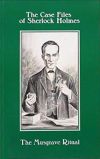
- The Case Files of Sherlock Holmes: The Musgrave Ritual
- Edited by Christopher Roden & Barbara Roden
- Calabash Press, 1995; 167pp; Hardback £16.99 (US$26.50), Paperback £10.99 (US$17.00);
- ISBN: (Hardback) 1-899562-15-X, (Paperback) 1-899562-16-8

Reviewed by Chris Redmond
In publishing a volume on 'The Musgrave Ritual' as the first in The Case Files of Sherlock Holmes, Christopher and Barbara Roden, under their corporate name of Calabash Press, have taken the first step in a long journey which we may all hope they will take to completion. Although the 'Preface' does not positively say so, the implication is that every story in the Sherlockian canon will some day be the subject of an anthology like this first one. And so the Rodens are one-sixtieth of the way to completing a series which, though its editors explicitly disavow any attempt to be 'definitive', will nevertheless be indispensable for serious readers.
As the first volume in a project that will take, at best, many years to complete, The Musgrave Ritual can and must stand on its own merits for the time being. Almost no such books-anthologies about a single Sherlock Holmes tale — have hitherto existed, although there are a few monographs that amount to chapbooks; the only anthology that springs to mind is Reflections on A Scandal in Bohemia, published by Magico in 1986. The expectations for such a collection are high: it must not be idiosyncratic or partial; it may not be definitive, but it must not ignore any major topic of interest in connection with the story under examination. It can fairly be said that The Musgrave Ritual meets the standard. It can, of course, also be said that its quality, thoroughness, style and interest are uneven; has the anthology ever seen print of which that is not true? This one ranges from the mundane (a perhaps useful listing of screen adaptations of the story under discussion) and the disappointing (a discussion of the story's chronology which really offers nothing of note) to the unexpected, the interesting and the distinctly new.
Contents of the book include a little traditional Sherlockiana, a great deal of what the editors label Doylean 'new scholarship', and some discussion of derivative creations. Purists might argue that the latter do not belong in a book that is intended to be about a story, but the results justify such inclusions. The editors can thus be commended for having found space for a detailed discussion, by Barbara Roden herself, of Sherlock Holmes Faces Death, the Rathbone-Bruce film that is loosely based on 'The Musgrave Ritual', and for a survey by R. Dixon Smith of illustrations for the stories.
'The Musgrave Ritual' is an interesting choice for the first volume in a series about Holmes's cases. Christopher Roden's introductory essay notes that it is among the more popular of the sixty stories a status that seems well established, odd though it appears to this reviewer, who has little taste for the stories that are told in Holmes's voice rather than in Watson's. (The essay by Owen Dudley Edwards later in the volume gives some attention to that characteristic of 'The Musgrave Ritual' and its effect on the reader.) It is the second, not the first, story in chronological order if one arranges the stories as they are set in the career of Sherlock Holmes; it is nowhere near the beginning of the series as they were first published, but halfway through The Memoirs of Sherlock Holmes. One suspects that it was chosen to begin the Case Files series because it is one of the stories about which Christopher Roden knows the most, from his editing of The Memoirs for the Oxford University Press edition of Sherlock Holmes two years ago. Well, there are worse reasons for writing a book, or editing an anthology, than because one knows something about the subject and has more to say than has so far found space in print.
The resulting book, a 167-page large-format paperback and hardback, contains a total of 13 essays, including a five-paragraph 'numismatic note' by Christopher Roden about the allegedly rusty coins of Charles I, which reads rather like the starting-point of a more substantial essay that the author never found time to write. Of the others, four are of sufficient interest to be given special comment.
Catherine Cooke, of the Marylebone Library where Britain's major public Sherlock Holmes collection is housed, writes about Arthur Conan Doyle's sources for the story, some in literature and some in the history that ACD must have known. Strikingly, she concludes that the history that influenced this tale has less to do with the England of Holmes, the Musgraves and Charles I than with the Scotland of ACD and Sir Walter Scott; she tells in particular of the rediscovery of the crown of Scotland in 1818 under Scott's supervision. This insight has the ring of truth, and provides a useful reminder that scholars who see Conan Doyle's Holmes as a product of London and the home counties are missing a good deal of the truth. However, 'sources' are always plural, as Cooke herself notes, and there is always more to be said. At least one odd omission in her own article leaps to the eye: she quotes from a somewhat obscure question-and-answer folk rhyme, 'The Cutty Wren', but does not mention two better known examples of the genre, the verses about Cock Robin and the bells of St. Clement's. In any case, Richard Lancelyn Green, in a later and slighter article in the anthology, points indisputably to a more important, hitherto unrecognized, question-and-answer source for the Ritual, namely the catechisms of Masonry. Some of the parallels he cites are breathtaking.
Roger Matthews presents the longest essay in the book and, if not the best organized by any means, certainly the most comprehensive. It begins with random observations on several aspects of the story, and makes a segue into one of those trigonometric discussions that exhaust and irritate all but the most compulsive Musgravians. Several drawings about the relative positions of oak, elm, old wing and new wing lead to the only possible conclusion (though Matthews presents it less explicitly than he might): that the details of the story were thrown together for artistic effect, not calculated for accuracy. Fortunately, Matthews moves on, first to a discussion of what caused Brunton's death, and finally, more gloriously, to a lively narrative of the flight of Charles II and the likely circumstances in which his crown came to be hidden at Hurlstone. Perhaps the story is less new to British readers than to North Americans, but certainly the latter will benefit from hearing it.
Owen Dudley Edwards does what he does best, unburden himself of a torrent of obscure fact, informed speculation and dramatic leap. His essay of some sixteen pages is presented not as biography, his forte, but as literary criticism, addressing the question of 'what went wrong with the original design' for this story. (Something must have done, he argues, since Conan Doyle or Watson — originally described it as a story in which Holmes 'erred', though in the end it is nothing of the sort.) He examines, exhaustingly, the context of other work done by Conan Doyle at about the same period, what he may have known and read, what themes explored in this story are also touched on in later tales, and so on. The polymathic Edwards, as always, writes densely, parentheses within parentheses, trivial but apposite detail piled upon presumption, and the result can be both illuminating and irritating. ('I have not seen his Confirmation certificate,' Edwards writes, and the reader finds it difficult not to retort: 'No, and neither have I.' Surely only Edwards, of all scholars writing about Arthur Conan Doyle, would take for granted that readers expect him to have seen everything and to know everything.)
John Hall, recovering from his chronological dullness earlier in the volume, plays the pure Sherlockian game as no one else in the volume does, observing the unlikelihood of Brunton's having opened the cellar door in pursuit of the Musgrave treasure with no other help than that of his former lover, Rachel Howells. Who, then? Hall offers an entirely reasonable answer which does not require such unacceptable conclusions as that Holmes was implicated or covering something up, or that Musgrave was playing a double game.
All this is good reading, as are the lesser pieces which space out these most important studies. It remains only to say what might be lacking in a slim volume about 'The Musgrave Ritual', apart from the text of the story itself, which the editors have quite reasonably decided to omit. (Purchasers of the recent Major Stories with Contemporary Critical Essays, by contrast, found that they had paid for a good deal more by way of major story, which they doubtless already had at hand, than by way of critical essay.) As far as scholarship and speculation go, it is always easy to suggest new lines of inquiry, if not always so easy to carry the idea through to completion. The duality of the case (murder and love) is perhaps not thoroughly explored in any of the essays here. Nor is 'The Musgrave Ritual' compared to other Holmes tales, such as The Valley of Fear, which depend on country-house conventions and some knowledge of English history. And it would not have been either a surprise or a disappointment to find an essay connecting the events of the story to 'ritual' in a religious or folkloric sense. The immurement of Brunton begs for an interpretation as ritual sacrifice, preferably by a scholar who is prepared to take into account the theory that the execution of Charles I was in formal compliance with an ancient English custom by which kings were sacrificed on certain dates. But why stop there? A dozen essays about one story cannot, as Christopher Roden sensibly writes at the beginning of this volume, possibly be the last word on the subject; there is always more to say.
The volume does not contain, and might well have contained, a substantial bibliography. Several of the essays, though not all, have bibliographies or notes or both, and a systematic collection of those references might have been useful. More than one of the authors does acknowledge the long bibliography of 'The Musgrave Ritual' collected in Ronald De Waal's volumes, but the very length of the De Waal listings argues for the preparation of a selective bibliography including only those items that a self-respecting scholar might find useful. Preparation of a central bibliography-perhaps by the editors, and perhaps at an early stage, for the benefit of contributors as well as for eventual readers-might have been of real value.
As for the physical book itself, one need only say that it is designed, typeset, printed and bound with professional quality, a statement that cannot be made of all Sherlockian books by any means. And there are several illustrations, including (besides good reproductions of Paget and Steele, movie stills and so on) four drawings by Paul Lowe. The book does not say who he is but then it does not identify the authors of the essays either-but it would appear that these four drawings are new for this book; they are an asset, and more of the same would have been welcome.
Chris Redmond
- Article courtesy Christopher Roden, founder of The Arthur Conan Doyle Society (1989-2003).

