Review:The Casebook of Sherlock Doyle/Christopher Roden
This review of the book "The Casebook of Sherlock Doyle", by Harry Stone was written by Christopher Roden and published in the A.C.D. - The Journal of The Arthur Conan Doyle Society (Vol. 2, No. 2) in autumn 1991.
Review


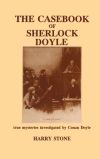
- The Casebook of Sherlock Doyle
- by Harry Stone
- Ian Henry Publications, 1991; 186pp; £15.95

Reviewed by Christopher Roden
THE CASEBOOK OF SHERLOCK DOYLE is something of a departure for Ian Henry Publications. Until now, this fast-growing publishing firm has confined itself to Sherlockian pastiche and play-scripts: a field from which they are, no doubt, reaping considerable success. The fictional world of Sherlock Holmes and the factual world of Arthur Conan Doyle are, however, far apart, despite the efforts which this book's title makes to link them. It is a misconception that anything with 'Sherlock' in the title will sell well, just as it is a misconception that anything which mentions 'Doyle' alone will not capture the interest of a wider public. And so, for me, the book fails firstly in its choice of title.
It is, perhaps, unfortunate that Mr. Stone's book should have appeared contemporaneously with Peter Costello's The Real World of Sherlock Holmes. The latter, despite its defects and shortcomings (see Richard Lancelyn Green's review in this issue) does, at least, offer a wide variety of cases which Conan Doyle may have considered, however nebulous his involvement as a 'criminologist' may have been. Stone, on the other hand, concentrates on only five cases and one of these occurred when ACD was a lively one-year-old, hundreds of miles away in Edinburgh. A comparison of the two volumes is irresistible, and Stone's book fails on the second count.
Appearance plays an important part in marketing a product and I have been critical of Ian Henry publications in the past for their failure to come up to the mark in this respect. This volume is nicely presented in a glossy two-tone dust wrapper but is let down badly by sloppy art-work and a type-face which is unattractive and difficult to read. A glossy appearance is not sufficient to justify a price-tag of £15.95 (£1 more than the nicely-produced Costello book), and Ian Henry Publications must learn that Sherlockians and Doyleans also appreciate good value for money. The book, therefore, fails on the third count.
But should a review concern itself with such considerations as these? Of course not the book's content does make some contribution to a reader's reaction, and so it will be as well to look there.
I found Stone's brief introduction to his subject disjointed, poorly written and, at times, incomprehensible. It is as though the foreword were conceived as a hastily written afterword:
- 'In one case', we are told, 'Oscar Slater, accused of murdering an old woman in Glasgow, was a German Jew with a very dubious character and in the habit of frequenting gambling dens. George Edalji was a successful solicitor living with his father, who was a Parsee vicar in a Midlands mining town.'
What are we to make of this? What did the two of them do in this 'one case? Did Slater and Edalji conspire to beat the Parsee Vicar to death and dispose of the body down a pit shaft, or was their crime more serious? Such is the reaction which hastily composed prose inspires.
But I digress from comment on the book's content. Stone firstly considers Mary Emsley, who was murdered in 1860 and whose case was one of Conan Doyle's Strange Studies from Life the series written for The Strand which he aborted after three episodes because he was so dissatisfied with it. Stone would have been better taking more notice of Conan Doyle's view on the series as this episode is totally out of place in a book of this nature and irrelevant in its isolation from the other 'studies'. If Mary Emsley is worthy of consideration, then so too are William Godfrey Youngman (The Holocaust of Manor Place) and George Vincent Parker. All three cases were ACD's narration of events which he gathered from the sources available and, whilst he undoubtedly gave consideration to the cases, by no means can this be considered 'investigation'.
Edalji and Slater are obvious inclusions and their cases are supplemented by chapters on The Irish Crown Jewels and Norman Thorne's conviction for the murder of Elsie Cameron.
Stone's approach is to intersperse adapted transcripts of the trials concerned with invented conversation between ACD and his chauffeurs. The trial transcripts are interesting, even though they are abbreviated, but the conversations fail miserably. The style copies the method adopted by John Dickson Carr in his The Life of Sir Arthur Conan Doyle, and one for which that biography has been much maligned. Dickson Carr may have partly succeeded by putting his 'conversations' into their proper time scale. Stone, however, presents Bill Latter as ACD's chauffeur in 1908 when, in fact, Latter did not join the Windlesham staff until 1925. (I understand that this rather serious error was pointed out during the book's preparation stage by at least two independent authorities). The book, therefore, fails on the fourth count, and there really is nothing here, apart from curiosity-value, to warrant adding the book to a serious collection.
In the case of The Casebook of Sherlock Doyle, I have considered the evidence and find both author and publisher guilty.
- Article courtesy Christopher Roden, founder of The Arthur Conan Doyle Society (1989-2003).

