Review:The Complete Brigadier Gerard/Paul M. Chapman
This review of the book "The Complete Brigadier Gerard", by Arthur Conan Doyle was written by Paul M. Chapman and published in the A.C.D. - The Journal of The Arthur Conan Doyle Society (Vol. 6, 1995).
This review examines the Canongate edition of The Complete Brigadier Gerard, edited by Owen Dudley Edwards, discussing the editorial choices, introduction, and historical context provided for Conan Doyle's Napoleonic stories. It highlights Edwards's interpretation of the character and the literary, historical, and humorous dimensions of the Brigadier Gerard tales.
Review


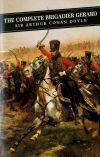
- The Complete Brigadier Gerard
- by Arthur Conan Doyle
- Edited and Introduced by Owen Dudley Edwards, Edinburgh, Canongate Classics #57, 1995; xxvi + 387pp; paper; £4.99; ISBN: 0-86241-534-9

Reviewed by Paul M. Chapman
This volume is very much what it claims to be, comprising full texts of The Exploits of Brigadier Gerard and The Adventures of Gerard, plus 'The Marriage of the Brigadier' (from The Last Galley) and, as a prologue, the non-Gerardien precursor to the whole series. 'A Foreign Office Romance'. The texts used are those of the original Strand appearances, as are the story titles, some of which were altered for subsequent book publication. Thus 'How the Brigadier Joined the Hussars of Conflans' was re-titled 'How the Brigadier Captured Saragossa'; 'The Crime of the Brigadier' became 'How the Brigadier Slew the Fox', and so on. Usefully for the non-Napoleonic specialist, the editor has also included brief chronological preambles, placing each tale within its historical context.
In Owen Dudley Edwards these magnificent stories have found an appropriate and sympathetic editor (indeed, he sees the Gerard tales as a prime candidate for the overall title of the greatest historical short story series), and his Introduction, as is to be expected, is incisive and stimulating. Many literary purists would doubtless be horrified by his comparison of Conan Doyle to Tolstoy when discussing the Brigadier's escapades in the Moscow Campaign of 1812 (a campaign which Gerard initially refuses to discuss but, as is here pointed out, one too rich in dramatic incident, and too well chronicled by its contemporary memorialists, for Conan Doyle to miss out), or even more by his contentious assertion that in Conan Doyle's projection of a sense of space or his use of the theme of awakening national consciousness, 'the entire corpus of Gerard stories makes for nothing less than a Tolstoyan totality'. It is such views which make Edwards's Doyle scholarship so enjoyable, and occasionally frustrating.
However, for all Conan Doyle's admiration of Tolstoy's work, Gerard's is not a Tolstoyan universe. Tragedy is always balanced by an ever-present humour — a trait seldom noted in the great Russian's writings — which, in both blatant and ironic forms, gives the stories much of the irresistible exuberance and panache, but can equally, if misread, lead to their dismissal as mere boys' entertainments, a danger which this Introduction does not fail to recognise.
As probably the most accessible and fresh of all Conan Doyle's historical works (and this is not to disparage the rest), the Gerard stories are more in danger of their historical intent being disregarded than, for example, the more reverential mediaeval romances, whilst, ironically, exuding a more convincing period atmosphere. The short contextual preambles of this edition thus serve to demonstrate Conan Doyle's historical care, as well as to guide the non-historian. There is one story, however — 'How the Brigadier Lost his Ear', a tale of Venetian intrigue which echoes the interest in Italian secret societies later to recur in two Holmes stories, 'The Six Napoleons' and 'The Red Circle' — which is shown to make historical nonsense, and which the editor finds explicable only at a convoluted metaphorical level.
More tangibly, Edwards also discusses Gerard's antecedents. Conventional wisdom has tended to accept Baron Jean Baptiste Antoine Marcellin de Marbot, whose Memoirs Conan Doyle particularly admired, describing them as 'the first of all soldier books in the world', as the original of Gerard. Here the list is convincingly lengthened to include Marshals Murat and Ney and General Lasalle, the Hussar par excellence, whilst it is also noted that the name was taken, probably subconsciously, from the real Maurice-Etienne de Gerard. At a different level it is argued that Conan Doyle intended his creation to represent not only the beau ideal of the French Hussar, but also to be the embodiment of the spirit of Napoleon's Grande Armée as a whole, a hand rather overplayed in the assertion that the relationship between the Brigadier and the Emperor is akin, on a larger scale, to that of Conan Doyle's doctor and detective: 'Holmes would have been nothing without Watson; Napoleon will live because of Gerard'.
Gerard's other standing, as a son of Gascony, is interpreted in both literary and biographical terms. His romantic, excitable and impulsive nature is compared to that of Dumas' Gascon d'Artagnan, whilst also reflecting Conan Doyle's own Celtic Scots-Irish lineage in a way that the stolid, but still romantic, heroes of the more Anglocentric novels such as The White Company, Sir Nigel, and Micah Clarke never could. Edwards furthermore sees the humour, in its frequent forays into satire, as another reflection of the Irishman within the writer, especially in the fun poked at the English (in which there is an element of self-effacement of Conan Doyle's part towards his own adopted Englishness), whose national character is subjected to a particularly wry scrutiny through its sports: fox-hunting and cricket both being effectively lampooned, the description of the latter being one of the funniest ever committed to paper. The mockery is only seen to bite in its assessment of the Europe-wide aristocratic cult of duelling (the essential pointlessness of which Joseph Conrad, one of Conan Doyle's preferred authors, was to illustrate in his Napoleonic novella 'The Duel'), the detestable Colonel Berkeley representing an opprobrious international type. Conan Doyle's very English sense of fair play never allows him to limit the worst human weakness or wickedness to one nation.
I have only been able to touch on the main points of Owen Dudley Edwards' Introduction here. Its wide-ranging and readable nature, together with the textual content of this edition, attractive Edouard Detaille cover, and, of course, the excuse (as if one were needed) to re-read, or even read for the first time, some of Conan Doyle's finest short stories, all combine to make this a highly recommended addition to any collection.
Paul M. Chapman
- Article courtesy Christopher Roden, founder of The Arthur Conan Doyle Society (1989-2003).

