Review:The Dying Detective/David Stuart Davies
This review of the book "The Dying Detective ", by Arthur Conan Doyle was written by David Stuart Davies and published in the A.C.D. - The Journal of The Arthur Conan Doyle Society (Vol. 2, No. 2) in autumn 1991.
Review


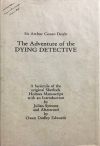
- The Dying Detective
- by Arthur Conan Doyle
- A facsimile of the original Sherlock Holmes manuscript with an Introduction by Julian Symons and Afterword by Owen Dudley Edwards
- The Arthur Conan Doyle Society & Westminster Libraries, 1991; Manuscript format; 53pp; Standard Edition £25; De-Luxe Limited Edition (100 copies) £100

Reviewed by David Stuart Davies
Even facsimiles of Conan Doyle's works are rarities these days and certainly it is not within the scope of most of us to own an original, even if one should come on to the market. Actually in October 1991, the manuscript of The Mazarin Stone was up for auction at Sotheby's in New York. I never heard what it went for, but the expectation was for bids in the region of $100,000. Therefore a production like The Dying Detective facsimile, as Holmes himself might say, 'assumes some importance.'
The Dying Detective was written in 1913, at a time when ACD had given up writing the Holmes stories regularly and, as Owen Dudley Edwards points out in his Afterword, it was the first story to be written after the appearance of Ronald A. Knox's satirical essay Studies in the Literature of Sherlock Holmes. In this piece, Knox presented what he considered to be the basic features of the Holmes tales, most of which, if not all, he claimed, were to be found in every story: the cosy Baker Street opening, the hints Holmes gives to the police which they ignore, the cross-questioning of relatives etc. Mr Edwards observes, quite rightly, that 'in The Dying Detective the structure as defined by Knox is shot to pieces'. One can only wonder if this was a deliberate attempt on Conan Doyle's part to show clearly that there was no rigidity of structure in these detective stories and proving, as ODE maintains, that the old dog had new tricks'.
Indeed The Dying Detective is like no other Holmes story and, as was demonstrated by the reading of it at the launch, it is highly dramatic. This may be because it was originally planned as a play, but proved to be unworkable as a cohesive theatrical piece. The drama theory is enhanced by the presence of another hand in a section of the manuscript. The handwriting has been shown to be that of ACD's secretary and friend, Major Wood. It is likely that this section of the story was dictated to Wood by the author, possibly from his drama notes. Julian Symons in his Introduction presents some other possibilities, noting that 'It is a nice little puzzle, good enough for Sherlock's attention.'
It is then a fascinating document a handsome one too. This attractive — and limited — package will, I suspect, be much sought after in years to come and, while not reaching the giddy dollar heights of an original, will certainly increase in value.
One final note: Owen Dudley Edwards raises an interesting question about the Paget illustration. (Walter Paget, that is, finally taking over as the Holmes illustrator, having been mistakenly passed over years before in favour of his brother Sydney who, by 1913, had died). In the picture reproduced on the title page — 'Put it down! Down, this instant, Watson this instant I say!' — there is a portrait over Holmes' bed. Of whom does it remind you?
- Article courtesy Christopher Roden, founder of The Arthur Conan Doyle Society (1989-2003).

