Review:The Early Christian Church and Modern Spiritualism/Christopher Roden
This review of the monograph "The Early Christian Church and Modern Spiritualism", by Arthur Conan Doyle was written by Christopher Roden and published in the A.C.D. - The Journal of The Arthur Conan Doyle Society (Vol. 9, june 1999).
Review


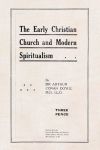
- The Rupert Books Monograph Series
- The Early Christian Church and Modern Spiritualism
- Arthur Conan Doyle
- Monograph #9. Cambridge: Rupert Books, 1998; 28pp.
- ISBN: 0-9530869-9-2; £10 (Limited to 400 copies).

Reviewed by Christopher Roden
Rupert Books of Cambridge have added further titles to their monograph series, reprinting, among other things, scarce pamphlets from the pen of Arthur Conan Doyle. This volume has an afterword by Michael W. Homer, who analyses the text from a modern perspective.
The Early Christian Church and Modern Spiritualism is the sixth of ACD's Spiritualist pamphlets/lectures to be reprinted, and is important in that we find Conan Doyle presenting his view of the state of conventional religion and offering reasons why even committed Christians should be turning their attention to the new alternative.
Although Conan Doyle's text is ostensibly non-denominational in its criticism, one cannot help feeling that the underlying tone is to disparage to some degree the Roman Catholic Church with which he severed ties in his youth. He does not say as much, preferring instead to lay the fault with conventional religion fairly and squarely at the door of 'the sinister figure of the Theologian'. 'In the sad history of humanity,' he writes, 'the dogmatic Theologian has been a greater evil than smallpox. ... Gradually with his theories and his definitions, defining the letter and ignoring the spirit, a huge edifice has been built up which we call Christianity.... What is amiss with religion? We must clearly diagnose the disease before we can prescribe the cure.'
ACD answers this question with the thesis that religion has got far away from the facts of the spirit, that it has become so crusted by what is worldly. 'Surely, he writes, 'the practical object of religion is to make us sweeter, more unselfish and more virtuous souls — in every way better citizens. With that definition before your mind ask whether any man was ever prevented from doing a dishonourable action by the reflection that there were three persons in God or that original sin was a fact. It has no bearing at all upon our conduct. I have always observed that the standard of a chivalrous gentleman is a more practical code, and one may be surer of the conduct of such a one than of an orthodox Christian, because one would be aware that Theology has little to do with actual conduct. There are many things which a gentleman would rather die than do, and when we get can [sic] an ethical code which will reach that point we shall have got a living practical religion.'
All of what ACD says may be perfectly valid, but his argument seems aimed at the bishops and clergy and the academic theologians far more than it is at the 'churchgoer', who, in the main, does not have his head shrouded in religious dogma, but rather seeks to pursue a belief, a faith. And, in the main, it is belief and faith which inspire any person to follow their chosen religion. In the case of Christianity, the belief is founded upon the Biblical accounts of Christ's time on earth; the faith upon the promise that a belief in Christ and God are a means by which to achieve eternal life. Belief also embraces the resurrection of the body, the Communion of Saints, the forgiveness of sins, tenets which have been strongly held for two thousand years: everything, in fact, inscribed in the universally accepted Nicene Creed.
By contrast, modern Spiritualism is based upon a fraud: that of the Fox sisters in Hydesville in 1848, and it spent many of its early years attempting to purge itself of the frauds of those who claimed to be mediums. Conan Doyle told us that, in his view, religion suffered in that it has become so crusted by what is wordly' [i.e., materialistic); by the same token one could argue that Spiritualism has suffered by being 'other worldly': striving to convince that it is possible to communicate with the dead, that it is possible for objects to be apported; that it is possible to fly out of one window and in through another by means of levitation. In The Early Christian Church and Modern Spiritualism he draws the analogy, as he did in The New Revelation and The Vital Message, of Christ as a mediumistic figure. All of Christ's miracles,' he writes, 'fit themselves very readily into the different categories of psychic phenomena as we know them. The walking on the water for example is levitation. ... The miracle of bread and fishes would come under the head of apports, where objects are brought from a distance... the groans of Christ as He prepared for so great a psychic effort as the raising of Lazarus must remind us of the sounds which many of us have heard when some great mediumistic strain has been incurred ... There are some who consider it derogatory to the Christ,' Conan Doyle continues, that His powers should be fitted into any scheme which the human mind can explore and understand. In my opinion the worst enemies of Jesus are those who make him incredible. How can one love or honour that which one cannot understand?' But surely here ACD argues against himself, for we can no more understand the mysteries of God than we can the mysteries of the séance room, if, as Conan Doyle insists, the latter are true mysteries.
Faith is in the heart, and faith is the essence of any religion. The adherents of the great churches down the centuries have found that faith to be enough. Certainly, even though there was a shift towards Spiritualism in the late 1800s and early 1900s, no lasting impact is perceivable. It may be, as others have said, that we have not cared enough to pick up the torch that Conan Doyle left for us. More likely, however, we have seen little enough wrong with our own faiths and beliefs to make us seek solace in Spiritualism. For the time being, I suspect, Christians and otherwise will continue to accept sanctified bread and wine in the belief that it is symbolic of The Last Supper and the Body and Blood of Christ, and be content that the faith in their own hearts is sufficient motivation for them to lead a reasonably good life. There will always be those who reject a certain religion, or consider a certain religion inadequate, or seek positive proof of what it is a certain religion is preaching, or those who simply could not care less one way or the other. That must be a matter for the individual's conscience.
If, as Conan Doyle says, the Christ-life was a psychic manifestation, and that everything in it can be related to the Spiritualism of his times, perhaps the Spiritualists misunderstood their mission. Christ taught that there were standards by which we should live our lives; that belief in God and in Him offered the promise of everlasting life. I don't recall his teaching that we should spend our time attempting to communicate with those who have passed on. The past is history. Those who have passed on live in our hearts, as does our faith. Conan Doyle may have been right in everything he says, but I rather think the jury will remain out for many years to come.
- Article courtesy Christopher Roden, founder of The Arthur Conan Doyle Society (1989-2003).


