Review:The Life and Many Deaths of Harry Houdini/Christopher Roden
This review of the book "The Life and Many Deaths of Harry Houdini", by Ruth Brandon was written by Christopher Roden and published in the A.C.D. - The Journal of The Arthur Conan Doyle Society (Vol. 4, 1993).
This review assesses Ruth Brandon's biography The Life and Many Deaths of Harry Houdini, portraying Houdini as a complex, obsessive figure whose hostility toward spiritualism may have stemmed from personal frustration rather than pure scepticism. It highlights the psychological depth of Brandon's study, particularly in examining Houdini's relationship with his mother, his marriage, and his public crusade against mediums.
Review


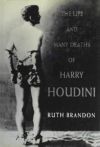
- The Life and Many Deaths of Harry Houdini
- by Ruth Brandon
- Secker & Warburg, 1993; 338pp; £17.99, ISBN: 0-436-20060-0

Reviewed by Christopher Roden
Jim Collins, an assistant to Houdini, supposedly confessed to planting a ruler in a specially designed cabinet to be used by the medium Margery Crandon at an investigation in 1924. As a rider to his 'confession' he made a rather telling remark, which was reported by Colin Wilson in Afterlife, his Investigation of the Evidence for Life after Death (Grafton, 1987): 'There's one thing you've got to remember about Mr 'Oudini — for 'im the truth was bloody well what he wanted it to be.' Such an assessment conjures up a picture of a man who would go to any lengths to obtain what he wanted, who would not shirk from breaking or reviling those who could not supply those ends, or whose ideas did not conform to his own. Bearing this in mind, it is hardly surprising that Ruth Brandon shows little love for her subject in this new biography.
The accounts of Houdini's escapades are well recounted, and attempt to explain some of the mystique which surrounded the man. It is when delving into the psychological aspects, however, that Brandon is at her strongest. Houdini's obsession with his mother is well known. It was an obsession which extended beyond her death, and goes some way to explaining the deep interest Houdini had in spiritualism. His reputation as 'the greatest medium-baiter of all times' seems fair enough, but it would appear that his approach was borne of frustration: the frustration of not being able to contact his dead mother, rather than of a genuine desire to expose spiritualism through its not uncommon frauds. After all, many other serious spiritualists were also trying to expose fraudulent mediums, but the fact that fraud existed did not make men like Lodge and Conan Doyle any less devoted to their cause.
Houdini seems to have had an unnatural obsession with death, illustrated by the numerous hours he would spend sitting in graveyards among the monuments to the dead. Often, of course, there was a publicity motive: and no-one sought publicity more than Houdini.
His marriage, too, comes under Brandon's scrutiny, and there are many extracts from the daily letters Houdini wrote to his wife Bess. They present a picture of a man intent on totally dominating the marriage partnership, to the extent that Bess appears as little more than the archetypical repressed woman. And the story of Bess's own sad life following Houdini's death is recounted in the final chapter, 'Houdini Lives'.
Legend and enigma Houdini may have been. Whether he was quite so popular as he saw himself, the reader will judge from this fascinating book.
C.R.
- Article courtesy Christopher Roden, founder of The Arthur Conan Doyle Society (1989-2003).

