Review:The Mystery of the Spot Ball/Christopher Roden
This review of the parody "The Mystery of the Spot Ball ", by "C" was written by Christopher Roden and published in the A.C.D. - The Journal of The Arthur Conan Doyle Society (Vol. 7, 1996/7).
Review


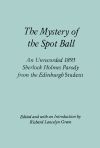
- The Mystery of the Spot Ball
- An Unrecorded 1893 Sherlock Holmes Parody from the Edinburgh Student
- Edited and with an Introduction by Richard Lancelyn Green Cambridge: Rupert Books, 1997: Rupert Books Monograph Series No. 2; 24pp; Card covers; £10.00, ISBN: 0-9530869-1-7

Reviewed by Christopher Roden
I first heard of 'The Mystery of the Spot Ball' some seven years ago, when the late David Kirby told me that he was planning to issue it as the first publication under his intended new imprint, Picardy Press. The details were sketchy: I knew that it was a Sherlock Holmes parody — and a good one, by all accounts, I knew that it was a very early attempt at the genre; and I knew that it had been discovered by Richard Lancelyn Green in the pages of Edinburgh University's Student magazine, which had published Conan Doyle's own parody, 'The Field Bazaar' in 1896. More than that I did not know and it was, therefore, a delight to learn that Rupert Books had decided to revive Dave Kirby's project by issuing the parody in the first wave of their new Monograph Series.
Richard Lancelyn Green's Introduction to this handsome card-bound booklet is, as one has come to expect of him, full of background information. There is a potted history of the Student magazine; information on what issues looked like; speculation on who might have been the author of this particular parody; and an analysis of the parody itself, which contains a tantalising reference to 'The Mystery of the Three Grey Pellets', a parody which apparently appeared in Billiard Monthly in 1913 when Conan Doyle was competing in the Billiard Association Amateur Championship, and which, as far as I can see, is not referred to in any edition of De Waal. Perhaps this might form the subject for a future Rupert Books Monograph (Hint!).
Also included here is the text of a letter from Conan Doyle to the Student, written in June 1915, in which he praises the Edinburgh University men who are contributing to the Great War. There is also a reprint of a short article on ACD which appeared in the 10 February 1892 issue of the magazine.
The parody itself is of very high quality and, as Green writes in his Introduction, there are certain features which helped to define the genre: 'There is the deduction based on a person's clothes which is correct in itself, but proves to be false as the clothes belong to another person. There is the extravagant hypothesis of the murderer disguised as the person he has murdered, the bathos of the correct solution, and the suggestion by Holmes that Watson should in future do the detecting while he would do the writing.'
There are all the things one might expect to find in a good parody:
'On your trousers I have noticed for some time two or three crumbs of a peculiar shape and colour. These I recognised at once as belonging to the common water biscuit. I may mention that I have written a monograph on the subject of biscuit crumbs. ...'
'I perceive,' he said, 'that you have just come from Glasgow, and that you received a severe cut over the right eye about four years ago; you have three teeth stopped with gold, you wear your boots down at the heel, have a taste for drink and a weakness for peppermints, are in comparatively poor circumstances, have had a love affair many years ago, and have something on your mind at present.'
'Indeed, sir,' replied the lady, in evident alarm. 'I have something terrible on my mind, but I have never been to Glasgow, and my teeth—' and so on.
Surprisingly, there is often confusion between parody and pastiche. In simple terms, parody is the humorous exaggerated imitation of an author's style, whilst pastiche is an attempt to produce work which seeks to imitate an author's style, most often, as in the case of Conan Doyle, by using the character creations of another author in an original work. The essence of parody is the humour, the ability to make one laugh (and whilst many pastiches do make one laugh, simply because they are so unbelievable, this is gnerally not their intended purpose).
'The Mystery of the Spot Ball' has humour in abundance and I, for one, am glad to see it at long last.
Christopher Roden
- Article courtesy Christopher Roden, founder of The Arthur Conan Doyle Society (1989-2003).

