Review:The Quest for Arthur Conan Doyle/Christopher Roden
This review of the book "The Quest for Sir Arthur Conan Doyle", by Jon L. Lellenberg was written by Christopher Roden and published in the A.C.D. - The Journal of The Arthur Conan Doyle Society (Vol. 1, No. 1) in september 1989.
Review


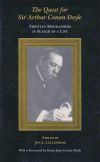
- The Quest for Sir Arthur Conan Doyle
- Thirteen Biographers in search of a life
- by Jon L. Lellenberg
- Southern Illinois University Press, 1987; 236pp., U.S. Dollars 19.95

Reviewed by Christopher Roden
The many thousands of words which have been set down in an attempt to record Sir Arthur Conan Doyle's life and activities already fill numerous volumes, so that the task of examining the biographical and autobiographical writings would seem to most of us as daunting a prospect as embarking upon a completely original biographical study.
Jon Lellenberg's approach to the problem was well conceived: by engaging a number of contributors, each a recognised suthority on the subject of Conan Doyle, and allowing them to provide critical surveys of previous material, he left himself free to provide a lengthy introduction and epilogue, summarising what needed to be done and what had been achieved. Finally, by procuring a foreword from Dame Jean Conan Doyle, Mr. Lellenberg has provided us with a work, considered and authoritative in its own right, and also a splendid base from which to explore the existing biographies more deeply.
Southern Illinois University Press has played its part too in the presentation of a volume which should serve as a lesson to British book publishers in the care and effort taken by their American counterparts to produce attractive and appealing volumes.
Mr. Lellenberg begins his introduction by outlining Conan Doyle's life: highlighting the major problems of Conan Doyle biography 'that have posed serious problems for those trying to render a portrait of this man, his creative impulse, and its remarkable literary and cultural results. Five of them are conceptual hurdles, the sixth a problem of research materials.'
The particular problems defined are:
- (i) Simplicity or complexity: was Conan Doyle simply 'The man in the street'.
- (ii) Was Conan Doyle Holmes? The role of Bell.
- (iii) Conan Doyle's psychology, and his work as the mirror of his mind.
- (iv) His place as a writer: literature or popular fiction?
- (v) The spiritualist crusade.
- (vi) Family co-operation and the archives.
The analysis of 'all that has gone before' is dealt with in two sections: 'Autobiography' and 'Biography' .
Ely M. Liebow analyses the autobiographical fiction and highlights those items omitted from the conventional autobiography. Liebow's summary spells an appropriate word of warning to those keen to lift examples from Conan Doyle's fiction for use in biography:
- 'Scholars have made use of autobiographical content in Conan Doyle's fiction — but incompletely, sometimes uncritically, and too often without enough knowledge of Conan Doyle's life to obtain full benefit from the clues he scattered throughout his literary output. The latter is indispensable, for without the navigational assistance afforded by a sound working knowledge of Conan Doyle's life, uninformed biographical mariners can all too easily sail past items of interest in his fiction or run aground on the reefs of his undeniably fertile sense of creativity.'
It falls to Richard Lancelyn Green to delve into 'Memories and Adventures' and would be expected from one who has 'been around Conan Doyle for so long', he performs his tack admirably: highlighting omissions from Conan Doyle's own account of his first twenty years and questioning the truth lying behind the omissions. This chapter is a concise summary of Conan Doyle's autobiography and a probing analysis of those things which the author preferred to keep to himself.
Andrew S. Malec's contribution concentrates on 'Western Wanderings' and 'A Visit to Three Fronts' before turning to the Spiritualist autobiographies, an area sadly neglected by biographers generally. A strange inclusion in the midst of the discussion on the Spiritualist books is 'Three of Them', Conan Doyle's charming digression on home life. Mr. Malec draws few conclusions regarding Conan Doyle's spiritualism, preferring instead to discuss the general contents of the volumes under review.
Moving to the biographical writings, Philip A. Shreffler discusses Lamond's 'Arthur Conan Doyle : A Memoir', concluding that the work is every bit as much Spiritualist propaganda as it is a biography of Conan Doyle.
There are few who would term Lamond's contribution 'biography' in the true sense of the word but this volume is, nevertheless, useful in providing the student of Conan Doyle with an analysis of his evolution from agnostic to spiritualist.
Nicholas Utechin has the unenviable task of reviewing Hesketh Pearson's contribution to Conan Doyle biography — a contribution which roused Adrian Conan Doyle to launch his vitriolic attack on Pearson. Mr. Utechin concludes that Pearson's remains an unsatisfactory biography and, concentrating as it does rather too heavily on particular aspects, this may be a fair summary. One should never overlook, however, Pearson's admiration for Conan Doyle, nor the fact that he was one of the few to have access to the family's papers whilst preparing his work.
James Bliss Austin examines Adrian Conan Doyle's hagiographic offerings concluding that 'The True Conan Doyle' 'is a book that one can read once with some pleasure and profit, but it is hardly a candidate for a shelf of reference volumes. Rather it is an interesting and somewhat elusive item for the collector.'
The 'Centenary' volume is not, he says, 'a book for concentrated reading but rather a tabloid through which one can browse for one's edification for many pleasant and instructive hours.'
Solid coverage of Dickson Carr and Nordon follows from Howard Lachtman and Donald A. Redmond, whilst Edward S. Lauterbach is allotted the task of reviewing 'Four Miniature Portraits'.
Jon Lellenberg and Peter Blau combine to investigate Higham's 'The Adventures of Conan Doyle', agreeing with Dame Jean Conan Doyle that the book was a 'good read, even though at times a fanciful one.'
- 'For the serious student of Conan Doyle,' they conclude, 'its many problems limit its usefulness and make its conclusion about his life and work at best tentative ones requiring further testing.'
Pearsall's generally unpopular biography is discussed by David R. Anderson who credits the author with a considerable knowledge of Conan Doyle's times. The work, however, 'offers little new information, and Pearsall's simplistic view of Conan Doyle as a person prevents him from offering a biographical 'solution' after all.'
There is a second contribution from Richard Lancelyn Green in the form of a short article discussing the little known 'Portrait of an Artist — Conan Doyle' by Julian Symons. Green concludes that despite its defects, Julian Symons' well written, intelligent, and neatly-ordered book is, aguably, the best short biography of Arthur Conan Doyle that has yet been written.
Christopher Redmond examines Owen Dudley Edwards' 'The Quest for Sherlock Holmes' in depth, highlighting the shortage of documentation to support some of Edwards' speculation, but concluding:
- 'It tells the reader a good deal about a scholar's approach to a new subject — which is of course not the approach of an enthusiast already familiar with it — and might well give useful guidance to the next scholar to take up the work. That so rich a dove was waiting for Edwards' investigative eye says something, too, about how little has really been done in the way of research into Arthur Conan Doyle's life and work, and how easy it will be to do a great deal more.'
Jon Lellenberg's epilogue ably summarises the contributions and concludes that:
- 'All this voluminous biographical effort, unfortunately, has done disappointingly little to provide satisfactory answers to the principal problems of Conan Doyle biography.'
He sets the input of this volume against the headings detailed in the introduction, and discusses recent and pending biographical work.
The final paragraph of 'The Quest for Sir Arthur Conan Doyle' has the following message:
- 'The quest for Sir Arthur Conan Doyle is still incomplete. The true nature of the man and his life still eludes us. His works continue to be read avidly, some of them studied worshipfully as if they were revealed truth, but critically we are still unsure what to make of them — even the greatest and most exceptional of them. And yet, much valuable work has already been done, and many signposts along promising new roads of biographical interest now point the way. Perhaps Donald Redmond is correct that Sir Arthur's spirit is roaring with mighty laughter at the whole thing. But the joke would surely be on us, his readers in a world imbued with his creations, if no one travelled the rest of the distance and completed the quest.'
'The Quest for Sir Arthur Conan Doyle' is a highly important contribution to existing biographical work. It is certainly a book which should be included in every Conan Doyle collection.
- Article courtesy Christopher Roden, founder of The Arthur Conan Doyle Society (1989-2003).

