Review:The SH Reference Library: The Adventures of SH/Barbara Roden
This review of the book "The Sherlock Holmes Reference Library: The Adventures of Sherlock Holmes", by Leslie S. Klinger was written by Barbara Roden and published in the A.C.D. - The Journal of The Arthur Conan Doyle Society (Vol. 9, june 1999).
Review


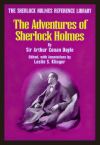
- The Sherlock Holmes Reference Library:
- The Adventures of Sherlock Holmes
- Edited, with annotations by Leslie S. Klinger
- Indianapolis, In: Gasogene Books, 1998; xvi + 324pp;
- ISBN 0-938501-26-7; U.S.$26.95

Reviewed by Barbara Roden
Any reader whose bookshelf already groans with the weight of the Baring-Gould Annotated (in either its one- or two-volume incarnation), and/or the nine-volume Oxford University Press Oxford Sherlock Holmes series, will doubtless emit a groan or two when they realise that yet another edition of the canon, complete with scholarly footnotes and appendixes, is being issued in nine volumes by Wessex Press. The series — which has been given the collective name of The Sherlock Holmes Reference Library — was introduced to the world in January 1999, when the first volume, The Adventures of Sherlock Holmes, was published; the remaining eight volumes will be published over the next few years.
The first question one has to ask is: for whom is this work intended? (Actually, the first question that sprang to mind was: why not A Study in Scarlet first? I assume as it is not explained in the book —that it was felt the series would be better off starting with a collection of short stories — the form in which Holmes appears to best advantage — than with a short novel written before author or detective had really hit their stride, and from which the ostensible hero disappears for much of the time.) Back then to the question: who is this intended to appeal to? Sherlockians, Doyleans, the man in the street, or (d) all of the above?
Editor Leslie Klinger, who has been a student of Holmes and his world for more than thirty years, sets out his stall in the first line of his preface. 'While The Sherlock Holmes Reference Library is primarily intended for the serious student of the Sherlockian canon, its thousands of footnotes and hundreds of bibliographical entries may also serve to introduce the vast world of Sherlock Holmes to a newcomer. But it bears emphasis: this work is for the true Sherlockian [italics his].' He goes on to add, 'There is little in these volumes for the student of Arthur Conan Doyle, not because such study is unimportant, but because that field has been ably dealt with by others.' One could, legitimately, say that the field of Sherlockian studies in general, and annotated Sherlockian works in particular, has also been ably dealt with by others; but that would be to miss the point of this series, which is to pull together not only the works from the Golden Age of Sherlockian studies the works on which Baring-Gould, for instance, drew-but the literally hundreds of works, long and short, which have appeared since, both in book form and in journals and periodicals. There is an extensive bibliography at the end of the book, listing a truly impressive range of sources and references (although, speaking as one of the editors of the series The Case Files of Sherlock Holmes, I was disappointed that the Case File dealing with 'The Speckled Band' was not listed, and that only one fleeting reference was made to it in the annotations, despite the fact that one article dealt at length with a topic — the identity and location of 'Stoke Moran' — which Klinger discusses).
This, however, is a small point, one which pales beside the staggering amount of information provided. Indeed, there is such a wealth of information, speculation, and detail here that the annotations often dwarf the text: one page in 'The Noble Bachelor' contains three lines of the original story, with the rest of the page given over to notes. This is, of course, an unavoidable hazard in a work of this nature, and having the annotations on the same page as the point they annotate is far preferable to having them tucked at the end of the volume. It does, however, emphasise Klinger's point that this volume is intended for serious Sherlockians: it is to be doubted whether the casual reader approaching Holmes for the first time would find this a practical volume to use, purely in terms of layout; although I would certainly advise having it on hand, for the time when the stories are more familiar and the questions, inevitably, start to multiply.
A question many potential readers and buyers will doubtless be asking themselves is, will this set (when it is complete) replace Baring-Gould? The answer is, I think, no; and I do not think that Klinger has set out to replace the volumes which occupy a treasured space on so many shelves. The Klinger version certainly has more, and in some cases more detailed, annotations, and he is able to make use of the fruits of research written in the decades since the Annotated was compiled, which in itself makes this series invaluable. However, both authors have approached the material in different ways, Baring-Gould clearly introducing more by way of personal interpretation, Klinger by collating vast quantities of information on previous scholarship; and as a result we have two works which complement, rather than compete with, each other.
The volume, therefore, is certainly one which will be embraced by Sherlockians. What, then, will Doyleans make of it? By Doyleans, I should perhaps explain, I mean those who acknowledge that Holmes was the creation of Arthur Conan Doyle, and who have at least a passing acquaintance with, tales and interest in, the life and other works of the great man. Well, those looking for information about ACD's involvement with the tales-the circumstances which led up to the writing of the Holmes stories, what might have inspired events in individual, what the author thought of them-will have to look elsewhere, as Klinger has more or less said in his introduction. He plays the Sherlockian game, for better or worse, which means that his annotations stick to the 'rules' of that particular game: as Conan Doyle was merely a friend of Watson's, and had no bearing on the writing of the stories, he ceases to be of any kind of importance as far as the annotations are concerned.
As an example, let us take the annotation for 'Langham Hotel' in 'A Scandal in Bohemia'. Klinger quotes from Michael Harrison (The London of Sherlock Holmes) and William H. Gill (Some Notable Sherlockian Buildings), and we find out that it was built in 1865 and was known for its magnificence. A check of this same note in The Oxford Sherlock Holmes tells us where the Langham is, when it was built, who designed it, that it was damaged in 1940, was used as an annex of the BBC, and has now been restored to its original use. It also informs us that ACD dined at the Langham on 30 August 1889, with J. M. Stoddart and Oscar Wilde, when he was commissioned to write The Sign of the Four. I would have thought that a fact which has significant bearing on the writing of the canon, and the development of the character of Holmes, was not without interest even to Sherlockians; but apparently not. (Baring-Gould, as a matter of interest, notes the BBC connection, and also adds that it was at the Langham where Mary Morstan's ill-fated father was to stay (briefly) in The Sign of the Four).
Let us take another example. In the annotation concerning Godfrey Norton's assertion that his marriage to Irene Adler must take place before noon or 'it won't be legal', Klinger quotes from Jay Finley Christ and C.R. Andrews; the latter wonders why Norton, a lawyer, did not know that in 1886 the law was changed so that couples had until 3:00 pm to legally be wed. As most Sherlockian chronologies place this story in 1888 or 1889, this would seem to be a valid Sherlockian question, and I am sure that reams of speculation, conjecture, and surmise have been written to explain this away. However, readers with a headache may wish to consult the Oxford edition, which simply remarks that when Conan Doyle was wed in 1885, the law required marriages to be solemnised before noon, thus making it plain that the author was almost certainly drawing on his own personal experience, unaware (and almost certainly unconcerned in developing his quickly written story) that the law had subsequently been changed.
Married as I am to one of the quartet of scholars who edited the Oxford series, it is perhaps hardly surprising that I should have kind words for it. That apart, however, and speaking as a Doylean, I have to take issue with some of Jon Lellenberg's comments in his otherwise excellent introduction to the new Adventures. He notes that the Oxford Sherlock Holmes was 'a British effort at annotating the Canon', further noting that a 'failure to include American contributions to canonical scholarship, [cuts] its readers off from substantially more than half of what has been done over the years, and, frankly, from very often the richer part', and maintaining that a fundamental drawback to the series is that as annotation of the Canon goes, it is a
Doylean work'. So parochial a view may be fair enough, but the Oxford Sherlock Holmes never set out to be an 'annotated canon', at least not in the Baring-Gould or Sherlockian sense; rather, it was meant as a scholarly look at the Holmes stories and the man who created them, with those stories firmly placed in the context of the author's life and experiences; something for which many game-playing Sherlockians have little or no time. It was also intended to stand with other volumes in the Oxford World's Classics series as a critical analysis of an important body of work, and an attempt to explain people, places, and events in that time to an audience which is now a hundred years removed from it. Speciality Sherlockian presses such as Wessex and Calabash can never hope to reach an audience of more than a few hundred, and are, in a sense, preaching to the converted. Oxford University Press, however, with its print runs of thousands, may well have been introducing the Holmes stories to hundreds of new readers; readers who might conceivably want to know about the man who wrote the stories and the world he lived in.
Lellenberg also goes on to say that he suspects the Oxford series 'represents a serious attempt by its editors to make Conan Doyle and Sherlock Holmes respectable in Academe'. Whether that was a goal of the series, I don't know. I can't recall it ever being brought up in conversation as a stated aim: and I myself suspect that Holmes is far too popular-as the editors all well knew-to ever be taken seriously by the academic establishment, which seems to cherish the belief that if 'the public' enjoys reading something, it can't be worthy of study. Perhaps, however, the Oxford Sherlock Holmes — by treating Conan Doyle with respect and honour-was trying to redress the balance, make up, in small measure, for the indignities done to ACD over the years by some of those intent on 'playing the game'. It should also be noted that the hardback treatment allowed Conan Doyle in this series by Oxford had previously only been extended to Charles Dickens and Jane Austen-quite respectable company by any standards-and that the subsequent World's Classics paperback edition was an eventual spin-off from that.
These comments are not, however, meant to detract from the main body of the work under discussion here. If this, the first volume in The Sherlock Holmes Reference Library, is an indication of the quality of the books which are to follow, then Sherlockians are in for a treat: an annotated canon which spreads its net of references wide, provides much of the latest thought on questions which have been vexing devotees of the canon for decades, gives the thoughts of all the major chronologists as to when each story took place, and (hurrah!) presents the stories in their familiar order, rather than the chronological order decided on by Baring-Gould. I could wish that the volume had been made available in a hardback format, so that collectors. (and, more importantly, those to whom these books are a working tool, and therefore subject to frequent usage) had the option of investing in a volume with more durability; and that the Table of Contents had drawn attention to useful Appendixes concerning, for example, The Unrecorded Cases'. But these are minor points. Leslie Klinger's annotated Adventures of Sherlock Holmes is a major new work, one which certainly deserves a place on the bookshelf of anyone with an interest in Holmes and his world; right beside Baring-Gould and the massed volumes of the Oxford Sherlock Holmes...
Barbara Roden
- Article courtesy Christopher Roden, founder of The Arthur Conan Doyle Society (1989-2003).

