Review:The Shaw Festival's Sherlock Holmes/Christopher Roden
This review of the book "The Shaw Festival's Sherlock Holmes", by William Gillette was written by Christopher Roden and published in the A.C.D. - The Journal of The Arthur Conan Doyle Society (Vol. 5, 1994).
This review examines a published edition of William Gillette's Sherlock Holmes as staged at the Shaw Festival, discussing its textual history, illustrations, and accompanying scholarly essays on Gillette and his relationship with Arthur Conan Doyle. It highlights the contextual contributions on Shaw, politics, and Spiritualism, while assessing the volume's production and format.
Review


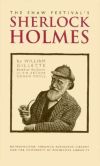
- The Shaw Festival's Sherlock Holmes
- by William Gillette, based on the works of Sir Arthur Conan Doyle.
- Metropolitan Toronto Reference Library & The University of Minnesota Libraries, 1994; 208pp; Cerlox-bound; £10, US$15, C$20 (plus £2 ($3) postage and handling). ISBN 0-9695673-10-9 (Cerlox) ISBN 0-9695673-11-7 (Hardound (no price quoted)).
- Available from The Battered Silicon Dispatch Box, George A. Vanderburgh, PO Box 204, 420 Owen Sound Street, Shelburne, Ontario, Canada LON 150.

Reviewed by Christopher Roden
How nice it would have been to join the Bootmakers of Toronto on 2 July 1994 when they made the trip to Niagara-on-the-Lake, home of the annual Shaw Festival, dedicated to staging the works of GBS and his contemporaries. The reason why one hundred and seven Sherlockians (and Doyleans?) and guests made the trip? A preview performance of the Shaw Festival's production of William Gillette's Sherlock Holmes. Well, we couldn't make it on that occasion, but this co-production by Metropolitan Toronto Reference Library and the University of Minnesota Libraries offers the next best thing.
In her introductory remarks, Denyse Lynde draws attention to the special challenges of the play:
To start with, there exist several versions of the play: one of four acts, one of three, and two of two. Some of these can be traced back to Gillette's various productions, while others stem from more recent attempts to bring this text to life.
After considering the various texts, Director Christopher Newton gave the company a three-act version based on one of Gillette's texts, with the result that we have here a version of the play entirely suited to the demands of a modern audience.
The script itself is complemented by some splendid illustrations, both of early productions and the current one, including some particularly fine shots of William Gillette.
The essays in the book begin with Vincent Starrett's 'Introduction to Sherlock Holmes', written in 1935. This is followed by Gillette's own 'A Preface to Sherlock Holmes' from the same year. Chris Redmond contributes a very thorough essay on Gillette, 'The Man Who Made Sherlock Holmes Famous' (funny, I'd always thought that was ACD!), providing important biographical information as well as looking at the history of Sherlock Holmes in Gillette's hands and the subsequent history of the play.
In 'A Genial Creature: GBS and ACD', Doug Elliott provides an extremely interesting account of the two men, who were antagonists on occasion but who, more often than not, managed to maintain a friendly relationship. Elliott discusses the backgrounds from which the two men came, before looking at their involvement in Politics and The Boer War, The Titanic disaster (see also the paper 'The Titanic Disaster: Letters to the Editor by Sir Arthur Conan Doyle and George Bernard Shaw' in this issue), The Great War, The Casement Defense, Votes for Women, and Spiritualism. It is an excellent summary of their involvement with one another and alone justifies the cover price.
To complete the volume, the script of Gillette's 'The Painful Predicament of Sherlock Holmes', premiered in Canada on that marvellous July day, is also included.
The edition is produced in both cerlox- and hard-bound format. Unfortunately, the copy I have is the former — but I'm trying hard not to let that spoil the overall pleasure and my enjoyment of this particular book.
Christopher Roden
- Article courtesy Christopher Roden, founder of The Arthur Conan Doyle Society (1989-2003).

