Review:To Arms!/Christopher Roden
This review of the pamphlet "To Arms!", by Arthur Conan Doyle was written by Christopher Roden and published in the A.C.D. - The Journal of The Arthur Conan Doyle Society (Vol. 9, june 1999).
Review

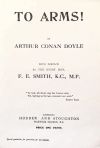
- To Arms!
- Arthur Conan Doyle
- Monograph #11. Cambridge: Rupert Books, 1999; 62pp.
- ISBN: 1-902791-01-0; £10 (Limited to 400 copies).

Reviewed by Christopher Roden
In the words of F. E. Smith's Preface to this pamphlet, To Arms! was written in order to explain Britain's part in this tremendous struggle [the war with Germany] and to spur the manhood of our people to return such an answer to the call to arms that there may be no question as to the issue of the conflict.'
It seems as remarkable today, as it did to Smith then, that able-bodied men should crowd 'in their tens of thousands to cheer their representatives on the football field but [be] unmoved by the terrible experiences of our men on the field of battle.' No one, it has to be said, can really want to go to war, but this was a time of national emergency in Britain, and the job of the propagandists was to ensure that the 'facts' were made known, and that the rallying call was heard loud and clear.
Conan Doyle's essay is interesting in that it attempts to place the existing crisis in historical perspective. Inevitably, from a man who has developed an intense dislike for the Germans, there is a bias and, as Philip Weller demonstrates in his extremely effective Afterword, an inaccuracy in what ACD wrote.
In fact, apart from making this scarce text readily available, the real value of this monograph lies in Philip Weller's able contribution. He discusses historical perspective and Conan Doyle's changing opinions on Germany; the publication history of the pamphlet itself; and the Literary Propaganda war which was underway. Turning to the impact of the pamphlet itself, Weller notes that by the time that To Arms! had been published, over one million men had volunteered in response to Lord Kitchener's appeals, and that, in fact, recruiting figures went into decline after the pamphlet was issued. He also provides useful background on F[rederick] E. Smith, who wrote the Preface for the pamphlet, and rounds off the contribution with an analysis of the text and conclusions.
It is perhaps easier to write of the events with the hindsight of eighty-five years, when events, causes and effects have been analysed over and over from the perspectives of succeeding generations. Nonetheless, Weller is right to make it clear that ACD erred in reporting and in interpretation. 'ACD must be commended for the way in which he attempted to aid the war effort,' he writes, particularly in the practical aspects of his contributions to the war, and for the way in which he admired some of those who fought in the war, but To Arms!, like his other writings about the war, reveals many of his worst flaws.'
Fortunately, the publication of this booklet presents an opportunity for Doylean scholars to consider those flaws for themselves.
- Article courtesy Christopher Roden, founder of The Arthur Conan Doyle Society (1989-2003).

