Review:Victorian Tales of Mystery and Detection/Barbara Roden
This review of the book "Victorian Tales of Mystery and Detection", by Michael Cox was written by Barbara Roden and published in the A.C.D. - The Journal of The Arthur Conan Doyle Society (Vol. 3, 1992).
Review


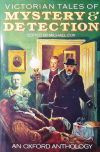
- Victorian Tales of Mystery and Detection
- Edited by Michael Cox
- Oxford University Press, 1992; xxvi + 578pp: £17.95, ISBN 0-19-212308-4

Reviewed by Barbara Roden
Like its relative the ghost story, the detective story has a readily identifiable beginning: Edgar Allan Poe's 'The Murders in the Rue Morgue' (1841). The influence of Poe on the detective story cannot be underestimated: in only three short stories he laid out most of the ground rules which authors today still follow. As Michael Cox points out in the introduction to this volume, however, it was Poe's misfortune to be writing short stories at a time when the novel was in the ascendancy, and thus his influence on short detective fiction did not truly make itself felt until five decades later. The exact date that the genre finally caught on with the Victorian public can, however, be easily established: July 1891, when a short story entitled 'A Scandal in Bohemia' appeared in the pages of The Strand Magazine. Just as Poe influenced the shape of the detective story, Conan Doyle influenced the size. Detective novels had been the preferred format for tales of ratiocination from the 1860's onward. It was a stroke of genius on the part of Conan Doyle to create a series of short, sharply drawn detective stories featuring a central character who dominated the action and was readily memorable. Pretenders to his throne appeared immediately, sparking off an avalanche of detective fiction which is breathtaking in its variety, daring, colour, and ingenuity.
Cox has selected thirty-one tales from the golden age of the short mystery story. beginning with Poe's 'The Purloined Letter' (1845) and ending with Robert Barr's 'The Clue of the Silver Spoons' (1904). Along the way the reader encounters fiction from the pens of (among others) J. S. Le Fanu, Charles Dickens. Wilkie Collins, Grant Allen, Israel Zangwill, Fergus Hume, Arthur Morrison, Mary E. Wilkins, and Sax Rohmer. Sir Arthur is represented twice: by 'The Blue Carbuncle' and 'The Lost Special'.
The two choices are excellent ones, for different reasons. Of course, it would be impossible to have a collection of classic detective stories without a Holmes tale, and 'The Blue Carbuncle', while perhaps somewhat over-familiar to enthusiasts, is one of the very best in the canon: the deductions made about Henry Baker by way of his hat are nothing short of brilliant. The tale is an example of the 'detective' story, in which a central sleuth unravels the clues which are (or at least should be) there to enable the alert reader to puzzle out the solution.
This collection does not, however, consist solely of tales in which a detective appears. Many fine mystery stories contain no detective at all, and 'The Lost Special' is such a tale. Conan Doyle himself realised this when he began writing the series of stories of which 'The Lost Special' formed a part. In a letter to his Strand editor Greenhough Smith, ACD wrote:
- 'Detective Stories' would not fairly characterise them, and I want to give myself a very free hand so that in case any tap runs dry I can turn on another. I should therefore not say anything about Detectives or Holmes in the announcement. To say however that they deal in mystery and adventure would be true...
In Conan Doyle's tale of mystery the reader is presented with a seemingly insoluble puzzle, which looks for a time as if it will remain unsolved. No reader, no matter how clever, would be able to deduce how the special became lost, and why. Instead we read the tale carefully, knowing that we will fail to find a solution and yet secure in the knowledge that a suitably ingenious ending is in store. Like a child watching a magician, the reader is carried along by the mechanics of the tale and then thrilled by the outcome.
The content of this volume is superb, with familiar creations such as Holmes, Martin Hewitt, and the Old Man in the Corner standing beside lesser-known sleuths such as Loveday Brooke, Lady Detective, the brainchild of Catherine Louisa Pirkis and one of the first female detectives in fiction. It is in this way that these anthologies best serve the reading public: by rescuing authors and creations who have, in many cases unjustly, been condemned to obscurity, and making them accessible to a new generation of readers.
This anthology would almost be worth buying for the introduction alone, which is an informative and knowledgeable overview of the detective story from its inception to the end of the Victorian era. Cox compares the genre with another type of short story popular in Victorian England: the ghost story. Where ghost stories caution against too great a faith in rationalism, however, the detective story 'celebrates the human ability to explain and comprehend.' He concludes by explaining that the tales in this volume will appeal to modern readers for precisely the same reasons that they appealed to their original audience: '... what fascinated the Victorian reading public fascinates us. The lure of the puzzle remains; the spectacle of the unknown becoming known continues to satisfy; the triumph of reason soothes us still.'
B. R.
- Article courtesy Christopher Roden, founder of The Arthur Conan Doyle Society (1989-2003).

