The Wild Geese

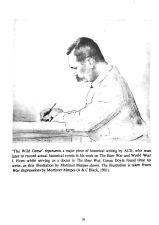
The Wild Geese is an article written by Arthur Conan Doyle published in The Irish Times from 13 to 22 september 1954.
Editions
- in The Irish Times (13-22 september 1954 [IE])
- in A.C.D. - The Journal of The Arthur Conan Doyle Society (vol. 4, 1993 [UK])
The Wild Geese


I am acquainted with few more interesting incidents in history than those which led to the formation and the existence for a hundred years of the Irish brigades in the service of France.
That so large a body of men should engage under the colours of a foreign nation, that they should fight mainly against the Government which claimed their allegiance, and that they should be able for a period which exceeds three generations to keep themselves well officered by Irish gentlemen of the best Catholic families, and their ranks filled with the best fighting material of Ireland, is certainly a most extraordinary phenomenon: It is perfectly comprehensible that exiles should fight against their country in a civil war, or that embittered religious refugees should act as the French Huguenots did towards the government of Louis the Fourteenth; but the existence of a military organisation of this unnatural sort for so long a period is unique, I think, in the world's history, and tells more than any words can do of the abominable misgovernment of Ireland in the eighteenth century.
Irishmen are subject to the same laws which govern all human feeling. They love to live in their own land, to hear their own speech around them, to look upon their own nearest and dearest. If for a long hundred years so many of the pick of the race were content to live among strangers of alien speech, and to spend themselves in hard service with but little return, we can understand how tremendous must have been that enduring sense of intolerable wrong which drove them to so repugnant a course.
The Treaty of Limerick
Carlyle has an aphorism that 'A political blunder always ends in a broken head for somebody.' It was never more truly exemplified than in the perennial dispute between these neighbouring islands — a dispute in which I am quite prepared to admit that the wrong has not always been on the one side.
But take this question, the origin of all the mischief, the Treaty of Limerick. Look at it not merely from a moral but from a political point of view. It was a political mistake to make the terms so harsh that the Irish Jacobite officers were dispossessed of their estates and had no choice but to seek their fortunes abroad — again it was a mistake to make Ireland so unpleasant a home for a Celt and a Catholic that the common soldiers were ready to follow their officers into exile — finally, having made this treaty, it was a mistake to supplement it by legislation which drove the Catholic population into a chronic state of mutiny, and supplied a constant stream of recruits for the Irish regiments abroad.
There were three great political mistakes, and then comes the subsequent tale of the broken heads. And what a catalogue it is! During a century the history of the Irish brigades, entwined with the military history of France. Their lives were spent in fighting against Great Britain or the allies of Great Britain. I find in my notes eighty-seven engagements in which they burned powder. They helped the French to victory. They covered the French retreat. In three Continents they fought their persecutors. Again and again their presence turned defeat into victory for their adopted country. The cases of Cremona and of Fontenoy are admitted on all hands. And then at last milder laws prevailed in Ireland, some limited measure of justice was done to the native population, and instantly the Brigades in France began to dwindle and disappear. I cannot conceive a finer illustration of Carlyle's remark, nor a better object lesson in the results of evil legislation.
Historical Sources
The student of history who endeavours to collect information about the Brigade finds his materials very limited. There is O'Callaghan's industrious, but aggravating history, and there is O'Connor's well-written, but incomplete, work upon the subject. Then for the later days of the Brigade there is Mrs O'Connel's recently published book upon 'The Last Colonel of the Irish Brigade,' and finally there are the allusions to the Irish regiments in such books as 'Fieffes et troupes Etrangères dans le service de la France,' [1] and scattered information in various military memoirs.
I have no doubt that among old Irish families who have been intimately associated with the Brigade — such families as the Dillons, the Nugents and the Walshes — there must be letters and papers about the matter; but it is a curious thing that during a hundred years the Brigade never found among its officers a single man to give any intelligible account to the world of their aims, their point of view, their organisation and their exploits.
We can only regret that there was not a Napier, or even a Marbot among these numerous educated gentlemen, who passed, I am afraid, many hours over the dice and the bottle which might have been devoted to rearing a monument over their own cause. Still, when we think of those 87 engagements of which I have spoken, we will make some excuse for them, and realise that a tent was more familiar to them than a study, and their fore-fingers more at home on a trigger than on a pen.
Devotion to James II
And first of all, as to the original formation of the Irish Brigade, which occurred before the great exodus of Irish troops out of Ireland in 1691. It came about in this way. When William was accepted by the British Parliament as King of Great Britain he had by that parliamentary acceptance some constitutional claim to be king there, although he had no hereditary right to the throne. But when the Irish Parliament were true to James, and James only, it is evident that in Ireland William had neither constitutional nor hereditary right, and nothing except the right of force.
Whether the Irish Parliament was right or wrong in being loyal to their old king instead of supporting a new one is another matter; but the fact remains that, to the individual Irishman, James was the rightful king, endorsed by their own parliament, and for them it would be rebellion against their own constitution to support William. This being so, the whole Catholic portion of the nation, nobles and people, were enthusiastic in the cause of James Stewart.
There was already a military establishment in Ireland at the time. This formed the nucleus for a national army; many noblemen and gentlemen raised regiments upon their own account, and James, who had fled from England to France, was summoned back again to Ireland to lead his devoted adherents.
A bad bargain
But before he left France he made what proved to be an uncommonly bad bargain with Louis the Fourteenth. He asked a loan of French troops from him, but the French king, who had already one war upon his hands and saw another bigger one looming in front of him, did not wish to weaken his establishment. At the same time he wished to have some hand in the Irish Campaign, so that in case it was successful he might be able to pose as the restorer of the Stewarts.
There was only one way in which he could hope to do this — to take part in the war in Ireland and yet not weaken his force in France — and that was the way which he adopted. He promised to send a force into Ireland if James would consent to three Irish regiments coming into France in exchange.
James consented, but the sequel proved that the exchange was a very bad one. It is true that James got 6,000 men, while he only gave Louis 5,000. But the 5,000 were the pick of the Irish army, the three strong regiments, each of two eight-companied battalions — the regiment of Mountcashel, commanded by the Viscount of that name; the regiment of Clare, lead by Daniel O'Brien, the eldest son of Lord Clare, and the regiment of Dillon, which during 150 years was never without a Colonel Dillon to command it. These three regiments were sent out of Ireland at a moment of national and religious enthusiasm when they would have fought to the death for their king, while the troops who were brought in in exchange were in the main the dregs of the French army, who had no enthusiasm for the cause, and no knowledge of the people or country in which they found themselves. Of the six corps which came over there was not one which had ever gained any distinction in the service of France, and certainly they carried no laurels back from Ireland.
How often must Sarsfield and his brother officers have longed for the 5,000 stout Paddies of Mountcashel's Brigade, who were away campaigning against the Italians, when they ought to have been lining the battered walls of Limerick!
Just a word as to the doings of the original three regiments before I return to the main current of my story.
On its arrival in France, the brigade was at once marched 500 miles across the country — how much these Celtic peasants must have been struck by the settled order and the prosperity of everything as compared with their own unfortunate and distracted land! On reaching Savoy, the Irish Brigade reinforced the French Army, who, under Marshal St. Ruth, who died afterwards in Ireland, were fighting against the Piedmontese.
It was a war of surprises and ambuscades, of the defence of passes, and the turning of difficult positions. The Irish appear to have been always alluded to as mountaineers, and acted up to the character, for they distinguished themselves in this irregular and harassing warfare. Men from Clare or from Kerry would naturally be more at home among the hills than peasants from the plains of France.
The Campaign, which was not an important one, ended by the Italians being pushed through the passes into their own country. In the next year the Duke of Savoy, who had been reinforced by 20,000 veteran Austrian troops, came through the Country of the Vaudois and broke into the South of France. It was all-important to delay his advance until some preparation could be made to receive him, and, in order to effect this, two little towns which barred his way, Guillestre and Embrun, were held by small garrisons to the last extremity.
The only regular troops in Guillestre were 200 Irish, and they held the little place with a determination which compelled the Duke of Savoy to bring up his battering train and besiege it in due form. This delay, which gave time to save Provence from invasion, was one of the first among the many presents given by Irish valour to France.
When at last Guillestre fell, Embrun, also largely defended by the Irish, still blocked the way; and by the time that that also had been reduced, the season was so advanced that the Duke of Savoy, afraid of the passes being blocked by snow behind him, was compelled to withdraw into Italy again. It is impossible to tell how much damage was averted from the South of France by the desperate defence of these two towns.
The Boyne
This brings the doings of Mountcashel's Brigade down to the year 1692. In the meantime events had transpired in Ireland which had the effect of sending 20,000 more Irish into France. What these events were, I shall sketch in the very briefest manner, as they are really only preliminary to my subject.
The two rivals, James and William, had found themselves face to face at the Boyne river on July 30th, 1690. James had about 20,000 men, one third French, the rest Irish. William had considerably more probably from 30,000 to 40,000 — of all nations, English, Scotch, Dutch, Swedes, Danes, and French Huguenots. William won the battle, but the victory was by no means a conclusive one. The loss of officers was greatest in William's army. His veteran Marshal, Shomberg, was killed. So was Caillemote the Huguenot, and Walker the plucky defender of Londonderry. The Irish withdrew unbroken, but James abandoned his followers, and to his eternal infamy, fled to France. Well might the gallant Sarsfield exclaim to a Williamite: 'Change Kings and we will fight you again!'
Deserted by their King and by many of their leaders, the Irish army still held together owing to the devotion of the privates and the regimental officers. They retreated to the South and West, and fortified Limerick, while William, with faulty strategy, moved down the East coast to take Dublin and Wexford.
St. Ruth arrives
And now a rift appeared between the French and Irish. The Irish wished to stand at Limerick; Lauzan, the French General declared that it was a place which could be taken by pelting it with roasted apples. Each party followed its own opinion, Lauzan withdrew into Galway, and took a great part of the stores and ammunition with him. The Irish stood firm, and, unaided and abandoned, beat William off and compelled him to withdraw into winter quarters, leaving Limerick untaken.
Lauzan and his French men withdrew from Ireland during the winter and nobody was much the worse for their going, but Louis the Fourteenth, whose attention had been excited by the valour of Mountcashel's Brigade in Savoy, and by the fact that the Irish had successfully held a town which a French General had declared could be taken by roasted apples, sent them a General worth having for the ensuing campaign.
This was St. Ruth, who arrived in Ireland with many stores but no men in June of 1691. He at once began to make order out of chaos — for the whole winter had been consumed in those fierce dissensions which have been the curse and the ruin of Ireland in every crisis of her affairs. There was a peace party, and there was a war party, and there was a third 'Ireland for the Irish' party which was not Jacobite at all.
But St. Ruth did what he could. He lost Athlone after a gallant defence, and then he lost his life at Aughrim, and his death changed what might have been a victory into a defeat, upon July 12th, 1691. Galway fell after the battle, and again the Celtic Irish found themselves with their backs against the Atlantic making a last stand in their fortress of Limerick.
The Treaty
But the Irish soldiers were numerous and brave, and the season was so far advanced that the Williamites would probably have been compelled to raise the siege and wait for another spring had it not been for the dissensions of the Irish among themselves. Many of the Gentry could not see why, in order to prolong what appeared to be a hopeless struggle, they should place themselves outside of all hopes of saving their estates from confiscation. Others were prepared to fight to the bitter end. Towards the end of August there was an armistice which lead to a treaty — the famous and much debated treaty of Limerick.
The choice given was that the Irish soldiers should either conform to the laws of the Country and disband themselves, or that they should have free permission to pass over with their arms and their officers into the service of France. During the period which elapsed between the signing of the treaty and the giving-in of their decision by the men, the utmost efforts were made by both parties to influence the soldiers. The agents of the British Government on one side, and the Catholic officers who were condemned to exile in any case, did all in their power to draw the soldiers to their respective sides.
It may be safely said that the British Government would have tried harder still if they could have realised what a thorn these men and their descendants were to be in their sides for the next century. But, as it was, they offered quarters and pay to all who would serve King William, issued reassuring proclamations to the troops, and plied all those who wavered with beer and tobacco. On the other hand, Sarsfield, Wauchop and the Catholic Clergy did all they could by playing upon the religious and national passions of the troops and by picturing the advantages of the French service, to hold them to the service of King James.
On the day of the decision, it was found that the eloquence of the patriots had prevailed over the beer and of [sic] tobacco. The troops were drawn up and divided into bodies, those who would go and those who would stay. Nearly all wished to go. Out of 1,400 men in the fine Regiment called the King's Guards only seven hung back.
Out of the total infantry force of 15,000 men there were not more than 1,000 who wished to remain, although the exiles were to lose home, wives and children, and everything which makes life dear.
The flight
This dramatic episode was known as the flight of the wild geese. It was a wild and stormy day when this large body of men, who represented the pith and marrow of an ancient nation, set out from their native shore. The coast was lined with women and children who gazed through their tears until the topsails of the vessels had vanished from their sight. So, amid tears and lamentations, the Irish soldiers passed out of Ireland out of Ireland — but not out of history, for they went only from a small stage to a larger one, and exchanged the obscure warfare of their lonely island for a service which filled the eyes of Europe, and which has made their names famous in the history of the last Century.
Before dismissing this incident, which was the origin of all that follows, one word may perhaps be said about it from the English point of view. Much of the unfortunate bitterness which has so often marked the relations between the two islands has come from the want of any effort upon either side to sympathise with or to understand the other's ideas.
We have consistently made the worst and not the best of each other — a devil's work in which I am afraid the Representative of the gospel of Peace of all denominations have invariably in the van. (1)
Britain's part
To say that Britain acted foolishly in this matter is very true, for she bred herself great troubles. To say that she acted ungenerously is also true if judged from a 19th Century standpoint. The troops of Limerick were not treated by de Ginkle as General Grant treated General Lee. But it is not fair to expect a nation to be 200 years before its time in sagacity and civilisation.
England was abreast of its neighbours, but not ahead of them. The Irish Catholics groaned under a tyranny and fled to England as a land of freedom. The revocation of the treaty of Nantes was a greater wrong to French Protestants than the Penal Code was to Irish Catholics.
The fact is that all Governments had not yet learned their functions, that all were liable to be carried away by those foolish sectarian prejudices which have done so much harm in the world, and that the very crime which each denounced in the other as tyranny was practised in its own case as a service to the Almighty.
In all these matters we must judge not according to our present ideas but in accordance with the general standard of European thought at the time of which we speak.
So now we come to the actual landing of this main body of Irish soldiers upon the soil of France.
You have not forgotten that Mountcashel's brigade of 5,000 picked men was already down in Savoy. The newcomers arrived in various detachments. There were 4,500 under Sarsfield — who had been made Lord Lucan by James. A second body under Wauchop numbered 4,700. A third numbered 300, and then finally there were the Guards and a considerable number of English and Scotch Jacobites, who brought the whole force up to 19,000 men.
Add to these the 5,000 of Mountcashel and we have 24,000 men — all good trained soldiers of great endurance and hardihood, with an experience of several campaigns.
We must always remember then that when we speak of the Irish Brigades we are not talking of some insignificant band of exiles — such, for example, as the Huguenots in the English Army — but of a powerful body of troops, fluctuating very much in numbers from time to time, but at its best capable of forming a formidable little army by itself.
Regiments broken up
The War Minister of Louis seized upon this body of men with avidity, and proceeded to break them up into twelve regiments to fit into the French Military Establishment. This was very hard upon the officers of the old Irish regiments, who found themselves deprived of their commands very often — or at any rate reduced to a lower rank. Sometimes two weak regiments would be turned into one strong one, and then all the officers of the one of them might find themselves without employment — though the regiment had perhaps been originally formed through their exertions. After these changes the force — apart from Mountcashel's Brigade, still consisted of two horse regiments, Sheldon's and Lord Calmoy's, two dragoon regiments, the dragoons being of course mounted infantry, and eight infantry regiments, the King's Guards, the Queen's Guards, Marines, Regiment of Limerick, of Dublin, of Athlone, of Clancarty, of Charlemont. There is not much importance in these names, for these regiments were rapidly changed, and in any case they soon came as was the custom in the British service — to be known by the name of their Colonel rather than by a territorial name. You are more likely, for example, to hear of Burke's or of Fitz Gerald's than of the Regiments of Athlone or of Limerick.
It is interesting to look over the names of the original officers of the Irish Brigade, as far as we can trace them. They are for the most part very Celtic, though leavened by a few English or Scotch Jacobites and a few Anglo-Irish families. There are, for example, Prendergasts and Butlers and Laceys, but the vast majority are O'Carrolls and O'Garas, Murphys and Burkes, MacCarthys and Powers, O'Neals and McMahons and O'Mahonys. In each of the regiments were many poor gentlemen who could not get commissions, but who depended upon the generosity of their more fortunate kinsfolk until such time as the French King might find an opening for them.
Their First Battle
There never was a country in this world where fighting men were needed so badly as they were in France at the time. Louis in his old age had — as he confessed upon his death-bed — contracted a perfect passion for war, and his conduct had been so outrageous that all his neighbours had combined against him. By the treaty of Augsburg, the Emperor, the King of Spain, Holland, Sweden, Bavaria and the Duke of Savoy were all allied with the King of England to check the inordinate ambition of the French King. North, East and South the French frontiers were on fire. It was an appropriate moment for the entrance of 20,000 homeless and desperate men.
The Irish troops were first assembled on the French coast near Brest in the expectation of a descent upon England, but the English fleet having won the victory of The Hague, the army of invasion was dissolved and the Irish were drafted away in the Army of the Rhine under De Lorges. Here they established that high reputation as soldiers which they never lost in the French service, but there was no single action in that campaign which was sufficiently striking to be dwelt upon in this very hurried and limited account.
Some of the newcomers, however, had been sent down to join Mountcashel's Brigade, who were still serving under Marshal Catinat against the Duke of Savoy. These troops were present at the Battle of Marsiglia, and it was undoubtedly their presence there which gave victory to the French arms the first battle but very far from being the last, of which this may be said.
Mountaineers crushed
In this engagement Catinat distributed his Irish. The King's and Lucan's dragoons, 1,400 men under Lord Kilmalloch, were on the right. Clare's 2,000 strong were on the left: Wauchop, with 2,600, in the centre. On the right, the Irish Dragoons fought desperately and lost most of their officers. They broke the Austrian infantry, and beat off the Austrian horse. On the left, three French regiments gave way, but two others with Clare's restored the battle. The Austrian centre, under the famous Prince Eugene, held its own, but finally, finding both its flanks exposed, it withdrew in good order.
The Memoirs of Marshal Catinat — which are surely the highest authority upon the subject attribute this victory to the valour and impetuosity of the Irish. The Dragoons suffered most; O'Carroll, Maxwell, Fordun and Wauchop were killed, and so was Lord Clare, the Colonel of Clare's. This battle was really the debut of the exiled Irish upon the stage of European Military History.
Catinat shortly afterwards, being much harried by the Vaudois Mountaineers (that staunch nest of Protestants who among their native hills had resisted all the dragoons whom Louis had sent as missionaries to labour amongst them), determined to crush them by means of his battalions of Irish Mountaineers. It is the misfortune of mercenary troops that they forfeit the privilege of freemen and that they have no longer any voice as to the cause in which they are employed. They become against their own will tools for the tyrant and the bigot.
The Irish did their work only too well in extirpating the brave and unfortunate mountaineers. O'Connor narrates in his history that, though six generations have passed since then, the Vaudois still remember the Exiles of Limerick and still execrate the Irish name.
It is sad, but it is natural, that these victims to cruelty should themselves be cruel, and that they should revenge upon the Protestants of the Alps the wrongs which they had suffered in places of which these Mountaineers had never heard the name.
Sarsfield dies
In the meanwhile, this war, which is so widespread that it is very difficult for me to help you to follow it except by the general remark that it was upon every frontier of France at once, had been burning fiercely in the Lowlands. Here in 1693 was fought the famous battle of Lauden, which is celebrated in Irish history because the gallant Sarsfield lost his life in it. The battle was fought between the French under Marshal Luxembourg and the Allies under William, the allies being very inferior in numbers but having an entrenched position.
The contest lasted for 11 hours and ended in a French victory, though the beaten forces retired in good order. It will be remembered by students of English literature through that fine example of Macauleyese, where the historian alluding to the physical peculiarities of the two leaders, remarked that: 'A deformed dwarf led on the fiery onset of the French, while the slow retreat of the English was covered by an asthmatic skeleton.'
The French lost 8,000 and the allies 10,000 men. The Royal Irish Jacobite footguards — or regiment of Dorrington — was present at Lauden and distinguished itself very much. They were the first regiment to break through the entrenchments and so to make a way for their French comrades. A contemporary account says: 'It was the Irish Royal Regiment of foot which first opened the entrenchment, and so the Gallic troops reaped the advantage after suffering much before in fighting against an entrenched army. In this action Colonel Barrett of Cork, by his bold leading of the said Irish regiment, signalised himself and slept in the bed of honour.'
The Irishmen found a good many of their old opponents facing them in this battle and they had the satisfaction — which I have no doubt that they dearly prized of driving Ginkell, the Dutch General who arranged the Treaty of Limerick, into a river where he was nearly drowned.
During the Campaigns of '95, '96 and '97 the armies seem to have performed the sort of stately minuet which had come into vogue with Conde and Turenne, which was destined to become less monotonous under Marlborough and Prince Eugene, still less so under Marshal Saxe, and finally to break into a very vigorous dance under the great Napoleon. The armies threw up lines and inspected each others' lines. They sat down before cities and they rose again. They retired early into winter quarters and they were called again in the late spring.
The fact is that both sides were very exhausted by war, and, though neither would be the first to call for peace, they were both very glad to wage the war in a manner which should not be too exhausting. It smouldered on in Germany, in Italy and in Spain — the Irish being busy in all three countries — until it terminated at last in 1697 by the treaty of Ryswick. All Europe settled down into what they imagined to be a lasting peace, although it was really only a lull before the much more terrible war of the Spanish Succession in which the same Adversaries were again to find themselves face to face, and to fight for ten long years without a break.
Here as there is a pause in history, I may pause also to give a few details about these Irish regiments and their way of looking at things. It is a curious thing that historians rarely give you those human touches and details, which are exactly what one wants to know, and that amid a monotonous record of battles and sieges, it is only here and there, in a footnote or in a quotation from a letter, that we get those crucial facts which one desires.
For example, one may read many books upon this subject and yet fail to learn from what part of Ireland the men came, what language they spoke, how they were recruited and what uniform they wore. On all these points I may perhaps give some information.
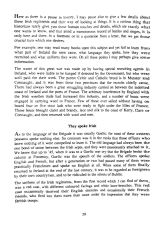
The waste of this great war was made up by having special recruiting agents in Ireland, who were liable to be hanged if detected by the Government, but who were well paid for their work. The purest Celtic and Catholic breed is in Munster and Connaught, and it was from these two provinces that the recruits chiefly came. There had always been a great smuggling industry carried on between the indented coast of Ireland and the ports of France. The arbitrary interference by England with the Irish woollen trade had increased this industry, and a number of boats were engaged in carrying wool to France. Few of these ever sailed without having on board four or five stout lads who were ready to fight under the lilies of France. These boats brought claret and brandy, lace and silk to the coast of Kerry, Clare or Connaught, and then returned with wool and men.
They spoke Irish
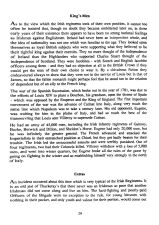
As to the language of the Brigade it was usually Gaelic: for most of these western peasants spoke nothing else. So common was it in the ranks that those officers who knew nothing of it were compelled to learn it. The old language had always been the one bond of union between the Irish septs, and they were passionately attached to it. We know that up to '45, when it was to a Gaelic war cry that the Brigade broke the column at Fontenoy, Gaelic was the speech of the soldiers. The officers spoke English and French, but after a generation or two had passed many of them were practically Frenchmen and spoke no English at all. When some of them finally returned to Ireland at the end of the last century, it was to be regarded as foreigners by their own countrymen, and to be ridiculed in the streets of Dublin.
The uniform of the Irish regiments, from the first record which I can find of them, was a red coat, with different coloured facings and white knee-breeches. This red coat occasionally deceived their English enemies and occasionally their French friends, who fired into them more than once under the impression that they were British troops.
King's Men
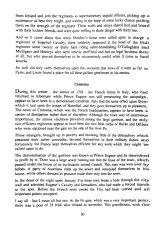
As to the view which the Irish regiments took of their own position, it cannot too often be insisted that, though no doubt they became embittered later on, in these early years of their existence there appears to have been no strong national feelings as Irishmen against Englishmen. Ireland had never been an independent whole, and the idea of nationality was not one which was familiar to the age. They looked upon themselves as loyal British subjects who were supporting what they believed to be their rightful king against their enemies. They no more thought of the independence of Ireland than the Highlanders who supported Charles Stuart thought of the independence of Scotland. They were Jacobites with Scotch and English Jacobite officers among them and they had no objection at all to the British Crown if they could get the man of their own choice to wear it. By a chivalrous fiction they endeavoured always to show that they were not in the service of Louis but in that of James, so that the fallen monarch might perhaps feel that he stood not in the relation of dependent but of an ally to the French king.
The war of the Spanish Succession, which broke out in the year of 1701, was due to the efforts of Louis XIV to plant a Bourbon, his grandson, upon the throne of Spain — which was opposed by the Emperor and the King of England. The first important movement of the war was the advance of Catinat into Italy, along very much the same line which Napoleon was to take a century later. His old opponent, Eugene, was waiting for him in the plains of Italy, and had so much the best of the manoeuvring that Louis sent Villeroy to supersede Catinat.
He had an army of 45,000 men, including the Irish infantry regiments of Galmoy, Burke, Berwick and Dillon, and Sheldon's Horse. Eugene had only 20,000 men, but he was infinitely the greater general. The French advanced and attacked the Imperialists in their entrenched position at Chiari, but they got badly beaten for their trouble. The Irish led the unsuccessful assaults and were terribly punished. Out of four regiments, two had their Colonels killed. Villeroy withdrew with a loss of 5,000 men, and went into winter quarters, but Eugene broke all the rules of the game by going on fighting in the winter and so establishing himself very strongly in the north of Italy.
Extras
An incident occurred about this time which is very typical of the Irish Regiments. It is an old jest of Thackeray's that there never was an Irishman so poor that another Irishman did not come along and live on him. The hard-fighting and poorly-paid Officers of the Brigade were no exception to the rule, for young kinsmen with nothing in their pocket, and only youth and valour for their portion, would come out from Ireland and join the regiments as supernumerary unpaid officers, picking up a sustenance as best they might, and waiting in the hope of some lucky chance putting them on the strength of the regiment. These waifs and strays shared bed and board with their luckier friends, and were quite willing to share danger with them too.
And so it came about that when Sheldon's horse were called upon to charge a regiment of Imperial Cavalry, there suddenly appeared at the head of the Irish regiment some twenty or thirty hard riding sabre-brandishing O'Callaghans and Mulligans and Hooleys who were strictly unofficial and had no legal business there at all, but who proved themselves to be uncommonly useful when it came to hard knocks.
So well did they carry themselves upon this occasion that news of it went as far as Paris, and Louis found a place for all these gallant gentlemen in his armies.
Cremona
During this winter — the winter of 1702 — the French forces in Italy, who had returned to hibernate while Prince Eugene was still prosecuting the campaign, appear to have been in a demoralised condition. Italy had the same effect upon them which it had upon the troops of Hannibal, and they gave themselves up to pleasure. The town of Cremona, which was the French headquarters, appears to have been a centre of dissipation rather than of discipline. Although the town was of enormous importance, the utmost slackness prevailed among the large garrison, and the only two efficient regiments appear to have been the two Irish corps of Burke and Dillon who were stationed near the gate on the side of the river Po.
These strangers, brought up in poverty and knowing little of the debauchery which attracted their softer comrades, devoted themselves to their military duties and fortunately for France kept themselves efficient for any work which they might be called upon to do.
The demoralisation of the garrison was known to Prince Eugene and he determined to profit by it. There was a large sewer running out into the fosse of the town, which passed under the house of an ecclesiastic named Cassoli. This man was won over by bribes. A party of Austrians crept up the sewer and concealed themselves in his house, while others dressed as peasants made their way into the town.
In the dead of the night upon January 31st these men broke a hole through the city wall and admitted Eugene's Cavalry and Grenadiers, who had made a forced march to the spot. Before the French were awake the City had been carried and all important points occupied.
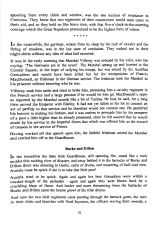
I say all — but I mean all but one. At the Po gate, which was a very important point, there was a post of 35 Irish who refused to surrender. This guardhouse, with fire spouting from every chink and window, was the one nucleus of resistance in Cremona. They knew that two regiments of their countrymen would soon come to their aid, and so they held on like brave men, with that five-o'clock-in-the-morning courage which the Great Napoleon pronounced to be the highest form of valour.
In the meanwhile, the garrison, woken from its sleep by the rush of cavalry and the firing of muskets, was in the last state of confusion. They rushed out in their night-shirts without any idea of what had occurred.
It was in the early morning that Marshal Villeroy was aroused by his valet, who ran crying: 'The Germans are in the town!' The Marshal sprang up and hurried to the Central Square, in the hope of rallying his troops, but was seized by the Austrian Grenadiers and would have been killed but for the interposition of Francis MacDonnell, an Irishman in the German service. The Irishman took the Marshal as his prisoner without knowing who he was.
Villeroy took him aside and tried to bribe him, promising him a cavalry regiment in the French service and a large pension if he would let him go. MacDonnell's reply as reported by the Marshal sounds like a bit of Tacitus. He had, he said, for a long time served the Emperor with fidelity. It had not yet fallen to his lot to commit an act of perfidy to that service and he therefore would not commit one. He preferred his honour to making his fortune, and it was useless to persuade him by the prospect of a post a little higher than he already possessed, since he felt assured that he would attain by his service in the Imperial forces that which was offered him as the reward of treason in the service of France.
Having worked off this speech upon him, the faithful Irishman seized the Marshal and carried him off to the Guardhouse.
Burke and Dillon
In the meantime the little Irish Guardhouse, still spouting fire, stood like a rock amidst this rushing river of disaster, and away behind it in the barracks of Burke and Dillon there was shouting in Gaelic, rattle of drums, and mustering of half-clad men. Austria must be quick if she is to take that little post!
Austria tried to be quick. Again and again her best Grenadiers were within a musket-length of the palisades — again and again they were blown back by a crackling blaze of flame. And louder and more threatening from the barracks of Burke and Dillon came the hoarse growl of the Irish drums.
And now the two Irish regiments came pouring through the barrack gates, the men in their shirts and breeches with fixed bayonets, the officers waving their swords, a pretty war picture in the bright cold morning.
Remember that these men had no conception how many enemies they were about to meet, and they might have been — as indeed they really were — almost the last corps left unbroken in the garrison. They had no doubt whatever as to what they wanted. There were 35 men missing down there by the Po gate, and they were curious as to what had become of them.
They swept aside the Imperial Infantry, they beat back the famous Imperial Cuirassiers with their bayonets, and so they smashed and shoved until they came to the indomitable guard-house. There they occupied all the building round and loop-holed them for musketry fire. Whoever could take the Po gate now — with Burke and Dillon on each side of it — would have a feather in his cap. From break of day until noon the gate was assailed, but at noon it was still untaken.
Bribes offered
Meanwhile the French had begun to rally. The Regiment des Vaisseaux was the first to get into order. Their Colonel, with the fine flippant French gallantry, cried out to Austrian Grenadiers: 'You are welcome, gentlemen, though you have deranged our toilets.' An instant afterwards he was a dead man. But the French had rallied, and though the city was still, with the exception of the Po gate, in the hands of the Austrians, there was resistance in every street and square.
And now a curious incident occurred. Eugene, finding that the Po gate was the key of the place, and that this key was very safe in the pocket of Colonel O'Mahony of Dillons, thought that he would try to buy over the Irish. For this object he despatched that Irish officer of his, Frances MacDonnell, who had already shown that he was himself above corruption.
MacDonnell approached under a flag of truce and assured the Irish that their position was hopeless, that they were the only troops left fighting in the City, that they would infallibly be cut to pieces, and that if they would come into the Austrian service they would have a large rise in pay.
O'Mahony's reply
O'Mahony replied: 'Prince Eugene seems to fear us more than he respects us, since he causes such proposition to be made to us. If His Highness only awaits your return to attack us and cut us to pieces, it is likely to be some time before he can do so; for we are going to take measures to prevent your returning. I arrest you as a prisoner, not looking upon you any longer as the agent of a great general, but as a suborner. It is by such conduct that we wish to gain the esteem of the prince, and not by an act of cowardice — a treason unworthy of men of honour.'
O'Mahony then arrested MacDonnell, amid shouts from the officers that they would live and die in the service of the King of France.
I think that this incident with Irishmen on both sides forms a curious historical episode. MacDonnell fell in battle next year, but he acquired a European fame through his refusal of Marshal Villeroy's offers, and when his father, who lived to be 118 years old was asked why he had attained such an age he always said: 'the remembrance of the fidelity and disinterestedness of his son contributed greatly to prolong his days.'
Eugene withdraws
And now, as it was evident that the Po gate was safe, the Irish, leaving a detachment to guard it, began to work round the ramparts in order to carry some of the other gates. They came upon a guardhouse held by the Austrians just as their own guardhouse had been held, but they carried it with a rush. Finding great forces opposed to them, and having repeatedly beaten back cavalry charges, they made their way back to the Po gate again.
I have already dwelt upon this incident at a length which is out of all proportion to the amount which I have to compress into my paper, but the repulse of Cremona is certainly one of the greenest of the many laurels plucked by the Irish Regiments. After a long day's fighting from seven in the morning to six at night, Prince Eugene withdrew from the City which, as was said at the time, he had won by one miracle and lost by another one.
As his rear emerged from the gate of St Margaret, the Irish came snarling after it, and took two kettledrums as souvenirs from his Cuirassiers.
The French loss was about 1,400, the Austrian about 1,200. The Irish had 600 men engaged and lost 350 killed and wounded. These figures speak for themselves.
The French present could not find words to express their sense of what they owed to their Irish comrades. Count de Vaudrey, in his account, says: 'Les Irlandais ont fait des choses incompréhensibles.' [2] The strangeness of the adjective gives an index of the height of the Count's admiration.
But I fear that no adjective of a historian could give the brigade the satisfaction which they had from the action of Louis, who at once raised the pay of all the Irish Regiments to the highest scale which was known in the French Army.
I shall now pass rapidly over the desultory and inconclusive fighting on every part of the French frontier which made up the campaigns of 1703 and 1704. Bavaria had joined France, and in 1704 an allied army under Marlborough and the ubiquitous Eugene penetrated into Bavaria and found itself faced by the Franco-Bavarian army under Marshal Tallard. There followed the great battle of Blenheim, which ended in one of the greatest defeats which the French arms have ever sustained. A word or two as to the Irish troops in this action.
The armies were about equal strength, but the French had the advantage of position, while the Allies on the other hand were commanded by the two most brilliant generals of the age. The dispositions of the French were most faulty. On their right flank in the village of Overklaw were posted three Irish regiments, Dorrington, Clare and Lee — Lee being that which was formerly known as Mountcashel's. Tallard had thrown his main strength into the village of Blenheim, which was masked by the Allies, while they turned their own strength to breaking the French centre, which they successfully accomplished. The French troops in Blenheim, 13,000 of the elite of the army, were simply out of the battle altogether.
Meanwhile the Allies tried to capture Overklaw, where the Irish were. Four Dutch regiments attacked it but were repulsed. One of them — Goor's regiment — was annihilated. Again and again it was attacked, but always with the same result. Meanwhile the 13,000 troops in Blenheim laid down their arms. The Irish in Overklaw, seeing themselves deserted, cut their way out through the enemy and effected an orderly retreat, covering the rear of the French.
It was one of those defeats in which the Irish troops gained as much honour as any victory could have brought them. The battle being lost,' says a French Chronicler, 'the Irish forced a passage for themselves through the enemy, who took no prisoners from them. And they did not lose any colours, which may be taken as a creditable circumstance upon that fatal day.'
Ramillies
The year 1705 was memorable for the great battle of Cassano between those old antagonists, Eugene and Vendome, in which Dillons, Galmoys, Berwicks, and Fitzgeralds were all conspicuous. Then in 1706 the scene of the main fighting changed to the Low Countries where Marlborough was opposed to Villeroy in the battle of Ramillies.
In this battle the opposing forces were about equal. The same could not, however, be said for the generals, and Marlborough carried all before him. Clare's Regiment was engaged in the battle and how they fought may be gathered from their loss of 289 men, 22 officers and 14 sergeants. They captured two Colours, one from a Dutch and one from an English regiment, and those two Colours captured by Clare's were the only two Colours lost by the whole allied army that day. I do not think that anything could show more conclusively what formidable troops these veterans had become. But the colonel and the major of Clare's were among the dead. The whole of this campaign was a triumph to the British, who almost cleared the French out of Flanders.
Their affairs, however, did not go equally well in Spain, where there had been much desultory fighting culminating in the year 1707 in the battle of Almanza. I know only two occasions when armies composed mainly of British troops were defeated upon the Continent last century. They were Almanza and Fontenoy and on each occasion Irish troops helped to turn the fight against them.
This battle was remarkable from the curious fact that the French army was commanded by an Englishman and the English by a Frenchman. The first was the Duke of Berwick, the natural son of James, and the other was Lord Galway, who was Ruvigny, the Huguenot refugee.
The forces were about equal, but the result was a crushing defeat of the Allies who lost 15,000 men. Berwick's Irish Regiment and Mahony's dragoons distinguished themselves in the engagement, which had the effect of ending the whole Campaign in Spain. Three new Irish battalions were formed out of the Irish prisoners from the British army, which shows that the laws had been powerless to prevent large numbers of Catholic peasants from enlisting.
Congress of Utrecht
The war now languished to a close, breaking out in fiery spasms in Spain and the Lowlands, but subsiding again into the deliberate warfare of fortified lines and entrenched camps. Politics in England brought about the recall of Marlborough, and the Duke of Ormonde, who succeeded him, was luxurious in the camp but sluggish in the field. Finally, England withdrew from the Alliance and, in 1713, the great struggle came to an inconclusive termination at the Congress of Utrecht, nobody being much the better for this profuse and prolonged expenditure of blood and treasure.
Europe settled down into a peace, broken only by the half-hearted campaigns between France and the Emperor of Germany, until the outbreak of the war of the Austrian Succession, which began in 1743.
The outbreak of Peace was a serious misfortune for the Irish regiments, which were reduced in numbers, and many poor officers who could not return to their own country found themselves vegetating upon half-pay in French provincial towns. The regiments themselves did not show up so well in peace as in war. They were unruly occasionally in their quarters. Louis XV remarked that the Irish troops gave him more uneasiness than all the others. 'That is precisely what your Majesty's enemies say,' said the Duke of Berwick, who overheard him.
At Deltingen
But again a great war was approaching, and again there was every effort by the Agents and the smugglers to get these fine regiments ready for their work. The first generation of the Brigade had passed away, and there were very few probably of those who followed Marshal Saxe who had been old enough to carry a fir-lock in the wars at Marlborough. The spirit survived — but it was a more bitter one than of old, and there was more of the National and less of the Jacobite feeling in the way in which they looked upon Great Britain.
The prolonged enforcement of the Penal Laws had had its natural effect, and Irishmen, outraged in every human right, had set their hearts like flint against the Government of which they were nominally the subjects. Soldiers in this frame of mind were awkward antagonists, at a time when the military reputation of England, both at home and abroad, reached a lower level than it has ever done in the whole of her long and, in the main, glorious history.
There were four regiments — Clare's, Dillon's, Roth's and Berwick's — at the Battle of Deltingen, but they could not get engaged. A letter is extant from an Irish officer bewailing the fact and showing the spirit which animated the troops. 'Had we been of the number that attacked,' says he, 'we might have retrieved the affair by inspiring other troops with an equal intrepidity, and thus the action might have been continued until the whole army arrived. But we should have been infallibly cut to pieces to the last officer and soldier before either Frenchman or Englishman should have had it in their power to reproach us with turning our backs, notwithstanding every inequality, until a retreat should be commanded. As I was early at the field of battle,' he adds, 'I had every Irish and English soldier transported to hospital before I suffered an Austrian or Hanoverian to be moved, and did them every kind of office in my power.'
It is charming in this last sentence to see that, in spite of monstrous persecution and bitter resentment, there was still that human, charitable feeling for men of their own speech.
Fontenoy
The Campaigns of 1744 were of no great interest, but those of 1745 — a disastrous year in every way for England — opened with the great battle of Fontenoy which spread the fame of the Irish Brigade throughout Europe, and may stand with Cremona as its greatest achievement.
The Allies consisted of 50,000 men, of whom 21,000 were British. The French were 40,000, with all the Irish at that time in the service, namely the foot of Clare, Dillon, Bulkeley, Roth, Berwick, and Lally, with the horse of Fitz James. Saxe, the greatest military genius of the age, led the French — it is, by the way, a curious fact that whether it be a Corsican like Buonaparte, a German like Saxe, or an Englishman like Berwick, the best leaders of the French have often been foreigners. The English were led by the Duke of Cumberland, a man who was cruel against the defenceless, but who was an absolutely incompetent General.
The French had a defensive position, which atoned for the inferiority of their numbers. The attack was made by a Dutch Column on one wing and by a column of British and Hanoverians in the Centre. Louis XV with his Court stood upon a hill and saw this huge scarlet mass, 15,000 men in all, coming slowly but as remorselessly as destiny, with 20 Cannon in front of it, against the middle of his position. There was one dreadful hour,' said one of these Courtiers, 'in which we expected nothing less than a renewal of the affair of Deltingen, our Frenchmen being awed by the steadiness of the English and by their rolling fire which is really infernal, and I confess to you is enough to stupefy the most unconcerned of spectators. Then it was that we began to despair of our cause.'
They had good reason to despair, also, for nothing seemed able to stop the slow, ponderous advance of that infernal column. The French Guard threw themselves in front of it, and was faced by the English Guard. The officers on both sides, with that fine chivalry which has so often marked French and English warfare, saluted with their swords. Lord Charles Hay, of the English Guards, shouted out: 'Fire, Gentlemen of the French Guard!' 'After you,' cried a French officer. The English took him at his word, and the volley that poured from them broke their brave adversaries to pieces.
Irish Charge
Regiment after regiment, the Swiss Guards, the Marines, the King's Regiment, the Cavalry, were each in turn brushed aside, and the column, bellowing in its exultation, had passed through the French line. Had the Dutch succeeded in their attack, nothing could have saved the French army. But now they concentrated all their efforts upon the column, assailing it with artillery in front, and charging home upon each flank.
The six Irish regiments, with a Gaelic slogan which meant 'Remember Limerick and Saxon Perfidy,' were the leaders in the great charge which at last broke the Column. They were fresh troops, and animated by every stimulus which could make men regard life as nothing compared to the cause in which they were fighting. The Column had already been shaken by the point-blank cannonade, before this fiery rush of the Irish. Gaps and rents appeared in its dense masses. The edges and rear began to shred out. The English saw the red uniforms and fair complexions of the Irish breaking through the smoke, and amid their Gaelic shouts, heard them call to each other 'Steady boys! forward! Charge!'
They broke through the Coldstream Guards and penetrated deeply into the Column. Lord Clare fell, so did Dillon, but the rush was not stopped. The French Cavalry hacked at the Irish, misled by their red coats, but this did not check the brigade. They took the Colours of the Guards, captured 15 cannon, and were only stopped when no foeman was left with whom to fight.
It is a scene which no patriotic British citizen can dwell upon without pain, and yet it must be confessed that but for the selfish commercial and agrarian legislation of England, these young men who turned the tide of battle against her would have been employed on the looms, in the linen and woollen factories, or tilling the land of their native island.
St Patrick's Day
When the victory was won, the King and the Dauphin rode through the lines of flushed and excited troops. When the Dauphin approached the Irish ranks he saw Lally — who had done more than any other man to bring about the victory — seated on a drum in front of the remains of his regiment. The Dauphin promised the favours of the King to the officers of the Brigade, to which Lally answered: 'Monseigneur, they are like those of the Gospel, for they fall upon the blind and the lame.' He pointed as he spoke to Colonel O'Hagerty, who had a bayonet wound in his eye, and to Major Glascock, who had a ball in his knee. The King then made Lally a brigadier and distributed many honours among all the officers.
There is an interesting account by MacDonough, an officer of the brigade, of the bearing of the Irish troops at the end of their great action. 'When the British had retired,' he says, 'the Brigade was ordered to rest, and when the officers came to move among the men they found several of them in tears. Being asked what was the reason of this, when they had so nobly done their duty, they replied that they would do so again when necessary, but that it was hard that they should have to fight against their own countrymen and even their own relatives.' To cheer them up the band was ordered to play 'St Patrick's Day', when the men instantly started up, shouted out 'Hurrah for old Ireland', and were as alert and as ready for a row as ever.
The English took the same view of the hardship of the thing. George II is reported to have cried out: 'Accursed be the laws which have deprived me of such subjects.' Henry Grattan, an Irish Protestant, said: 'We met our own laws at Fontenoy. The victorious troops of England were stopped in their career of triumph by the Irish Brigade, which the folly of the Penal Laws had shut out from the ranks of the British Army.'
Prince Charlie
The British Government of the day showed what they thought of the value of the Irish soldiers by at once passing severe laws by which any recruit leaving Ireland should lose all civil rights and be liable to death if he returned. The laws of the same sort which existed before had never been very stringently enforced, for the Government often winked at the flight of the Wild Geese, thinking that a dangerous high-spirited man was better out of the country, but now they suddenly realised that the Geese might come flying back again. In passing and enforcing these laws, the British Government was no doubt only doing that which it was entitled to do by the laws and customs of all nations. But the date of the new laws made them an obvious compliment to the Irish soldiers.
In 1745 Charles Stewart raised the standard of revolt in the Highlands, defeated the Government forces at Prestonpans, marched into England as far as Derby, and then, not meeting any support from the English Jacobites, who were rebels only over the claret bottles, they retraced their steps into Scotland and were finally dispersed at Culloden, near Inverness. During this campaign Colonel O'Sullivan, a Kerryman and a member of the Brigade, was chief of the Prince's staff, and he was supported by a small body — 150 or so — of the soldiers of the Brigade, who were the only disciplined troops in his army.
A great misfortune befell the Brigade at this time, for the transport Esperance, which carried 150 of them, including many officers, was captured at sea by the English, and all were made prisoners of war. An inhabitant of Hull who saw them says: 'The men are all clothed in red, and the Officers have mostly gold laced hats. To speak impartially, the Officers are as proper men as ever I saw in my life, being most of them 5ft. 10 or 6ft. high, and between 40 and 50 years of age; and the common soldiers are very good like men, and if they had landed might have done a great deal of mischief.'
Peace
Peace was fully proclaimed in 1748, and it may be said to be one of the very few wars between France and Britain in which France could at the end say that she had derived any advantage — for which she has largely to thank the genius of a German leader and the valour of Irish exiles. The French official Memoire upon the Brigade at the end of the war says: 'Union has prevailed to so great a degree in the Irish Brigade, since all the corps were thus made to serve together, that the most trifling dispute never took place, and it appeared as if the different battalions formed but one united and unanimous regiment.' 'It is considered,' says the report, 'that this conduct was as creditable to it, as the exactitude and willingness with which it served and the splendid and transcendent actions by which it distinguished itself.'
Peace was not of long duration, as might have been expected when the last war had left England sulky and France flushed and presumptuous. In 1756 broke out the Seven Years' War, and again the Brigade was summoned to action. But already the days of its decline had begun. The ameliorated condition of Ireland, and the increased vigilance of the British in preventing recruiting, had cut at the roots of the organisation. The officers were still Irishmen but more and more foreigners were finding their way into the historical ranks, and the Gaelic-speaking soldier was becoming rarer.
Lally's End
I had intended to give some account of the remarkable excursion of Lally to India, in which for a time he shook the very foundation of British power and besieged their head city of Madras. I find, however, that it is to some extent a divergence from my subject, and I will dismiss the incident in a paragraph. He took with him his own Irish regiment, the Regiment of Lorraine and some artillery, and after many victories and adventures, and doing all that a man could do, he fell into the hands of the English, who sent him back to Paris upon parole. There he was violently attacked by interested people whose peculations and civil deeds he had exposed in Pondicherry, and he — the victor of Fontenoy — was finally put to death by the public executioner in Paris.
He had been accused among other things of amassing a huge fortune in the East, but after his death it was found that he had really hardly anything. It is a shocking story, and one which I should think no Frenchman could read without a blush.
One of the chiefs of the Irish Brigade was so stirred by it that, appearing at the head of his regiment, he took the cockade from his hat and, spurning it upon the earth, he solemnly swore that he would never more serve a king and a people who had with such ingratitude sacrificed his friend and countryman, the brave Count Lally.
One only wonders that the whole Brigade did not resign in a body.
In 1757 the Great Frederic beat the French badly at the battle of Rosbach. The only laurels gathered on that side that day were by the Irish Cavalry Regiment of Fitz James and by two regiments of Austrian Cuirassiers. These three corps went on fighting when the rest of the French were in full retreat.
The Great Frederic mentioned their courage: 'The two Austrian Regiments formed to face him,' he says, 'and sustained the shock, but being abandoned by the French, with the exception of the regiment of Fitz James, they were almost totally destroyed.'
This same gallant regiment of Fitz James was nearly annihilated in a later campaign of the same war, in the action at Grachenstein. This was a surprise which fell with disastrous effect upon the French army, and particularly upon the Irish Horse, who lost 70 prisoners and a standard.
An English officer who was there says: 'We cannot help in this place lamenting the fate of Fitz James' Horse, tho' in the service of our enemies. They proved themselves our brethren, though misled. Is it not a great misfortune that through a false principle of policy we suffer many gallant men to enlist in our enemy's service?'
There was nothing else of interest which concerns the Irish Brigade in the Seven Years' War which came to an end by the Treaty of Paris in 1763.
In Austria
While Irishmen had been performing these feats in the service of France, their military reputation had been equally high in Spain and in Austria. That is a branch of the subject which I shall not touch upon, as it would require a paper by itself. The Emperor Francis I of Germany left a paper after his death which says: 'The more Irish Officers in the Austrian Service, the better. Our troops will always be disciplined. An Irish coward is an uncommon character and what the natives of Ireland dislike from principle they generally perform through a desire for glory.'
In an account of a Court festival in Vienna we find that there were present: 'Count Lacy, President of the Council of War, Generals O'Donnel, McQuire, O'Kelly, Browne, Plunket and McEligot,' with grand crosses and orders innumerable — and this at a time when under no possible circumstances could a Catholic officer rise to be more than a colonel in the service of his own country — so much so that, when a certain major-general in the British Army was asked what religion he was of, he replied that he was of the religion of major-generals.
In discussing this question we must remember all the time that the Catholic countries were even more distinguished for intolerance than the Protestants, and that in this very Austria the fate of the Lutheran officer would be as hard or harder than that of the British Catholic. Neither side can fairly blame the other, and looking back at it all, we can only marvel, with the dying Swedish Chancellor, upon the little wisdom which it takes to govern the world.
Loss to Britain
In 1776 we get an interesting glimpse of Berwick's Regiment in a letter from an English traveller, who had come across them in Calais. He says: 'I found Berwick's regiment on duty in this town; it is commanded by Mons, le Duc de Fitz James and a number of Irish gentlemen, my countrymen (for so I will call them). You may easily imagine that men who possess the natural hospitality of their own country, with the politeness and good breeding of this, must be very agreeable acquaintances in general; but I am bound to go farther, and to say that I am endeared to them by marks of true friendship. The Kings of France, nor any prince in Europe, cannot boast of troops better disciplined; nor is the King insensible of their merit, for I have lately seen a letter written by the King's command from Comte de St Germain, addressed to the officers of one of these corps, whereby it appears that the King is truly sensible of their distinguished merit, for braver men there are not in any service. What an acquisition to France! What a loss to Britain!'
Brigade declines
And now the decay and dissolution of the Brigade was rapidly approaching. Though it preserved its national names and its national officers, it had fewer and fewer Irishmen in its ranks. The relaxation of the penal laws and the great increase in Irish prosperity, coupled with the decline of the Stewart cause, made it harder and harder to revive the old spirit.
The Regiments fought both by sea and land in the American war, but there is no special achievement to be related about them. A spirit of loyalty had begun to spring up in the Irish corps of the British army which prevented them from deserting as they had once done. An officer in the House of Commons said: 'He called upon every military Gentleman in the house to say whether any men had ever behaved better. Though they fought against Papists, the French, yet their religion did not influence them to desert, but they did their duty and were as amenable to discipline as any men in the army.' Colonel Browne affirmed: 'Papists can be and are as loyal as any others, of which I will give an instance. In the time of the late war I recruited the regiment in which I served with about 200 Catholics raised in Cork. They went to Canada, and when in garrison in a Catholic town and surrounded with Catholics, while many Protestants deserted, not one of these Catholics ran away.'
We can see by such speeches as these in the House of Commons that Englishmen were waking up to the value of the material which they had for so long neglected.
France cast down
Then came the rapid change in Irish affairs, affected partly through the weakness of England after the American war, and partly from her sense of Justice. Ireland obtained her own Parliament, free trade, an almost total abolition of the penal laws, and other concessions. The Catholics were still far from being on an equality with their Protestant fellow-citizens, but at least those crying injustices which drive men to desperation were removed.
And as Justice was done the Brigade withered. It could not have lasted much longer, in any case, but the French Revolution was its death-blow. France was astounded at the change in Ireland which followed better legislation. 'The more Britain rejoiced,' says a contemporary, 'the more France was confounded. Her eyes, which are always open to her own interest, well see the tendency of such a fatal step to her. No sooner was it seen there that the Act was passed in favour of Catholics, than a universal cloud was seen in every countenance, and the general cry was: 'Here are 200,000 men armed against us.' They lamented to think that their Irish Brigades must now fall to the ground, and that they could no longer expect to be supported by a disaffected party among ourselves in case they should invade us. To show to what a length they carried their regret, the students of the English College at Douay wanted to give public thanks to God for the event, but they durst not do it.'
The Last Days of The Irish Brigade
And now the wheel of history took one of its strangest and most unexpected turns. The Irish regiments, like all foreign mercenaries, were attached to the King who paid them, rather than to the Constitution of the country in which they lived, so that they were royalists to a man. The mercenary troops in the French army had, in 1790, been allowed to sink from about 60,000 to about 20,000, and it is quite possible that, if it had not been for this, Louis would have had a tool in his hand with which he might have crushed the insurgents.
Several of the Irish officers were sacrificed for their loyalty to the King. One Dillon was murdered by his troops. Another was guillotined. The lady who should have preceded him on the scaffold shrunk back and implored him to go first. 'Anything to oblige a lady,' said he, and walked on to his doom.
When the Bourbons fled from France and were followed by their adherents, the officers of the Irish regiment threw their lots in with the exiled monarch, exactly as their great-grandfathers had done before them. The English Government had taken the same side, and so by the whirligig of fate these century-old opponents found themselves at last on the same side.
The Duke of Fitz-James, with all the officers of the Brigade, many of whom were indistinguishable from the other French emigrés, passed into the service of the British Government and were employed in raising regiments in Ireland. In order to combat Protestant prejudice these regiments were to be used only abroad.
So it came about that when, after all these long years of waiting, there was a serious French descent upon Ireland under Hoche, and afterwards Humbert, the very men who had been so eager for it were now the most anxious that it should fail, since its success would have weakened the cause of the monarch to whom they were true.
Change of Loyalty
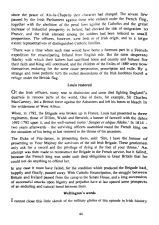
Lecky, in dealing with the subject, says: 'One of the most remarkable facts in the history of Hoche's expedition is the almost entire absence of those naturalised Irishmen who had so long and bravely fought under the French standard. Great numbers of the very flower of the Irish race had during the last century taken refuge in France, and the three Regiments of Berwick, Dillon and Walsh, which had been formed in 1689 out of the Jacobite Refugees, and replenished by the many Irish Catholics who fled from Ireland during the period of the penal laws, continued to the end of the Revolution.
'No Regiments in the French army had for 100 years a higher record of service, but since the peace of Aix-la-Chapelle their character had changed. The severe law passed by the Irish Parliament against those who enlisted under the French flag, together with the abolition of the penal laws against the Catholics and the great increase of industrial prosperity in Ireland, had checked the tide of emigration to France, and the Irish element among the soldiers had been reduced to small proportions. The officers, however, were Irish or of Irish origin, and to a large extent representatives of distinguished Catholic families.
'There was a time when such men would have borne a foremost part in a French expedition for emancipating Ireland from English rule. But the same desperate fidelity with which their fathers had sacrificed home and country and fortune for their faith and King still continued, and the children of the Exiles of 1689 were now themselves enduring for the same cause persecution, proscription and exile. By a strange and most pathetic turn the exiled descendants of the Irish Jacobites found a refuge under the British flag.'
Louis restored
Of the Irish officers, many rose to distinction and some died fighting England's quarrels in remote parts of the world. One of them, for example, Sir Charles MacCartney, led a British force against the Ashantees and left his bones to bleach in the wilderness of West Africa.
When, in 1792, the Brigade was broken up in France, Louis had presented to three regiments, those of Dillon, Walsh and Berwick, a banner of farewell with the dates 1692-1792 upon it, and the well-earned motto 'Semper et ubique fideles.' In 1814 — two years afterwards — the surviving officers assembled round the French king on the occasion of his being at last restored to the throne of his ancestors.
The Duke of Fitz-James, in presenting them, said: 'Sire, I have the honour of presenting to Your Majesty the survivors of the old Irish Brigade. These gentlemen only ask for a sword and the privilege of dying at the foot of your throne.' An attempt was then made to reconstruct the Brigade in the French service, but it failed, because the French king was under such deep obligations to Great Britain that he could not do anything to offend her.
In any case it must have failed, for the condition which produced the Brigade had, happily and finally, passed away. With Catholic Emancipation, the struggle between Britain and Ireland passed from the camp to the Senate House, and a long succession of successful attacks upon bigotry and prejudice have at last opened some prospects of an enduring and natural bond between them.
Wellington's words
I cannot close this little sketch of the military glories of this episode in Irish history better than by quoting the words of the great Duke of Wellington, when the British Government had fairly tried the experiment of admitting Irish Roman Catholics into her armies.
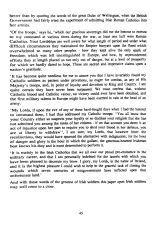
'Of the troops,' says he, 'which our gracious sovereign did me the honour to entrust to my command at various times during the war, at least one half were Roman Catholics. Your Lordships are well aware for what length of period and under what difficult circumstances they maintained the Empire buoyant upon the flood which overwhelmed so many other peoples — how they kept alive the only spark of freedom which was left unextinguished in Europe, and how, by unprecedented efforts they at length placed us not only out of danger, but at a level of prosperity for which we hardly dared to hope. These are sacred and imperative claims upon a nation's gratitude.
'It has become quite needless for me to assure you that I have invariably found my Catholic soldiers as patient under privations, as eager for combat, as any of His Majesty's troops, and, in point of loyalty and devotion to King and Country, I am quite certain they have never been surpassed. We must confess that, without Catholic blood and Catholic valour, no victory could ever have been obtained, and the first military talents in Europe might have been exerted in vain at the head of an army.
'My Lords, if upon the eve of any of those hard-fought days when I had the honour to command them, I had thus addressed my Catholic troops: "You all know that your Country either so suspects your loyalty or so dislikes your religion that she has not admitted you among the ranks of her citizens — if on that account you deem it an act of injustice upon her part to require you to shed your blood in her defence, you are at liberty to withdraw", I am sure, my Lords, that however bitter the recollections, they would have spurned the alternative with indignation; for the hour of danger and glory is the hour in which the gallant, the generous-hearted Irishman best knows his duty and is most determined to perform it.
It is mainly to the Irish Catholics that we all owe our proud pre-eminence in the military career, and that I am personally indebted for the laurels with which you have been pleased to decorate my brow. I glory, my Lords, in the name of Ireland, and it is the highest pleasure I could wish to help in the grateful task of closing the wounds which seven centuries of misgovernment have inflicted upon that unfortunate land.'
And with these words of the greatest of Irish soldiers this paper upon Irish soldiers may well come to a close.
(1) This would appear to be a misprint in the original article. From the sense conveyed, ACD appears to mean '... the Representatives of the gospel of Peace of all denominations have invariably been in vain.'
More sources
- A.C.D. - The Journal of The Arthur Conan Doyle Society (vol. 4, 1993)
-
 p. 16
p. 16 -
 p. 17
p. 17 -
 p. 18
p. 18 -
 p. 19
p. 19 -
 p. 20
p. 20 -
 p. 21
p. 21 -
 p. 22
p. 22 -
 p. 23
p. 23 -
 p. 24
p. 24 -
 p. 25
p. 25 -
 p. 26
p. 26 -
 p. 27
p. 27 -
 p. 28
p. 28 -
 p. 29
p. 29 -
 p. 30
p. 30 -
 p. 31
p. 31 -
 p. 32
p. 32 -
 p. 33
p. 33 -
 p. 34
p. 34 -
 p. 35
p. 35 -
 p. 36
p. 36 -
 p. 37
p. 37 -
 p. 38
p. 38 -
 p. 39
p. 39 -
 p. 40
p. 40 -
 p. 41
p. 41 -
 p. 42
p. 42 -
 p. 43
p. 43 -
 p. 44
p. 44 -
 p. 45
p. 45


