Review:Sherlock Holmes in Birmingham/Philip Weller
This review of the booklet "Sherlock Holmes in Birmingham", by Paul Lester was written by Philip Weller and published in the A.C.D. - The Journal of The Arthur Conan Doyle Society (Vol. 1, No. 3) in september 1990.
Review


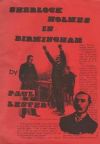
- Sherlock Holmes in Birmingham
- by Paul Lester
- Protean Publications, Flat 4, 34 Summerfield Crescent, Edgbaston, Birmingham B16 0ER, 1989; 20pp.; £4.00 paper)

Reviewed by Philip Weller
In spite of the title of Dr. Lester's booklet, he neither confines himself to Holmes, nor to the City of Birmingham. He provides, in addition to accounts of Holmes' activities in the area, a wide-ranging introduction to many aspects of Arthur Conan Doyle and his early days as a medical dispensary assistant, and discusses the subsequent effects of the days which he spent as an occasional resident of the Birmingham area. These times, from 1879 to 1882, were particularly important for Conan Doyle, since it was then that he began his literary career.
The booklet suggests that Conan Doyle received early encouragement for his written efforts, largely on the basis of the vivid letters which he wrote, and it identifies possible sources of that encouragement. Strong links are established with the semi-autobiographical Stark Munro Letters, as well as with the writing of The Mystery of Sasassa Valley. There is a claim for the inclusion of Dr. Hoare of Aston as a contributory element in the character of Sherlock Holmes which, when combined with all the other claimants for that honour, may further explain the complexity of the great detective. Reference is made to Conan Doyle's later involvement with the Edalji case in Birmingham, and to his association with the future Principal of Birmingham University, Professor Oliver Lodge, in the espousal of the spiritualist cause. The relationship of Conan Doyle with his later medical partner, Dr. Budd of Plymouth, is also discussed within a Birmingham context.
Dr. Lester rightly suggests that there has been a general lack of critical appreciation for Conan Doyle's sense of literary humour, and goes some way to correcting this by recording a number of "in-jokes" from the Holmes stories which relate to Conan Doyle's Birmingham experiences. He also mentions Conan Doyle's more direct sense of humour — the sending out of hundreds of gilt-edged invitations to a non-existent Mayor's Ball: an escapade which earned the young Conan Doyle a warning from the police.
There is a fairly thorough examinations of the locations used in the two main Sherlock Holmes stories connected with Birmingham: The Stockbroker's Clerk and The Three Garridebs, but the booklet does not provide locations for some of the minor Holmesian references to the area.
In general, Dr. Lester provides an excellent introduction to Doylean and Holmesian Birmingham. This booklet will satisfy the needs of most of those who have a passing interest in the area, and provides some good starting points for those who might wish to pursue more specialised studies. Although the text is clear, it is hoped that any future editions may be printed more professionally, to give this booklet the quality of production which its contents deserve.
- Article courtesy Christopher Roden, founder of The Arthur Conan Doyle Society (1989-2003).

