Review:Teller of Tales/Michael W. Homer
This review of the biography "Teller of Tales: The Life of Arthur Conan Doyle", by Daniel Stashower was written by Michael W. Homer and published in the A.C.D. - The Journal of The Arthur Conan Doyle Society (Vol. 10, may 2000).
This review assesses Daniel Stashower's Teller of Tales as a readable, generally accurate biography of Arthur Conan Doyle, while criticizing its lack of notes. It argues that the book captures Conan Doyle's character well, even if it does not fully explain the depth and logic of his Spiritualist convictions.
Review


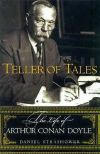
- Teller of Tales: The Life of Arthur Conan Doyle
- Daniel Stashower
- New York: Henry Holt & Company, 1999; 472pp.
- ISBN: 0-8050-5074-4; U.S.$32.50/Cdn$49.00
- London: Allen Lane The Penguin Press, 2000; 472pp.
- ISBN: 0-713-99373-1; £18.99

Reviewed by Michael W. Homer
Pre-publication publicity for Daniel Stashower's Teller of Tales: The Life of Arthur Conan Doyle promised that the book would provide 'particular emphasis on the "Psychic Crusade" which dominated his final years the work which Conan Doyle himself felt to be "the most important thing in the world".' [ www.stashower.com ] Although Stashower does discuss Conan Doyle's devotion to Spiritualism, which has either been totally ignored or at least glossed over by most previous biographers, he does not provide enough detail to fully explain Conan Doyle's zealous advocacy of it for more than fourteen years of his life. At the same time he does provide a very readable survey of the author's life from beginning to end. That is not to say that this biography does not suffer from some of the same defects as previous Conan Doyle biographies. For one thing, it lacks footnotes (and at very least footnotes should be used when an author quotes directly from another source). Many of the illustrations have been used before and there is no attribution to source. More interesting and relevant photographs could have been used, such as pictures of the Cottingley fairies, ectoplasm, Conan Doyle in military uniform, a sampling of the homes built by Conan Doyle, etc.; and there are also occasional errors, such as the reference to a 'civil' rather than a 'civilian' trial [327]. Nevertheless, the book is well written and, for the most part, it is factually accurate and has a balanced perspective.
Although Stashower does not ignore the events which transported Conan Doyle from being a medical student who was curious about ghosts and psychic events in the early 1880s to one of the most well-known missionaries on behalf of Spiritualism in the 1920s, he is most critical of Conan Doyle's infatuation with Spiritualism. Perhaps
Stashower's biggest indictment of Conan Doyle is his conclusion that ACD sometimes played fast and loose with facts when he was discussing Spiritualism. One example cited is ACD's account of an investigation of a haunted house in 1894, in which Conan Doyle suggested years after the event (1924) that he could not rule out supernatural events. Stashower suggests that ACD was willing to 'change the details' when they were inconsistent with the possibility, or perhaps even the probability, of the existence of psychic phenomena, and that ACD had 'harsh words for anyone... who disagreed with him'. [168-9] The only evidence he produces to support this conclusion is an account written by Jerome K. Jerome, which, like ACD's account, was written many years after a conversation the two authors had about the event (1926). According to Jerome, Conan Doyle told him at the time that he did not believe there was a supernatural origin for the noise at all. Given Jerome's well known antipathy toward Spiritualism in general, and Conan Doyle's advocacy of it in particular, this evidence is a thin reed upon which to conclude that ACD manipulated the facts for his own purposes. He was occasionally guilty of hyperbole, but this is a weak example.
Stashower also suggests that the only reason Conan Doyle mentioned this event at all was to prop up his oft-stated claim that his conversion to Spiritualism 'came as the result of decades of study, rather than as a latter-day conversion'. [166] This is dubious. When one reads his fiction from 1880-1916, his two letters to Light in 1887 (Stashower only makes reference to one), and his subsequent letters to the press on religious subjects written before his conversion, it is obvious that ACD was interested in Spiritualism throughout this period. He did not claim to be converted until 1916 even though his letters written in 1887 could be read as coming from a convert.
Another example cited by the author to support his conclusion that Conan Doyle manipulated facts is ACD's inaccurate quotation of a New York Times article concerning his 'first adventure' to America in 1922. In the text of his memoirs Conan Doyle wrote that a newspaper account recognized that his audiences 'saw a manifestation of the coming of a newer and finer religion'. The newspaper reported only that Conan Doyle told his audience that he saw such a manifestation. [372-3] While this criticism may be accurate, it is the type of criticism which should only be made by citing chapter and verse. There is no reference given to the New York Times article, or any assurances that all of the editions of the paper published the exact same words.
One of the most controversial events in Conan Doyle's life occurred when he published a series of articles and a book in which he argued that five photographs-which showed fairies-were real. The photographs were taken by cousins-Frances and Elsie-in Cottingley, Yorkshire in 1917 and 1920. This episode has become even more well known in the past year following the release of a movie-Fairy Tale: A True Story-which places the events in a very sympathetic, and at times inaccurate, context. Stashower believes that 'the fairy episode has done more than any other to annihilate any reputation Conan Doyle might have had as a sober-minded investigator into the unknown'. [357] Although this may be true, Stashower does not discuss all of the events leading up to the episode. Even his attempt to get into the mind of Conan Doyle, to figure out why the creator of the super-rational Sherlock Holmes could have believed in fraudulent fairy photographs, is selective. [351-363] Stashower argues that there are two reasons why Conan Doyle embraced the fairy photographs. First, he believed in spirit photography and he was overly impressed that photographic experts could not detect any obvious fraud (double exposure or tampering with negatives) in the photographs. Second, Stashower believes that Conan Doyle's family heritage also influenced his belief in the fairies. His Uncle Richard, as well as his father, Charles Altamont, drew many fairy figures in their lifetimes. Conan Doyle had listened to stories about fairies on the knee of his mother.
But this virtually ignores Conan Doyle's own explanation for his belief in the fairy photographs. In Our African Winter, published in 1929 more than eight years after becoming involved in the fiasco ACD summarized his own rationale. Stashower only mentioned one of them-that Frances had written a card to a friend in 1917, informing her that she had taken pictures of fairies, that the letter was written before any particular attention had been given to the episode, and that the young girl would not at that time have had any motive to deceive. But Conan Doyle provided additional reasons for his belief in the fairies. He wrote that if the fairy figures were cut out of a book the source should have been identified, and it had not been. He also believed that there were differences in solidity between the fairies photographed in 1917 and 1920, and that these differences were inconsistent with faking, and that experts had reported signs of movement in the photographs. Finally, Conan Doyle was impressed that Edward Gardner had formed a high opinion of the characters of both the girls and their father, and that their father would have known if there was any deception.
Since Elsie and Frances admitted, only after Conan Doyle and Gardner were dead, that the photographs were faked, it is perhaps unfair to criticize either man for believing that the girls were incapable of lying. It is surprising, however, that Stashower neglects to mention that at least one of the sources for the hand-drawn figurines was the Princess Mary's Gift Book, which was published in 1915, and which also contained an article by Arthur Conan Doyle. Given that irony, it is hard to forgive Conan Doyle for arguing in 1929 that a source for the fairy figurines was never established, when he could have discovered such an obvious source himself.
Although Stashower tells the story of Conan Doyle's attraction to Spiritualism, he does not explain why anyone especially anyone as clever as ACD would be attracted to séances, ectoplasm, and automatic writing. He fails to provide the reader with an elementary historical background to modern Spiritualism, and he does not describe the various phenomena that most Spiritualists espoused during the nineteenth and early twentieth centuries. Because much of the factual predicate is missing, some of the conclusions drawn are dubious. For example, Stashower emphasises 'belief' more than 'knowledge'. He maintains that 'like religion, Conan Doyle concluded, spiritual knowledge required belief rather than evidence', [334] and further that he believed that 'one must already believe in order to find proof'. [345] He also concludes that ACD 'had presented his spirit convictions as a matter of religious faith, and declared them immune to any scientific proof or disproof'. [437]
These conclusions are overly broad. It is true that Conan Doyle utilised different defences of Spiritualism depending on the situation, but he never placed belief above knowledge, or emotionalism above scientific proof. In his memoirs, ACD stated, 'I must have definite demonstration, for if it were to be a matter of faith then I might as well go back to the faith of my fathers. "Never will I accept anything which cannot be proved to me. The evils of religion have all come from accepting things which cannot be proved." Conan Doyle's insistence on substantive and empirical proofs of Spiritualism was consistent with the scientific revolution. Truth could not be proven without some material, tangible, experiential verification. Nevertheless, even though Conan Doyle insisted that his own conversion was dependent on obtaining 'direct proof', he eventually recognized that not all investigators would be able to obtain their own direct proof. He therefore sought to combine two divergent ways of thinking the classical or mechanistic emphasis on logic and absolute tangible answers with the romantic emphasis on intuition, inspiration, and personal revelation-in his system of conversion.
It is in this context that one attempts to understand statements concerning proof made by Conan Doyle. For example, in the account of his visit to Australia, Conan Doyle wrote: 'I have always held that people insist too much upon direct proof. What direct proof have we of most of the great facts of Science? We simply take the word of those who have examined. How many of us have, for example, seen the rings of Saturn? We are assured that they are there, and we accept the assurance. Strong telescopes are rare, and so we do not all expect to see the rings with our own eyes. In the same way strong mediums are rare, and we cannot all expect to experience the higher psychic results.' But Conan Doyle did receive a 'new revelation' and a 'definite demonstration' through phenomena ranging from physical raps and table turning to mental phenomena, such as automatic writing and speaking. He was convinced that his experiences were entirely consistent with modern science, and that they had endowed him and other Spiritualists like him with knowledge-not just belief that life continued after death. For that reason Spiritualism was, for ACD and others, 'a religion for those who find themselves outside all religions; while on the contrary it greatly strengthens the faith of those who already possess religious belief.' As Conan Doyle approached the end of his life he became more convinced of the truth and reality of Spiritualism. He told a Movietone audience that he was 'not talking about what I believe; I'm not talking about what I think; I'm talking about what I know.' He also wrote that he had received prophecies concerning the end of the world and that he had experienced a number of independent corroborations concerning them.
ACD believed that his own experiences and other corroborating evidence of Spiritualism provided an empirical factual basis for Spiritualism, in the same way that evidence and clues provided a basis for Sherlock Holmes to solve other, more mundane, mysteries. Since Conan Doyle 'knew' that the phenomena of Spiritualism were real-he was not simply a humble 'believer' who needed faith like the followers of most religions-it is hardly surprising that he never retracted his Spiritualist agenda, and that he became irritated with others who criticized him, or who ridiculed the phenomena he had seen with his own eyes. He was convinced that his acceptance of Spiritualism was consistent with the deductive reasoning of Sherlock Holmes. The great detective had observed in 'The Adventure of the Naval Treaty' that 'there is nothing in which deduction is so necessary as religion'. This statement-which was also used by Conan Doyle in the context of Spiritualism — is probably the most revealing statement he made concerning his conviction that Spiritualism is rational.
Although Sherlock Holmes may have come to a different conclusion concerning Spiritualism-'ghosts need not apply' he would have recognized that Conan Doyle, like Dr. Watson, was a sincere friend who was loyal and constant — even if he did not always evaluate facts correctly, and his conclusions were often flawed.
Although Stashower does not capture the essence of Conan Doyle's unquestioning acceptance of Spiritualism, he does portray the personality and character of the man. The book demonstrates that even if Conan Doyle was naïve and stubborn he was also sincere and genuine. For this reason Teller of Tales is a welcome addition to the biographies of Conan Doyle — and in this reviewer's opinion it is the best since Pierre Nordon's well written tome.
Michael W. Homer
- Article courtesy Christopher Roden, founder of The Arthur Conan Doyle Society (1989-2003).

