Review:The Secret Marriage of Sherlock Holmes and Other Eccentric Readings/Sonia Fetherston
This review of the book "The Secret Marriage of Sherlock Holmes and Other Eccentric Readings", by Michael Atkinson was written by Sonia Fetherston and published in the A.C.D. - The Journal of The Arthur Conan Doyle Society (Vol. 7, 1996/7).
This review discusses Michael Atkinson's The Secret Marriage of Sherlock Holmes and Other Eccentric Readings, which applies modern literary theories, such as Jungian psychology, semiotics, and mythic motifs, to Sherlock Holmes stories. It highlights how Atkinson reinterprets Conan Doyle's texts through unconventional critical perspectives to reveal new meanings in familiar tales.
Review


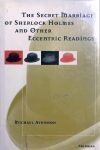
- The Secret Marriage of Sherlock Holmes and Other Eccentric Readings
- by Michael Atkinson
- University of Michigan Press, 1996; x + 198 pages; U.S.$29.95; ISBN: 0-472-10710-0

Reviewed by Sonia Fetherston
Since the Holmesian canon is regrettably finite we plan each return trip with great care. In The Secret Marriage of Sherlock Holmes and Other Eccentric Readings author Michael Atkinson, a literature professor from the University of Cincinnati, shows us there are more ways to arrive at 221B Baker Street than simply turning north at Portman Square. Atkinson approaches the Holmesian canon armed with maps representing different critical perspectives. His book, just nominated for a prestigious Edgar Award, paves new ground. In it, Atkinson pairs nine of the Holmes stories with an equal number of genres, testing Arthur Conan Doyle's work against modern literary analysis. Traditional romance motifs emerge from 'A Scandal in Bohemia', producing the secret marriage of the book's title. The stylistic split of A Study in Scarlet is held up against Jungian psychology. Semiotics is applied to 'A Case of Identity' to show Holmes is not always an empirical thinker. And, in what is perhaps the book's most provocative essay, kundalini yoga philosophy is compared with events from 'The Adventure of the Speckled Band'. This 'is not a shotgun wedding of Holmes to a particular style of reading, but a series of flirtations, tentative engagements, each with its own interest, all options kept open', Atkinson explains. In other words, there is still a great deal of mystery to be found in the canon.
Conan Doyle's texts are strong enough to withstand a variety of critical interpretations. But it is readers who are expected to show their muscles and flex the written word. This is a scholarly undertaking. Atkinson is a superb taskmaster, compelling us to think and participate. We imagine him to be inspiring in the classroom. But what possible new things can he point us toward in stories we already know inside out?
Well, consider 'The Adventure of the Six Napoleons'. Here, Atkinson incites us to stand 'not only against conventional reading, but against Holmes's own readings, not just doubting them, but actually opposing them'. Doing so is the reading equivalent of nihilism. And it works because to experience a story with Nietszchean themes of destruction, a Nietszchean reading is required. Atkinson exhorts us to become 'Overreaders', playfully recalling Nietzsche's Overman. An 'Overreader', he explains, is 'a reader who would resist, even scorn, the text's materials'. That said, we also resist Holmes and his conclusions. We do so by embracing the theories Holmes rejects in the course of this story. For example, Holmes pooh-poohs the notion of a criminal with a fixation on Napoleon. Given this, a nihilist reader insists the action does indeed centre around an idée fixe. But Atkinson doesn't stop there. He equates Holmes with the concept of idol-bashing. The detective was Conan Doyle's own nightmarish obsession:
- From museum to madhouse, Napoleon is the icon of the hero; and to Conan Doyle, as to many British, he is the model of heroism out of bounds — an Overman gone awry. Not for nothing did Conan Doyle name Moriarty the Napoleon of crime. He invented Moriarty in a story contrived for the purpose of destroying Holmes, his other Overman, so he might be free to write of other things.
As nihilist readers, we view the repetitive bust-smashing as Conan Doyle's revenge on Holmes; it's Conan Doyle seemingly saying 'take that! and that! and that!' to the character he sometimes resented. Both Napoleon and Holmes were brilliant leaders in their fields of endeavour. Both were tied to France. Conan Doyle exiled Holmes for a period, just as Napoleon was sent on a hiatus of his own. Both detective and dictator returned. Atkinson doesn't mention it, but violets were meaningful both to Napoleon and Holmes; it was the shared given name of a quartet of women who sought the detective's help, and the little flower was the symbol of the Bonapartists.
The final bust, oyster-like, conceals the priceless Borgia Pearl. As nihilists, if we reject the traditional notion that pearls symbolize tears, then releasing the pearl becomes a joyful act. The result of iconoclasm is happiness. Yet the irony of Sherlock Holmes himself shattering the last bust is the gateway to darker Doylean deliberations. 'It is that raised riding crop, not the pearl, we remember an instructive parable for readers', Atkinson advises.
Canadian Holmesian scholar Chris Redmond noted some dozen years before Atkinson that "The Six Napoleons" is another story with excellent possibilities for the disciple of [Samuel] Rosenberg'. Rosenberg, whose book Naked Is The Best Disguise identified Holmes with Christ and Moriarty with Nietzsche, still raises indignant howls from students of the Great Detective. While invoking Nietzsche, Atkinson is careful not to offend, dismissing Naked Is The Best Disguise as 'audacious'. When using Nietzschean ideas in his own book, Atkinson is clear that he intends 'no such allegory'.
Napoleons figure in another story Atkinson tackles, 'The Red-Headed League'. Here the napoleons are not busts, they are a shipment of gold coins, the object of subterranean hot pursuit. Atkinson doesn't go anywhere near Rosenberg in this instance, though he certainly has the credentials to prop up his much-maligned predecessor and acknowledge that gold and excrement are one and the same in some literary traditions — the French tale 'Donkey-skin' being just one example. In analyzing 'The Red-Headed League', however, Atkinson zeroes in on how character archetypes are used to conceal complex personalities. He makes fascinating work of it. On the surface, Jabez Wilson is 'docile', unquestioning as he sits and copies the encyclopedia day after day. It is a task so ridiculous that Holmes, in a rare show of emotion, roars with laughter. But just as his pawn shop conceals a great deal of activity beneath the surface, Wilson himself has deeper meaning. Atkinson carefully parallels Wilson and Merryweather. Both are in the money business (economics, in fact, is the underlying theme of this story). It's not enough that the bank and the pawn shop are neighbours; they are physically linked by the tunnel. Wilson is introduced as the central character. He is the subject of a virtuoso reading by Holmes. His appearance is meticulously catalogued by Watson. He is the victim of a brilliant scam by Clay. Then he's discarded as though he were a red herring, his story superseded by the struggle between those Titans, Clay and Holmes.
Clay is another archetype, the villain. We have a quick glimpse of him on the street, but we don't get a really good look until after Holmes visits 'violin land'. Holmes identifies Clay as a significant character by starting in his chair when Jabez Wilson mentions the scar on his assistant's forehead. Flawed intellect, we understand. Clay is merely the fourth smartest man in London, so we do not doubt that Holmes, a smarter man, will win. Atkinson is, however, struck by Holmes's professional respect for Clay. Is it the royal connection? The meteoric career of this young 'murderer, thief, smasher, and forger?' The sheer chutzpah of his latest attempt to break the law? Or is it what Atkinson calls 'the elegant design and purpose' of the fictitious brotherhood? Holmes apparently encountered Clay on at least one earlier occasion, and Clay has been a worthy opponent. With characteristic fondness for a good quote, Holmes concludes with Flaubert's 'L'homme c'est rien — l'oeuvre c'est tout'. Another apt observation might be these lines from Shelley's 'Epipsychidion':
- "True Love in this differs from gold and clay,
- That to divide is not to take away."
Holmes's only true love is his work, long may it divide and multiply! Clay and the gold, however, are absolutely parted. The criminal is taken away in handcuffs.
Red hair, or, more precisely, chestnut hair, is a theme that recurs in 'The Copper Beeches'. Atkinson selects this story as an example of how olde fairy tale elements are woven into contemporary plots. He sees a number of similarities between 'The Copper Beeches' and 'Bluebeard', whose best-known chronicler was the 17th century writer Charles Perrault. There are indeed many intersecting points between the two tales. A young woman is lured to a house. There is a key which opens a mysterious, locked room. The young woman's 'predecessor' (in the case of 'The Copper Beeches' the daughter of the household) is in that room. Despite these similarities, 'Bluebeard' is not a fairy tale per se. 'Bluebeard' lacks the oral tradition and many of the magical elements requisite in fairy tales. It can more accurately be classified a horror story, for it embellishes the true-crime spree of 15th century serial killer Gilles de Rais. Fairy tales frequently cross paths with hagiographic accounts, and one wishes Atkinson had ventured onto that ground. Like a modern Jeanne d'Arc, Violet cuts her hair and marches out to do battle in the world. The Maid of Orleans actually knew Gilles de Rais; a Marshall of France, he served as her official escort and as her companion-in-arms.
Hair is a primary motivator of this story. Violet was the chosen one because of her hair colour, and only by sacrificing its length can Violet enter the house. Many fairy tales contain the element of long, feminine hair, representing both allure and innocence. The image of Medusa, with a writhing nest of snakes on her head, is a profanity, the antithesis of the lovely young women who populate fairy tales. Atkinson cites 'Rapunzel', who symbolically loses her innocence when her hair is cut. Another comparison that would better bolster his argument on behalf of the fairy tale is Hans-Christian Andersen's 'The Little Mermaid', whose sisters sought to save the young heroine by sacrificing their hair to the witch. When Violet cuts her hair she helps set the stage for Alice's rescue. Atkinson is at his best describing the eerie scene where Violet places her shorn hair alongside Alice's:
- When Violet finds the coil of hair identical to hers, she is finding her double, her predecessor-and perhaps her fate. ... The marvellous moment in which Violet lays the two coils of hair side by side links Alice to Violet in much the same way that it connects the fairy tale to this detective fiction: the one is the invisible prototype of the other.'
Atkinson deals with the key as a symbol, the only magical ingredient of 'Bluebeard', but doesn't quite do it justice. Traditional folklore, from whence fairy tales evolved, associates keys with mythic beings such as Hecate. Some other fairy tale elements are toyed with briefly, or ignored, by Atkinson. Windows-representing separation-frequently appear in fairy tales like 'Rapunzel', and two windows are central to 'The Copper Beeches'. The stepmother, usually evil or manipulative, is a component of many fairy tales, including 'Cinderella'. In 'The Copper Beeches' the stepmother's ambition for her own child is the reason Alice is imprisoned. Finally, the name of the house, 'The Copper Beeches', implies many traditional meanings. Trees take on great significance in fairy tales, where stories often include a 'wood' or a 'tanglewood'. Snow White runs into a wood to escape death. A protective tanglewood grows up around Sleeping Beauty's castle. Trees link earth with sky, the known with the unknown. Sometimes trees, such as the Hawthorn and the Yew, have long-standing magic properties. It's delightful to hear Violet declare that her hair is 'luxuriant'. As any Victorian would know, the florigraphic meaning of the Chestnut, another tree, is 'luxury'.
Conan Doyle's mother suggested the story line for 'The Copper Beeches'. She also instilled in her son an enthusiasm for his Scots-Irish-British roots. Some elements of home-grown tradition tip-toe into 'The Copper Beeches', and, though they are important, Atkinson bypassed them. These are the enchantments, spells, and superstitions that lend true fairy tale flavour to the story. Just two examples:
- a) The 'peculiar tint of chestnut' hair shared by Violet and Alice. In many parts of the British Isles reddish hair is considered unlucky, those living under a head of it are even thought to be dishonest. 'The Loch Tay Boat Song', one of Scotland's most beautiful folk tunes, recalls an unfaithful neghean ruadh, Gaelic, for a girl with red hair.
- b) The kept hair. The ultimate intent of Jephro Rucastle may be found in the old British superstition that parents who keep locks of a child's hair will bring about the death of that child. Why exactly was Alice's hair locked in the drawer and not discarded, following careful ritual practices, to ensure her well-being?
In this dance with 'The Copper Beeches' Atkinson draws few conclusions, leaving readers with many avenues for independent exploration. Perhaps a better canonical candidate for examining fairy tale motifs is 'The Solitary Cyclist', with its strong Arthurian overtones. But that's Atkinson's entire point: think, flirt, experiment, try on, discard, and — above all — learn from each new perspective. Read Conan Doyle, he suggests, then bravely play with genre-pairings, likely or unlikely. The Secret Marriage of Sherlock Holmes is an unusual look at a collection of stories we're clearly just beginning to understand. It leaves us wanting to find out even more, the mark of a successful book.
Sonia Fetherston
- Article courtesy Christopher Roden, founder of The Arthur Conan Doyle Society (1989-2003).

