Review:The Doctor, The Detective & Arthur Conan Doyle/Michael Doyle
This review of the book "The Doctor, The Detective & Arthur Conan Doyle", by Martin Booth was written by Michael Doyle and published in the A.C.D. - The Journal of The Arthur Conan Doyle Society (Vol. 8, 1998).
This review judges Martin Booth's The Doctor, The Detective & Arthur Conan Doyle to be lively and readable, but ultimately undermined by weak research, unsupported claims, and factual errors. It argues that the book is an entertaining introduction to Conan Doyle's life, yet falls far short of the definitive biography still needed.
Review


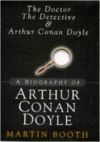
- The Doctor, The Detective & Arthur Conan Doyle
- Martin Booth
- 1997; London: Hodder & Stoughton; xii +371pp.
- ISBN: 0-340-64897-X; £20.00

Reviewed by Michael Doyle
The book begins with the author's caveat: it consists largely of material recycled from previous biographies. These are listed in the short, three-page bibliography, from which the ten issues of the ACD Society's Journal are noticeably absent. But within this unambitious limitation The Doctor, The Detective & Arthur Conan Doyle is a good overview of ACD's life and works. The chronology is accurate and the topics covered impressively comprehensive, though, by ignoring the work of the ACD Society, Booth naturally fails to mention material such as 'The Wild Geese' and 'The Blood-Stone Tragedy'.
Subject matter is effectively arranged and well balanced, thereby providing new insights and raising new questions. A modest amount of new material adds to this success, and the author displays an understanding of ACD's mastery of the short story and of his innate attraction to Spiritualism. Booth's text is well written and lively, with an on-going streak of humour, making this perhaps the most readable biography of Conan Doyle to appear to date.
Sadly, these merits are negated by two connected defects: lack of original research and lack of a mechanism linking the opinions in the text with sources to support them. There are no footnotes. Instead, we find a plethora of 'he appears to have', 'it seems most likely that', 'it may well be that', 'it must have been', and 'it can be reasonably argued that'. The result: a multitude of uncorroborated statements, some factually untrue, posing as biography.
Booth's analyses that ACD was a polymath (p. x); that it was through his letters to the press that he really showed the public his eclectic interests; that 'his arguments were always reasoned, his thoughts and comments original and individualistic, his conclusions circumspect and sapient' (p. 63) are welcome and patently true, as is "[he] was always ready to grasp any opportunity to get on' (p. 235), but the author runs into trouble with his unsupported 'he was also dictatorial, doggedly stubborn [and] rejected all criticism' (p. x); and his 'he was seldom self-critical and believed that, to whatever he turned his hand, he was beyond reproach or criticism' (p. 219). These opinions, even if true, are symptoms of a principled man of strong character who genuinely believes he is right; whose worst fault is a difficulty in distinguishing between facts, and opinions he is certain are correct. Martin Booth is nearer to the truth with 'he wanted to believe them so he did. And he would brook no opposition. If he stated that fairies lived in dells by streams in Yorkshire then he was right and there was no argument to be countenanced about it. Once his mind was set, his opinion or interpretation was, infallibly, correct' (p. 323).
The author's 'he would never admit he was wrong about anything' (p. x) is disproved by ACD's change of religion from Catholic agnosticism to Spiritualism; of profession from doctor to author; of bringing back Sherlock Holmes alive from the Reichenbach abyss; of conceding his readers' corrections to his interpretations of muddy bicycle tracks; and in his change of position on Home Rule for Ireland.
This last is a seminal failure of research. ACD's 'The Wild Geese' is nowhere mentioned, despite its publication by the ACD Society (ACD4, 1993, pp. 17-45). Sir Roger Casement is mentioned, but the parallel between his attempts to persuade Irish prisoners of war to form brigades fighting for Germany, and ACD's account of, and admiration for, the Irish brigades who fought for a hundred years for France (and, under a German commander, helped to beat the English at the Battle of Fontenoy) has escaped him. '[ ACD's ] support for Roger Casement had, it is thought, cost him a baronetcy during the war,' writes Booth (p. 334). Thought by whom? Booth does not share this with us.
The author accuses ACD of dishonesty: 'It has been conjectured [p. 65] that Conan Doyle did not actually take any photographs on the Isle of May and that his articles for the journal [ The British Journal of Photography ] were, in fact, as much exercises in poetic description of place as they were about photography.' But he provides no evidence to support this outrageous statement. ACD is accused of insanity, too: 'the fairies were equated in his mind with the voices his father had been locked up for hearing' (p. 323). How does the author know this? He does not enlighten us. We rather doubt that he could.
Another serious accusation concerns racial prejudice: '[ ACD ] also displays his own racial prejudices,' writes Booth, 'in describing [Steve] Dixie as a savage and putting into Holmes's mouth [words of personal offence]... Conan Doyle has [the Negro prize fighter] address the detective as "Masser Holmes" (p. 339). Can not Martin Booth grasp with his cerebral tentacle that the doll and its maker are never identical? Booth compounds his error: the language he criticises was not pejorative at the time the story ('The Adventure of the Three Gables') was written. It was common coinage earlier this century. Writing, for instance, in the Plymouth Western Morning News on 1 August 1908 of a contest in Plymouth's Cosmopolitan. Gymnasium the previous evening, featuring the epitome of contentious Negro prize-ring supremacy, Jack Johnson, the reporter describes 'the nigger delivering a series of powerful shortarm blows' and that 'Taylor seemed incapable of avoiding the nigger's smashing blows' (Jack Johnson vs Ben Taylor of Woolwich. Knockout 8th round. In his next fight Johnson won the world's heavyweight championship, the first negro to do so). The factual account contains no hint of condescension or disapproval of Johnson, whose skill and superiority are fully acknowledged. For Martin Booth to parlay a non-existent insult by the dolls to an accusation of racial prejudice by their maker is inexcusable. ACD's daughter, the late Dame Jean, has told us (Lellenberg, Jon L. (ed.) 1987. The Quest for Sir Arthur Conan Doyle (Carbondale: Southern Illinois University Press). Foreword p. xi) that prejudice of this sort was not to be found in her family. Martin Booth owes ACD's memory an apology.
The reader longs to redress the author's deficiencies by supplying his own footnotes: [Stonyhurst's education] was very traditional, lacking the flexibility to deal with an individual's abilities and weaknesses' he writes (p. 22). The modern technique of matching the pupil's interests and aptitudes was unknown; no attempt was made to provide satisfaction and success in enlightened career guidance. Had he taken the trouble, the author could have seen from Owen Dudley Edwards's excellent 'Conan Doyle and Stonyhurst' (ACD6: 1995, pp. 55-82. 'Preliminary Regulations, 1-2, p. 80) that the pupil was expected to have had his trade or profession chosen for him before he entered the school.
Booth's sloppy research produces factual errors, too: Douglas Stone did not believe that his patient was Lord Sannox (p. 196). The purloined document in 'The Second Stain' did not contain accusations of British atrocities in South Africa (p. 250). The baby in 'The Sussex Vampire' was not mentally deficient (p. 339). ACD did not interfere with the Marathon in the 1908 Olympic Games; the man shown in the photograph is not Conan Doyle. And the incident of ACD's alleged xenophobia at the immigration dock in Vancouver in 1914 (p. 295) is pure invention on the part of the author: ACD's one and only visit to Vancouver was in 1923.
Faulty research can produce untruths that not only misinform the reading public but also give pain to family members: '[ Jean ] was as ideal a companion for a famous author as Louise had been for a provincial town general practitioner' and 'Louise merely followed Conan Doyle' writes Booth (p. 213). 'Mary... had never really known [her] mother as anything but an invalid' (p. 215) but Mary had known her mother well enough to be, reportedly, bitterly hurt by John Dickson Carr's, and her half-brother Adrian's condescending descriptions of her. ACD's best literary work, including The Return of Sherlock Holmes, his service in the Boer War, his knighthood, his introduction of cross-country skiing to Switzerland, his first two children, his first visit to America, Henry Irving's appearance in Waterloo, his visit to the Sudan, his campaign for election to parliament, the construction of Undershaw, his frequent entertaining there and his regular riding to hounds with the Chiddingfold Hunt, on horses from his own stables-all these things occurred during the lifetime of his first wife. Martin Booth's book underrates the first Lady Doyle, as have others before him.
The Doctor, The Detective, and Arthur Conan Doyle has considerable merits, but they are overwhelmed by poor research and unsupported opinions. What remains is an entertaining but flawed introduction to the definitive biography so long awaited. The ACD family papers should shortly become available. Family members have stated their wish to set the record straight. The ACD Society has amassed a large bank of knowledge, a priceless resource on which to draw. The previous biographies, particularly those by Owen Dudley Edwards, Pierre Nordon, Geoffrey Stavert, and the Bibliography by Green and Gibson, if properly used, contain a wealth of material. The Arthur Conan Doyle Collection at The Toronto Reference Library has an ever-growing, easily accessible, body of relevant material, as do other major Doylean and Sherlockian collections in North America. The Conan Doyle Establishment at Crowborough is another vital resource. Richard Ellmann brought Oscar Wilde brilliantly and permanently to life (though it has to be said that his researchers seem to have been of a higher calibre than those used by Booth), and Sir Arthur Conan Doyle certainly deserves no less. Martin Booth should try again.
Michael Doyle
- Article courtesy Christopher Roden, founder of The Arthur Conan Doyle Society (1989-2003).

