Review:The SH Reference Library: The Memoirs of SH/Barbara Roden
This review of the book "The Sherlock Holmes Reference Library: The Memoirs of Sherlock Holmes", by Arthur Conan Doyle was written by Barbara Roden and published in the A.C.D. - The Journal of The Arthur Conan Doyle Society (Vol. 10, may 2000).
This review evaluates Leslie S. Klinger's annotated The Memoirs of Sherlock Holmes as a valuable reference work, especially for Sherlockians, while questioning some inconsistencies in its critical approach. It praises the book's breadth, layout, and usefulness, but notes uneven use of scholarship and some tension between Holmesian "game" annotations and Doylean literary commentary.
Review


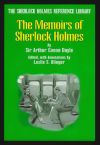
- The Sherlock Holmes Reference Library:
- The Memoirs of Sherlock Holmes
- Edited, with annotations, by Leslie S. Klinger
- Indianapolis, In.: Gasogene Books, 1999; xiv + 303pp.
- ISBN: 0-938501-29-1; U.S.$26.95

Reviewed by Barbara Roden
This, the second volume in the 'Sherlock Holmes Reference Library' series, follows on from last year's annotated The Adventures of Sherlock Holmes, which I reviewed in Volume 9 of ACD. I discussed the aims of the series, and its likely appeal, in that review; and in order to spare myself (and everyone else) a good deal of repetition, I would encourage readers interested in these two factors to go back and take another look at Volume 9.
Leslie Klinger repeats his assertion that this series is designed. more for Sherlockians than Doyleans, and, in his brief introduction, Peter Blau discusses the differences between these two groups of people. They are not, he argues, mutually exclusive; and he is right, inasmuch as almost everyone who freely acknowledges that Conan Doyle wrote the Holmes stories has probably 'played the game' in some way, at some time (mea culpa). He also comments that it can be amusing to watch someone switch from being a Sherlockian to a Doylean in mid-stream, as it were. Well, yes; but this switch sits somewhat uneasily, in my opinion, in a reference book. My personal feeling is that, if 'the game' is to be played in an annotated edition, then surely all of the notes should adhere to this rule, leaving anything Doylean to be discussed in a separate appendix (of which there are several in this book). As an example: at the beginning of 'The Cardboard Box', an annotation notes the exclusion of the story from the original book editions of the Memoirs, and concludes 'Curiously, not one of the numerous biographers of Arthur Conan Doyle has a word of explanation of this censorship, nor did Doyle himself comment upon it in 'Memories and Adventures.' This annotation clearly acknowledges ACD as the author of the story in question; yet a little further on, in 'The Stockbroker's Clerk', an annotation about differing bid and asking prices in various editions of the story remarks, 'Watson made this correction in the first English book publication of STOC.' Claiming in one note that ACD authored the stories, and in another that they emerged from Watson's pen, strikes me as wanting to have the best of both worlds. (And it should be noted that ACD did, in fact, make reference to the 'censorship' of 'The Cardboard Box': a card from ACD to an unknown recipient, which went up for auction at Sotheby's on 15 June 1999, made specific reference to the story and the reason it was excluded from the original edition of the Memoirs. Wrote Conan Doyle, 'There was a certain sex element in The Cardboard Box story and for this reason I discarded it when I published in book form.')
Blau's introduction (which, it must be said, has nothing whatever to do with The Memoirs of Sherlock Holmes) makes the valuable point that before Baring-Gould's Annotated was published a book which I daresay the majority of today's Sherlockians take for granted and assume has always been around-there was nothing remotely like it to which admirers of Holmes and his world could refer, and that it was therefore a landmark in Sherlockian studies. It is also, of course, the volume (or volumes) with which this new version will inevitably be compared. Well, those who feel that they don't need another annotated canon on their shelves will be missing out on a valuable reference tool, for Klinger has been able to draw on a further three decades of Sherlockian studies, and has also taken a somewhat different approach to the annotations, taking a more 'just the facts' approach than Baring-Gould; and, as such, providing a valuable. service to Sherlockians everywhere by collating much of the vast amount of material which has been published about the great detective over the years both pre- and ante-Baring-Gould.
I was pleased to see a number of references to annotations made in the Oxford edition of Memoirs, although Klinger has clearly been working from the first, hardback edition rather than the later paperback World's Classics edition, which corrected some errors in the first printing. In one of the footnotes to 'Silver Blaze', a reference is made to an incorrect annotation in the Oxford edition, which resulted in conveying, due to editorial intervention, a farcical interpretation of matters to do with the racing world. The erroneous annotation was corrected in the World's Classics edition, though the Klinger footnote makes no reference to the fact.
A charge which was levelled against the Oxford series (by Jon Lellenberg) in Klinger's first volume, The Adventures of Sherlock Holmes, was that it drew largely on British scholarship, and therefore missed out on a great deal of fine work being done in America. While this contention is disputable, it is interesting to note that Klinger seems to be drawing for the most part on American scholarship, somewhat at the expense of British and Canadian scholars. Indeed, apart from Donald Redmond, Chris Redmond, and S. Tupper Bigelow, I could find no references to anything written or published by anyone who resides north of the forty-ninth parallel. When I look at the substantial bulk of Canadian Holmes issues lined up on the study bookshelf, I feel sure that there must be more worthwhile scholarship contained therein than one would guess from perusing Klinger's footnotes and bibliography. For example, Vol. 8:2 has Don Redmond's look at the racing colours described in 'Silver Blaze' ('Yellow Cap and Sleeves? Whose Colours are Those?'); Vol. 13:3 contains the excellent 'The Greek Interpreter: A Family Tree' by Thelma Beam and Emmanuel Digakalis, which throws much interesting light on the Melas family; Vol 15:2 contains an interesting look at Victorian Biblical knowledge in general by Chris Redmond ('The Good Book-No, No, the Other Good Book'); while Vol. 15:3 has a thoughtful look at Moriarty in Karen Campbell's 'Death Be Not Proud: The Myth Behind Moriarty'. Surely there was something in these which deserved to be commented on?
Like its predecessor, the book is clearly and cleanly laid out, with the annotations contained on the relevant pages and not at the back of the book-which certainly makes it easier for the reader to follow up references. Klinger makes his points clearly and concisely, and provides a range of interpretations of many points, allowing readers to pursue matters further and make up their own minds. And in a series of useful appendixes, the author takes more in-depth looks at certain points, such as the calculations as to the train's speed which Holmes makes in 'Silver Blaze', or the Indian Mutiny (in 'The Crooked Man'). There is also a table for each story, laying out its dating according to all the major chronologists up to, and including, John Hall and June Thomson.
It will be impossible to judge fully the final worth of this endeavour until all nine volumes have been published. However, on the basis of the two volumes available, the 'Sherlock Holmes Reference Library' deserves a place on the bookshelf of every serious Sherlockian. I'm already looking forward to the next instalment.
Barbara Roden
- Article courtesy Christopher Roden, founder of The Arthur Conan Doyle Society (1989-2003).

