Review:A Study in Scarlet/Barbara Roden
This review of the book "A Study in Scarlet", by Arthur Conan Doyle was written by Barbara Roden and published in the The Parish Magazine (No. 9, december 1993).
This review presents the first book edition facsimile of A Study in Scarlet as interesting mainly for Charles Doyle's rare illustrations and its period advertising material. While the production is respectable, the reviewer judges the edition overpriced and ultimately recommends it only for completists with money to spare.
Review


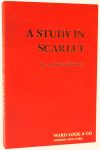
- A Study in Scarlet
- by Arthur Conan Doyle
- Dr Watson Books, 1993; 184pp; £38.00 (Special Edition), £150.00 (Presentation Edition)

Reviewed by Barbara Roden
It should be made clear from the start that this is not another facsimile edition of A Study in Scarlet's first appearance in Beeton's Christmas Annual: this is a facsimile of the equally rare first book edition, which was published by Ward, Lock & Co. in 1888. The question is, do we need it?
The answer is a qualified yes. The first book edition contains six illustrations by ACD's father, Charles, only two of which (Holmes, Watson and Gregson looking upon the body of Drebber, and Holmes with the Baker Street Irregulars) are at all well known. It is therefore interesting to be able to see the others, which are, it must be admitted, something of an embarrassment. Whatever skills as an artist Charles Doyle might once have possessed had, for the most part, abandoned him by 1888. The picture of the 'old woman' confronting a bearded Holmes is dreadful, and the three vultures perched on the ledge above John and Lucy Ferrier look like something out of The Lost World. Still, it is useful to have the illustrations available and accessible.
It is also interesting to note the adverts which come at the beginning and end of the book. These period pieces, extolling the virtues Dr Scott's Bilious and Liver Pills and Newton's Quinine, Rhubarb, Dandelion and Podophyllin Pills have gained an amusement value that would probably surprise their creators. Another point of interest is the 'Select Library of Fiction' listed at the end. Names such as Dickens, Austen and Scott are still well known, but how many people today have heard of such authors as Hawley Smart, Annie Thomas and Miss R. M. Kettle, all of whom have several titles to their credit?
The volume itself (we have seen the Special Edition) is well-enough produced, with a removable card dustwrapper on the volume and a sturdy slip-case for protection, although a little more care could have been taken with the actual printing on the slipcase. The Presentation Edition has been limited to 100 copies, while 500 copies of the Special Edition have been produced. Are the prices justified? There is no Introduction or explanatory material of any kind with the volume, and I am sure that every reader already has at least one copy of the text of A Study in Scarlet. The buyer is, therefore, effectively paying £38.00 (or £150.00) for little more than six illustrations by Charles Doyle in their original setting; and I would have to say that this does not justify the price tag. A high-priced facsimile of a book text gives us little that is new, as opposed to facsimiles of original manuscripts, which can tell us much about an author and his works. Admirable as it may be, this edition of A Study in Scarlet is for completists only: and those who have deep pockets to boot.
- Article courtesy Christopher Roden, founder of The Arthur Conan Doyle Society (1989-2003).

